
The first thing that fails on a Jeju driving day is the navigation app: the Korea Tourism Organization says the navigation feature of Google Maps cannot be used in Korea. That is only the first surprise. The rental papers, the left-turn rule and the printed closing hours of three fixed stops decide whether a full circle of the island fits into one day at all.

Why a Loop Works Only With a Car
VisitKorea’s Jeju feature lists estimated journey times from the airport, and the pattern reads like a map.
| Stop | By bus (min) | By taxi (min) |
|---|---|---|
| Dongmun Traditional Market | 20 | 15 |
| Hamdeok Beach | 60 | 40 |
| Hallasan National Park | 60 | 40 |
| Hyeopjae Beach | 70 | 60 |
| Manjanggul Lava Tube | 70 | 60 |
| Soesokkak Estuary | 90 | 70 |
| Seongsan Ilchulbong | 120 | 70 |
Two things follow. The bus is slower than the taxi on every one of those legs, by 5 minutes at Dongmun and by 50 at Seongsan. And these are all airport legs, not links between stops, so they say little about going from a museum in the northeast to a tea field in the southwest. A day that touches the northeast, the east and the southwest is a car day, since every figure in the table starts at the airport.
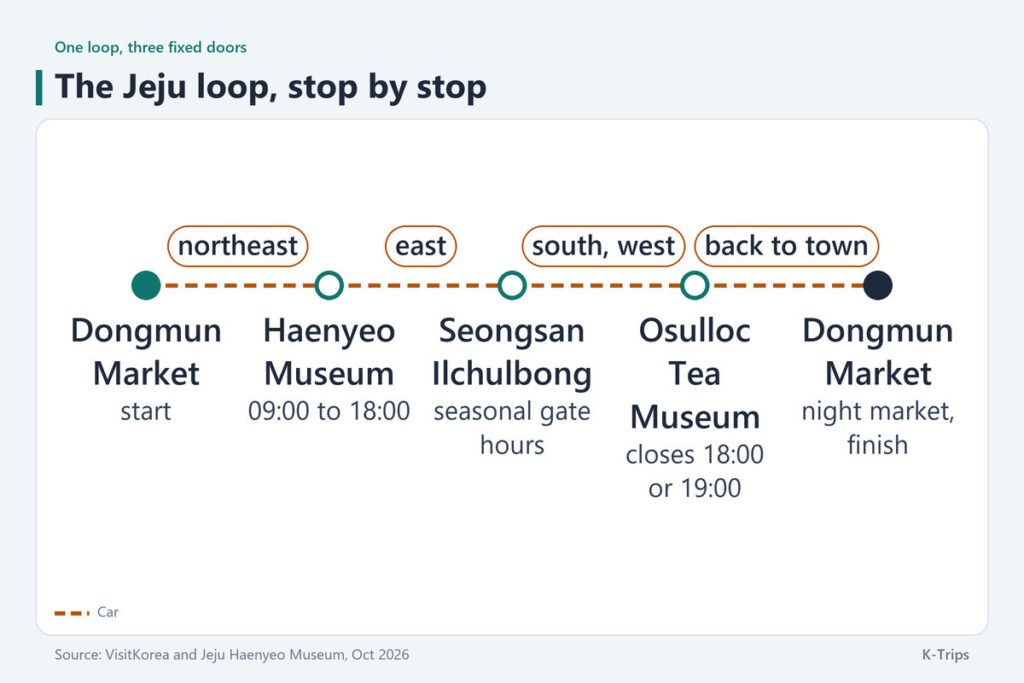
The mountain sets the shape. Hallasan, at 1,947 m the tallest mountain in Korea, is the reason a loop follows the coast and does not cut across the middle of the island. The route in this post runs clockwise from Jeju City: the haenyeo museum in the northeast, the sunrise peak in the east, the tea fields in the southwest, and black pork and a night market back in town.
Papers and Apps Before You Reach the Counter
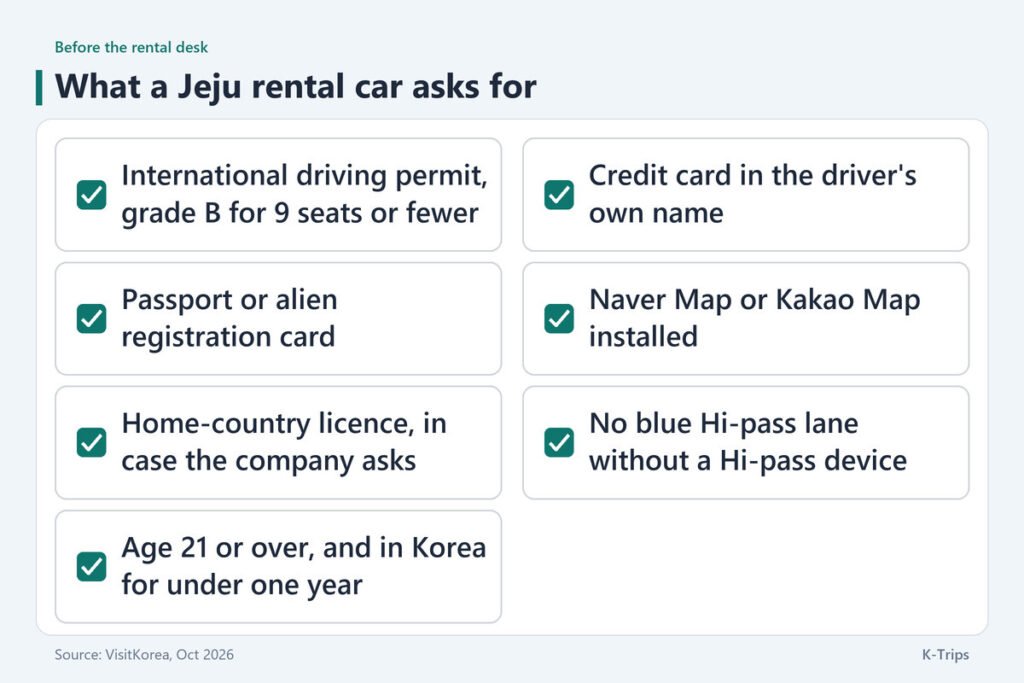
The tourism organization’s page on driving in Korea sets the conditions. Short-stay visitors can rent with an international driving permit, grade B for vehicles with nine seats or fewer and grade D for 11 to 12 seats, but must be over 21 and must have been in Korea for under a year. A passport or alien registration card has to be shown, some companies also want the licence from your home country, and the rental fee can only be paid by credit card in the driver’s own name. Insurance is usually part of the rental price but the page tells you to check whether it covers your own vehicle and what the options cost, which is the line to read twice at the desk.
Booking is simpler than the paperwork. The page recommends renting online in advance and notes that counters are easy to find at airports, near train stations and bus terminals, and in various places around cities. It names SK Rent-a-Car, Lotte Rent-a-Car and Jeju Airport Rental Car as major companies, the last with a Korean-only site. Costs vary by region, car type, season and company, and rentals are usually priced by the day or by a 24-hour period, so a loop that starts early and ends late is one rental day, not two. A loop plan built on a rental should treat the permit as the first item to confirm, because every later step depends on it.
Navigation is the other early decision. The page recommends Naver Map, available in Korean, English, Chinese and Japanese, and Kakao Map, available in Korean and English, and the driving guide adds that both offer GPS navigation in English. Install one before you leave the airport, along with a working data connection, which is covered in a mobile data plan and the apps that work in Korea. The short list below collects the items the page names.
Road Rules That Differ From Home
Korea drives on the right, with the driver’s seat on the left, and distances and speeds are in kilometres and kilometres per hour. The tourism organization’s driving guide adds that many road signs are pictograms but some are written only in Korean, and that most intersections have no stop sign, only a white stop line on the pavement where you must yield. The guide also lists the universal rules that are strictly enforced: seatbelts for the driver and every passenger, yielding to pedestrians first, no drinking and driving and no texting at the wheel.
The guide gives 50 km/h as the usual limit in town unless a sign says otherwise, 60 km/h on one-lane national highways and 80 km/h on two-lane ones, and warns that Korea relies heavily on speed cameras. Red-painted pavement marks a school zone where you must slow down, and a blue line marks a bus-only lane. Parking spaces are narrow and reverse parking is the norm, which the guide says the rear sensors and cameras on almost all rental cars help with; parking at a yellow curb or near a bus stop is a violation. At a roundabout you yield to the traffic already inside. For fuel, gasoline is usually marked yellow, diesel green or blue, and fuel is sold by the litre. Two further rules deserve a closer look because they catch visitors out.
Left Turns and the Unprotected Sign
A left turn is allowed only if the lane has a left-turn mark on the pavement and the signal agrees. At a four-signal light you go on the green left arrow. At a three-signal light you look for the blue sign reading “Unprotected” (비보호), which lets you turn on a straight green at your own risk when no pedestrians or cars are in the way. With no arrow on the pavement and no sign, the turn is not allowed. Right turns on red are generally allowed if nothing is coming, but you must pause for at least three seconds at the stop line, and U-turns need a U-turn sign.
Tolls and the Blue Hi-pass Lane
Highway tolls are paid to an attendant or electronically with a Hi-pass device. If your rental has no device, stay out of the blue Hi-pass lane. The driving page says that if you pass through it by mistake you should note the name of the tollgate and explain it to the attendant when you exit, and the employee will process it. The driving guide adds that Hi-pass gates are on the left, guided by a blue line, with the cash and card booths on the right, so the practical rule is simply to check the lane colour at any gate.
The Haenyeo Museum in Gujwa
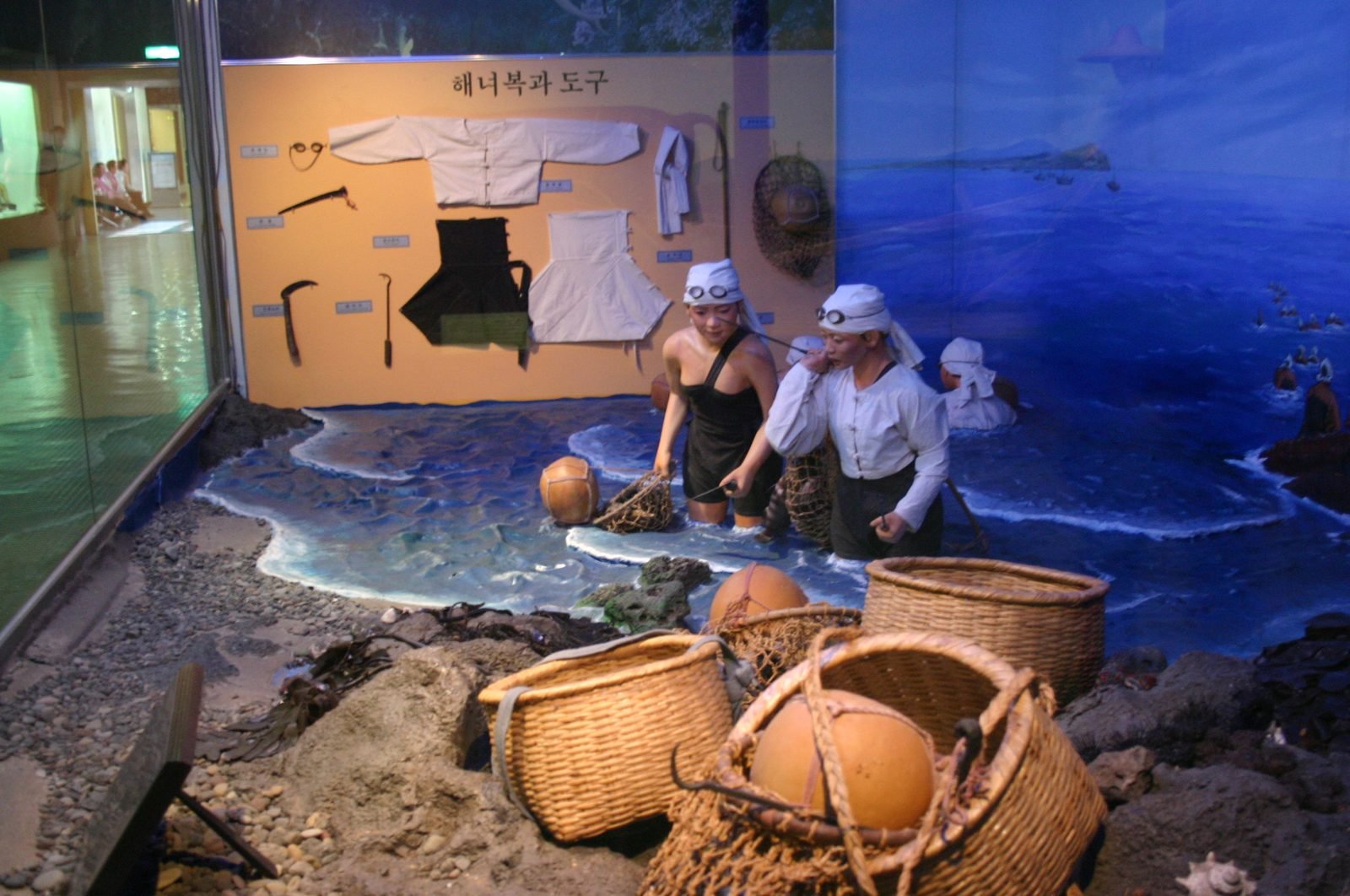

The first fixed door of the day is the Jeju Haenyeo Museum at 26 Haenyeobangmulgwan-gil, Gujwa-eup. It presents the culture of Jeju’s women divers in three exhibition halls, which the museum’s own site names for the haenyeo’s life, their workplace and their life course.
The museum opens at 09:00 and closes at 18:00, with ticket sales until 17:00. It is closed on Mondays, on New Year’s Day, on Seollal and on Chuseok, and when a Monday falls on a public holiday the closure moves to the next non-holiday day. Visitors from outside Jeju pay ₩1,100 as adults aged 25 to 64 and ₩500 at ages 13 to 24; groups of ten or more pay ₩800 and ₩300, Jeju residents pay half price, and children aged 12 and under and visitors aged 65 and over enter free. The inquiry line is +82-64-782-9898. Because it is the only stop on the loop with a weekly closing day, check the weekday before you fix the order of the route.
Seongsan Ilchulbong Before the Ticket Window Shuts
The east-coast stop is the middle of the loop. The tourism feature puts the summit about 30 minutes’ walk from the entrance, with a crater roughly 600 m across, and lists the peak as part of Korea’s first UNESCO World Natural Heritage listing. Its gate hours change by season, so check the closing time for your month before you commit an afternoon to it. The seasonal table, the first-Monday closure and the haenyeo demonstration beside the cone are set out in the guide to climbing Seongsan Ilchulbong around sunrise, and they decide how much of the east you can fit around the museum.
Udo Island is a short ferry ride from the same coast, but it is a day of its own, and adding it to this loop is the quickest way to turn a long day into an impossible one. Treat it as the thing you cut when the clock runs short, not the thing you add.
The Long Leg to the Tea Fields
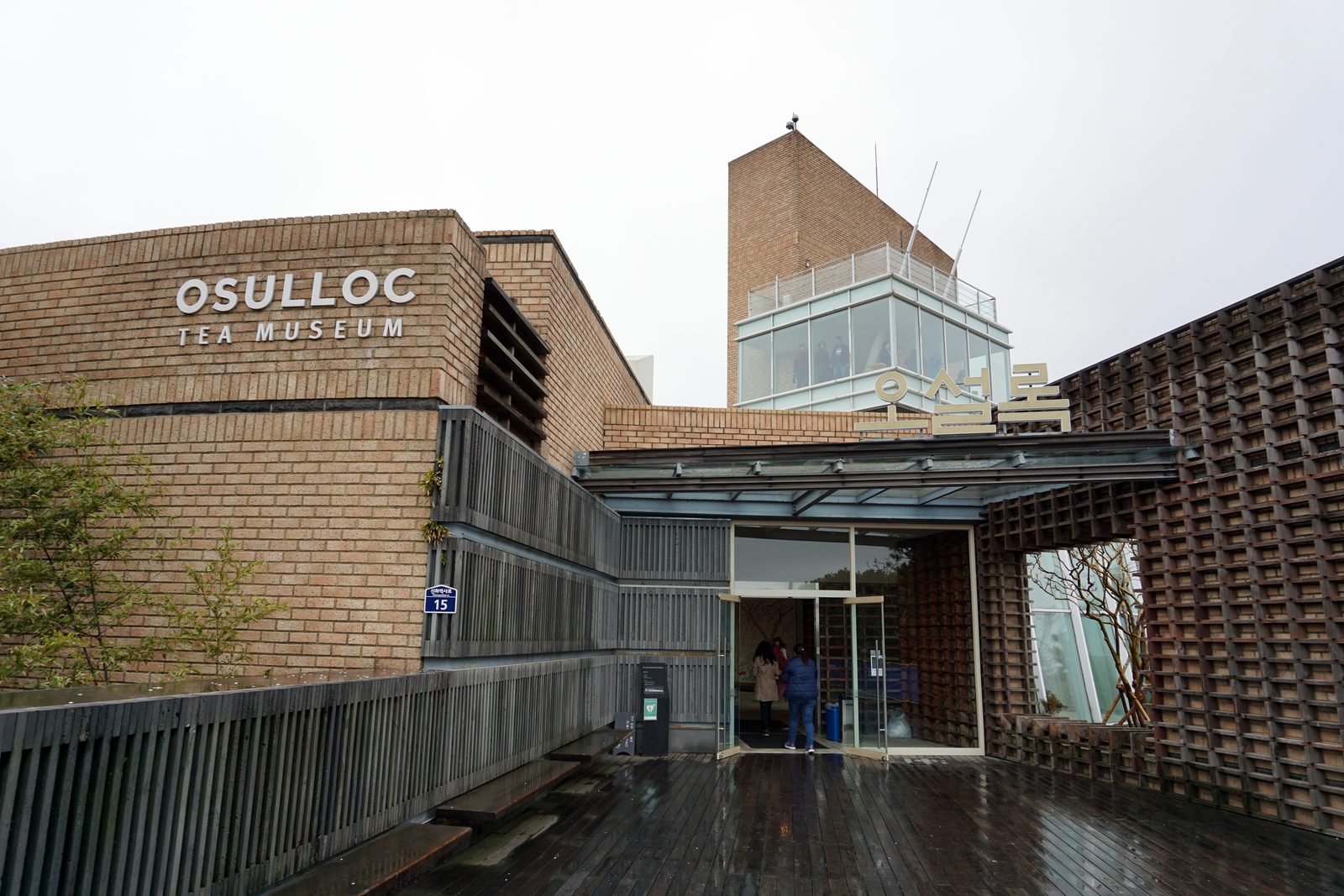

The southwest leg is the one that decides whether the day is a circle or a half. The O’sulloc Tea Museum stands next to the Seogwang tea plantation in Andeok-myeon, at 15 Sinhwayeoksa-ro, and Amore Pacific opened it in 2001 to introduce Korean tea and its culture. It has a tea gallery, an eco-friendly rest area and a cafe serving tea-based desserts. Hours are 09:00 to 19:00 in summer and 09:00 to 18:00 in winter, and the listing adds that they may change in bad weather. It is open all year, entry is free, and experience programmes carry separate charges.
If you cut the southwest leg, the same feature lists alternatives that are nearer to the airport and need no long cross-island drive. Hyeopjae Beach, on the western side, has shallow water that suits families and is noted for the sun setting behind Biyangdo Island. Soesokkak Estuary is a gorge where fresh water from Hallasan meets the sea, and visitors can ride a tewoo, a traditional Jeju raft, or take a small rowboat for two or three people. Manjanggul Lava Tube stays at a cool 12°C all year even in summer, and visitors can explore about 1 km of its 7.4 km length, including a lava column 7.6 m high that the feature calls the largest of its kind in the world.
The listing publishes no journey time from the east coast, so none is given here. What the closing hour does tell you is how much margin you have: summer closing is 19:00 and winter closing is 18:00, so a winter loop has an hour less margin at the tea fields than a summer one. Build your own estimate with a navigation app on the morning you go, and compare it with the closing hour for that season.
Black Pork and the Night Market to Finish
The VisitKorea Jeju feature groups the island’s food into seafood gathered by the haenyeo, pasture-raised Jeju black pork, and mandarins and hallabong. For a day that ends in town, the black pork and the market sit together. The feature calls Dongmun Traditional Market the island’s largest traditional market, with a history of more than 80 years, and says that every evening the area around Gate 8 comes alive with a night market selling street foods such as black pork kimchi rolls and abalone gimbap.
The same feature also covers a restaurant chain built on the haenyeo theme, Haenyeo’s Kitchen. Its Jongdal branch pairs a live performance with a buffet, and its Bukchon branch offers a multi-course seafood meal with immersive media art. The feature groups the Jongdal branch with Seongsan Ilchulbong on the airport table, at 120 minutes by bus or 70 by taxi, and the Bukchon branch with Hamdeok Beach, at 60 by bus or 40 by taxi. That makes the Jongdal branch a lunch option for the east side of the loop, and the Bukchon branch a better fit for the first or last hour, so confirm the hours before you plan around a meal.
Dongmun is also the closest of the feature’s attractions to the airport, at 20 minutes by bus or 15 by taxi, which makes it a sensible start and finish for the whole loop. That choice also has a practical benefit: the market’s evening opening is the one thing on the route that is still open when the museums and the tea fields have closed.
Full Loop or East Half-Circle?
| Plan | Full loop | East half-circle |
|---|---|---|
| Fixed doors | Museum, Seongsan, tea museum | Museum, Seongsan |
| Closing times to beat | Museum 18:00, last entry 17:00; tea museum 18:00 or 19:00; Seongsan by season | Museum 18:00, last entry 17:00; Seongsan by season |
| Bus option | Airport legs only | Airport to Seongsan 120 min by bus |
| Weekly closing day | Museum on Mondays | Museum on Mondays |
| What it drops | Nothing named here | Tea fields; Udo can be added |
The half-circle is the better plan if you start late or want time for Udo, because it removes the tea fields, the long cross-island leg. The full loop is for an early start, a car and a day on which the Monday closure, the season and the weather all line up. Whichever you choose, write down the three closing times before you leave, set the tea museum as the stop you can drop, and keep Dongmun for the end of the day, because it is the one stop whose evening hours work in your favour.