
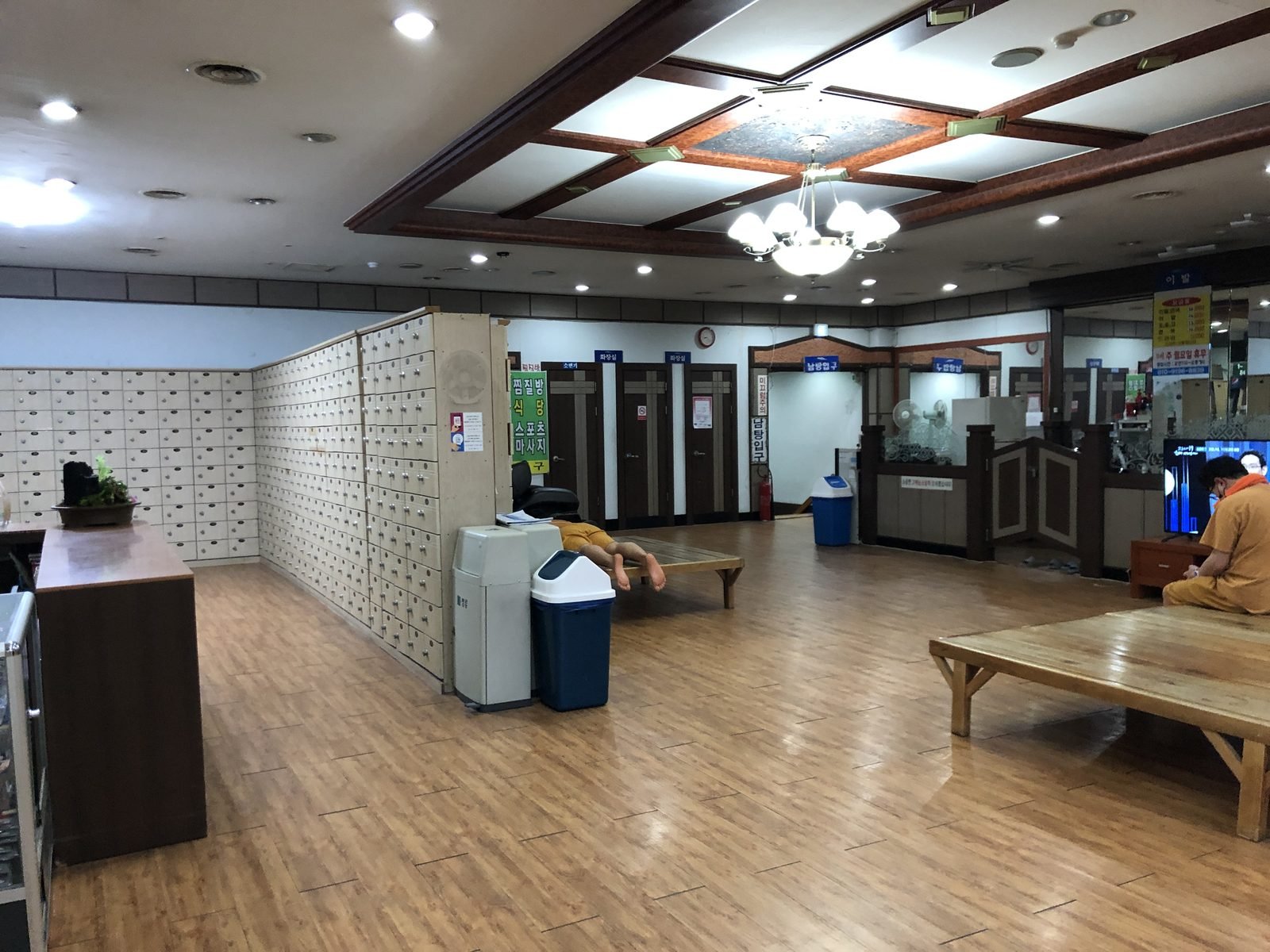
You push open a heavy glass door on a side street and the air changes before your eyes do: wet heat, the mineral smell of hot water on tile, and under it something sweeter, like boiled eggs. A clerk slides a wristband across the counter and points to a wall of shoe lockers. Past her shoulder two doors lead to the bathing floors, and beyond them is a wooden hall where people in matching cotton shirts lie flat watching a television nobody follows. Korean has three words for what this building might be, and picking the wrong one decides whether your evening is a fifteen-minute wash or the whole night.

Three Words, Three Different Evenings
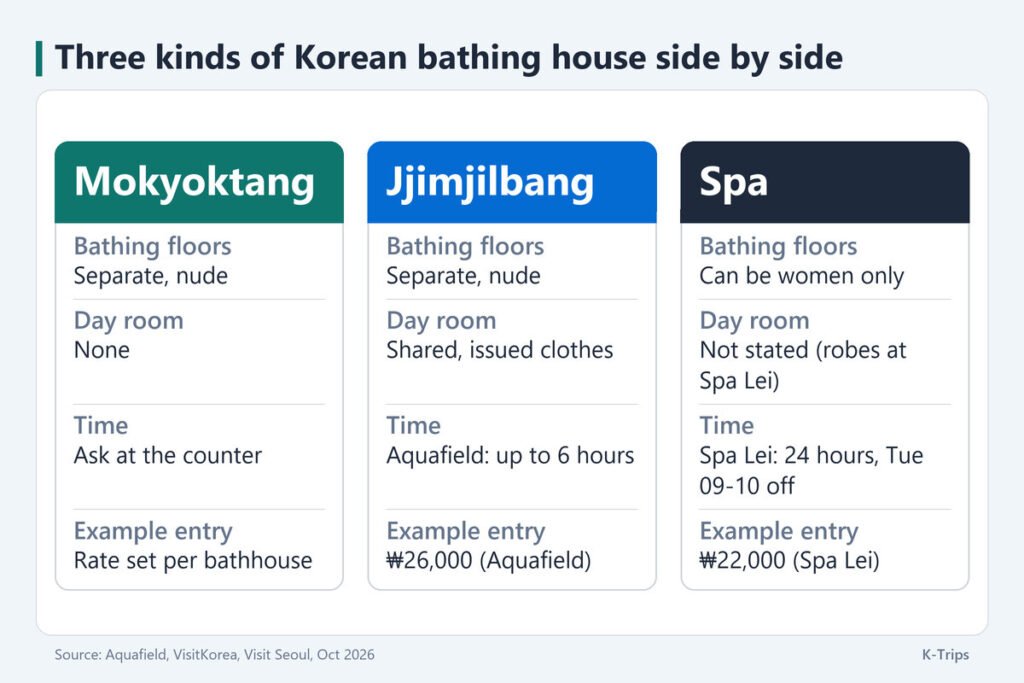
“Korean spa” is the English shorthand for all of this, and it hides the difference between buildings that sell different things. The three words describe different products. What separates them is not luxury but how much of the building you may enter and what you wear while you are in it.
On the street, look for the steaming-bath symbol (♨) above a door, then read the hangul underneath. 목욕탕 is the plain bathhouse, 찜질방 is the one with a day room, and 스파 is the one that promises the least about what is inside. The word on the sign matters more than the building’s size.
Mokyoktang, the plain bathhouse
A mokyoktang (목욕탕) is the neighbourhood bathhouse. Men and women use separate bathing floors, everyone bathes nude, and the room is built around water: a row of seated shower stations, pools at different temperatures, often a dry sauna box and a scrub table. You wash, soak and leave. Each bathhouse sets its own rate, so ask at the counter before you pay.
Jjimjilbang, the bathhouse plus a day room
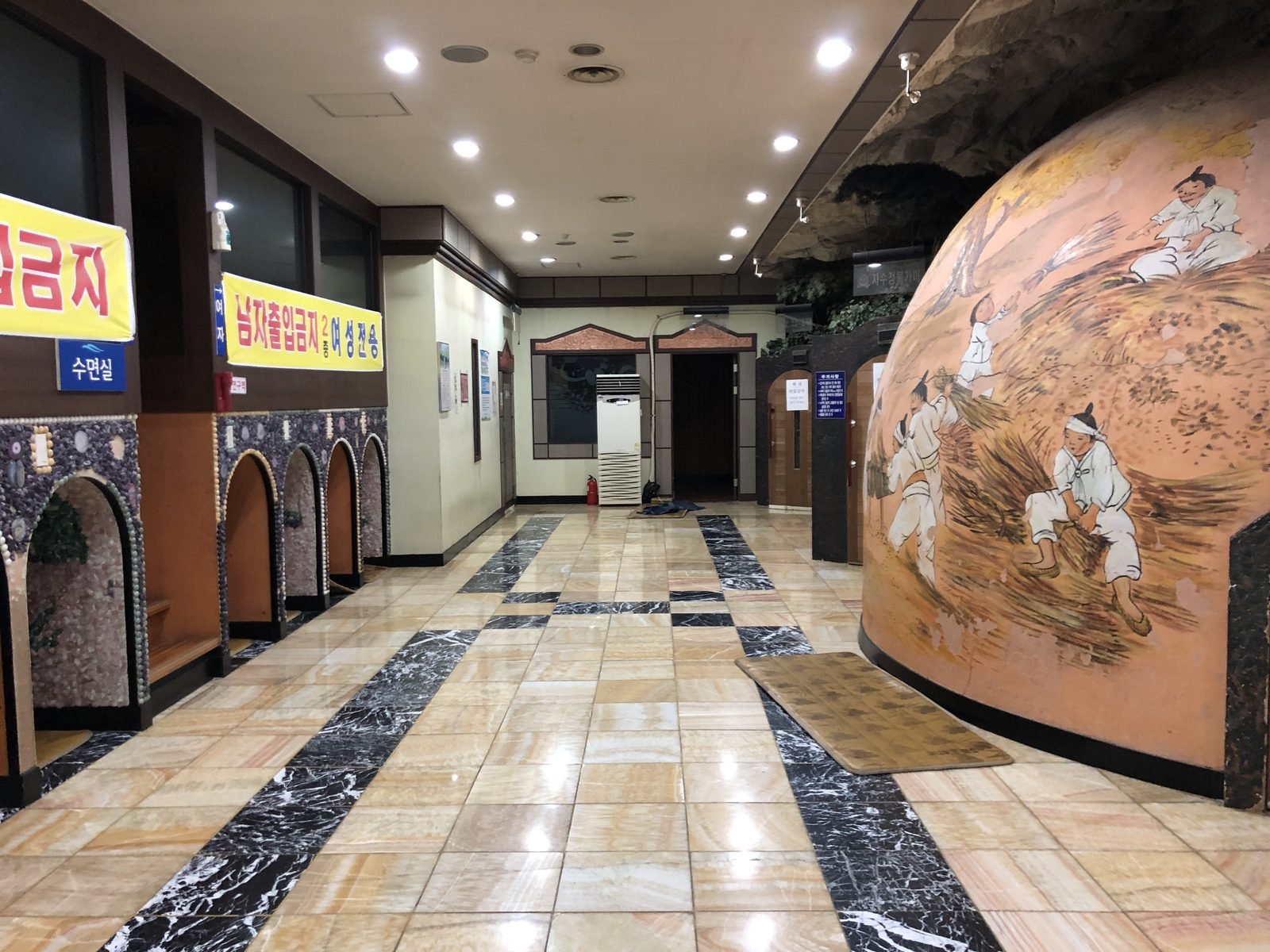
A jjimjilbang (찜질방) keeps the bathing floors and adds a day room. VisitKorea describes the format as a Korean-style sauna that combines a traditional bathhouse with a hot steam room. Beyond the wet area sits a shared floor where men and women together wear the same issued cotton clothes, with heat rooms, a snack counter and plenty of floor to lie on. At Supsok Hanbang Land in Seoul the heat comes from charcoal kilns set at different temperatures, and a brazier in front of the kiln lets you grill sweet potatoes or rice cakes. Aquafield, a multi-branch operator, advertises eight themed zones in its jjimjil-spa.
Spa, the polished version
Spa (스파) on a sign is the loosest of the three words, because it does not tell you who may walk in or what the building contains. Spa Lei in Seoul’s Seocho district is women only and open around the clock all year, apart from a regular maintenance hour on Tuesday mornings, from 09:00 to 10:00, and Visit Seoul says seawater delivered from the West Sea heats its special seawater bath. Spa Lei hands out robes made of natural cotton, a different dress code from the issued clothes of a jjimjilbang. Read the entrance sign before you pay.
Prices, Hours and the Six-Hour Limit
On the Aquafield usage page, the jjimjil-spa ticket is ₩26,000 for adults, meaning middle-school age and older, and ₩21,000 for children from 36 months through elementary school. Toddlers under 36 months enter free with documents. The jjimjil-spa runs from 10:00 to 22:00. The page carries separate tabs for its Hanam, Goyang and Anseong branches, so look at the branch you are actually visiting before you rely on any figure.
The number that catches people out is the clock. A jjimjil-spa ticket allows up to six hours, and every hour beyond that costs ₩5,000. The multipass that adds the water park to the jjimjil-spa costs ₩58,000 for adults and allows up to nine hours. A nap on a warm floor is exactly how an afternoon slides past the limit, so note the time you walked in.
Supsok Hanbang Land, a charcoal-kiln jjimjilbang in the Seodaemun district, lists ₩15,000 for adults and teenagers and ₩8,000 for children, with hours of 08:00 to 21:00 all year. Spa Lei charges ₩22,000. With Aquafield’s ₩26,000 that makes three posted entry prices, ₩15,000, ₩22,000 and ₩26,000, and each venue sets its own.
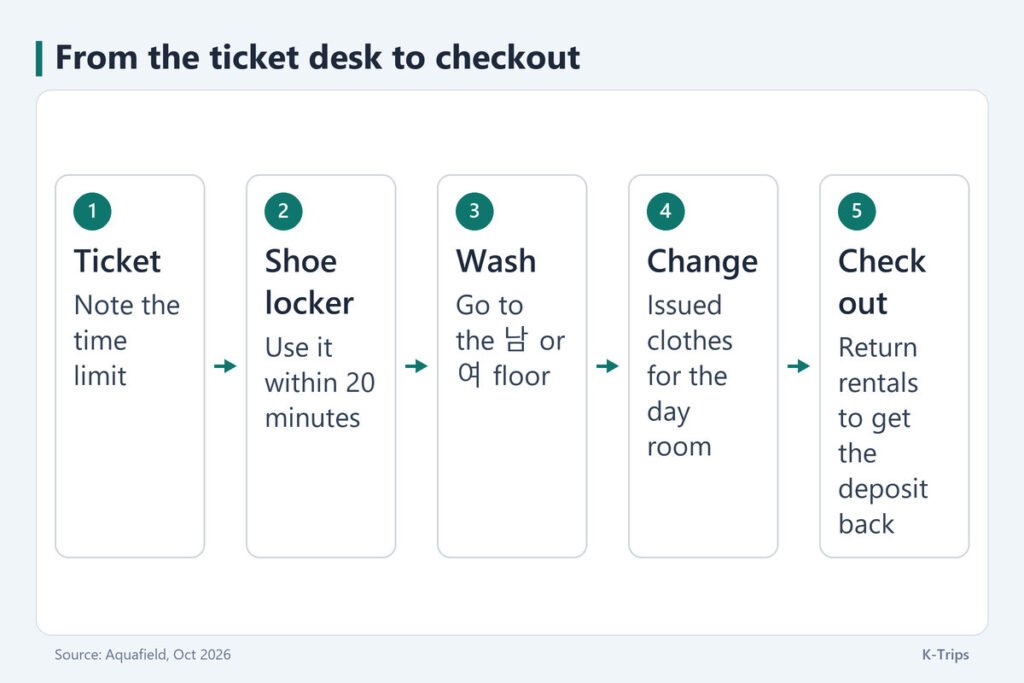
Towels are worth a closer look. Aquafield issues jjimjil clothes and a towel with the ticket, except to toddlers under 36 months, and it provides no shared shower towels for hygiene reasons. A relax towel is an optional extra at ₩5,000 plus a ₩1,000 deposit that comes back when the item is returned, listed on some of its branch tabs.
Concessions exist but need paper. Aquafield gives national merit holders and disabled visitors, plus one companion, 20 percent off, says discounts cannot be combined, and asks for proof when a child, toddler or local resident is claiming a reduced entry. Carry the paperwork with you.
Rules the Counter Assumes You Already Know
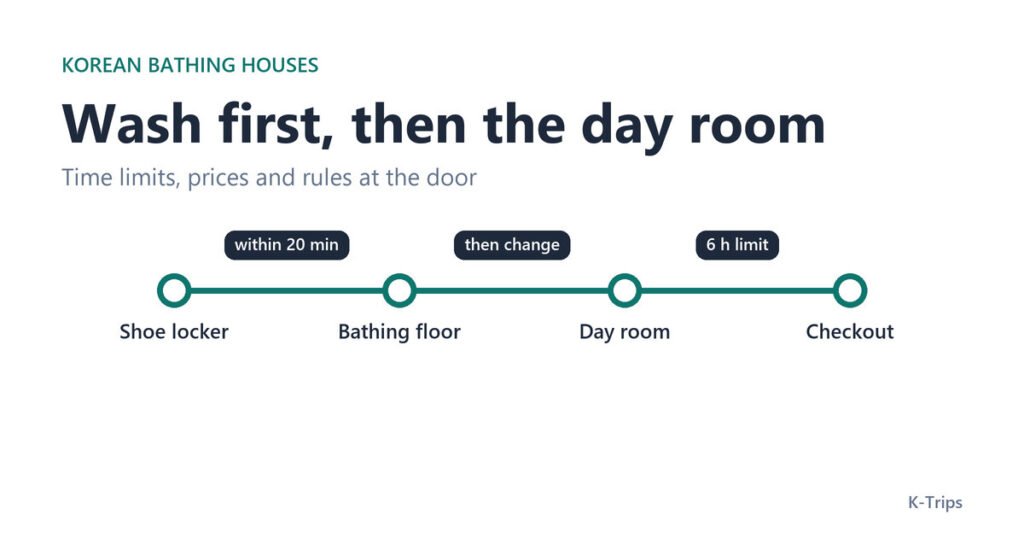
The routine is the same wherever you go. Shoes come off at the entrance and go into a shoe locker; Aquafield asks you to use it within 20 minutes of buying the ticket, after which the lockers lock themselves. Then the building splits you up: the signs 남 (men) and 여 (women) point to separate bathing floors.
Washing comes before the water
On the bathing floor everyone is nude and nobody wears swimwear. Sit at a shower station and wash thoroughly before you enter any pool, tie long hair up, and keep the small towel out of the water; folding it on your head is the usual solution. Leave your phone in the locker, because a camera has no place in a nude changing area. The swimsuit exception is a water park, which chains such as Aquafield sell as a separate ticket.

Heat rooms, hottest last
On the shared floor you wear the issued clothes and the heat rooms begin. Supsok Hanbang Land advises moving from the low-temperature kilns to the high-temperature ones, and warns that its hottest room, called Kkottang, can burn bare skin, so visitors wear socks and cotton gloves to go in. Treat a cool-down lie on the floor between rooms as part of the routine rather than a sign of weakness, and drink water when you leave the kilns.
Children and the other side of the door
Families should settle this before arriving. Aquafield’s notice says that, under Korea’s public hygiene law, children aged four (48 months) and older cannot use the bathing area of the opposite sex. A parent travelling alone with a five-year-old of the other sex therefore needs a plan, such as taking turns while the other waits in the day room. House rules on tattoos vary from place to place and none of the three venues above states one, so ask at the desk if it matters to you.
Matching the Building to the Evening
Decide first how much of the evening you are willing to give away, and look at prices second. An hour between checkout and a train, or a cold morning that needs fixing, is a job for a mokyoktang: find the steaming-bath sign, pay the posted rate and go. A long empty evening or a group that wants somewhere to sit together is what the day room is for, and Supsok’s ₩15,000 is the lowest entry price in the table at the end. A deliberate half day built around one bath or treatment is the case for a spa, and then the time limit, not the entry price, is what to plan around.
A mixed group has one practical problem: the bathing floors split you up, and the day room is the only place where men and women share a space. Agree a meeting time and a spot on that floor before you separate, because phones stay in the locker while you bathe and nobody can message anyone from the water.
Put the soak where it helps rather than where it fits. In a three-day Seoul plan it works best at the end of a heavy walking day, not before an early start. After an afternoon on Haeundae Beach the same logic applies: a hot floor suits tired legs better than another stop. Whatever the tier, bring little. At Aquafield the clothes and a towel come with the ticket, so a hair tie is about the only thing worth packing.
What One Visit Adds Up To
Entry is only part of the bill, so here are four visits added up from the published numbers. Totals use adult entry prices, and the optional relax towel is shown as an add-on.
| Visit | Entry | Extras | Total | Time |
|---|---|---|---|---|
| Aquafield jjimjil-spa, 5 hours | ₩26,000 | Optional relax towel +₩5,000 | ₩26,000 | Inside the 6-hour limit |
| Aquafield jjimjil-spa, 8 hours | ₩26,000 | 2 extra hours ₩10,000; optional relax towel +₩5,000 | ₩36,000 | 6 hours plus 2 |
| Supsok Hanbang Land | ₩15,000 | None listed | ₩15,000 | Open 08:00 to 21:00 |
| Spa Lei, women only | ₩22,000 | None listed | ₩22,000 | Open 24 hours, Tuesday maintenance 09:00 to 10:00 |
Adding the optional relax towel raises either Aquafield total by ₩5,000; its ₩1,000 deposit is returned at checkout and is left out. Prices change, so read the table posted at the venue on the day.