
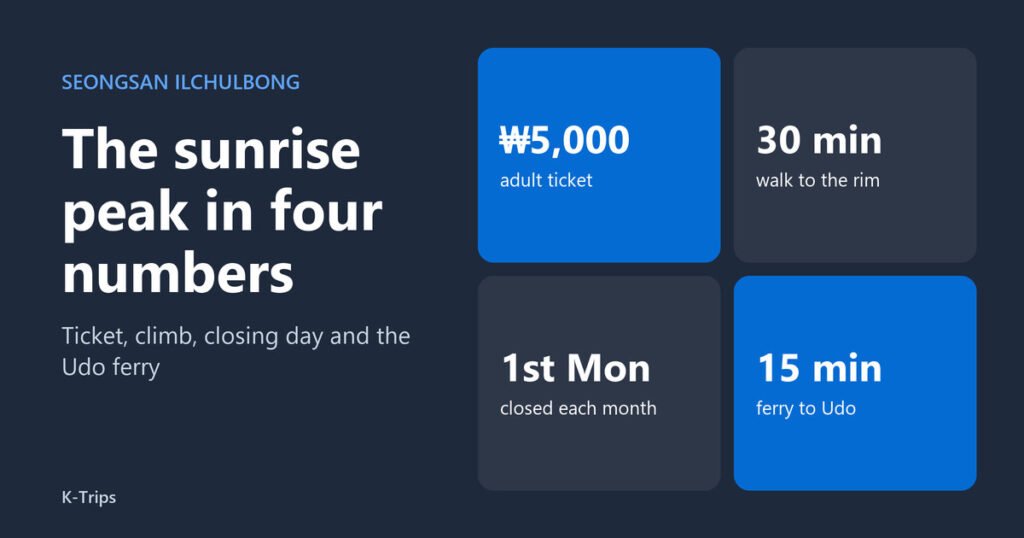
The common mistake at Seongsan Ilchulbong is to plan a sunrise around the sun alone. The site opens at 05:00 in spring and autumn, 04:30 in summer and 06:00 in winter, the ticket window shuts an hour before closing, and the whole place is closed on the first Monday of every month. Check those three rules before you set an alarm, because the climb itself is the easy part.

A Cone That Rose Out of the Sea
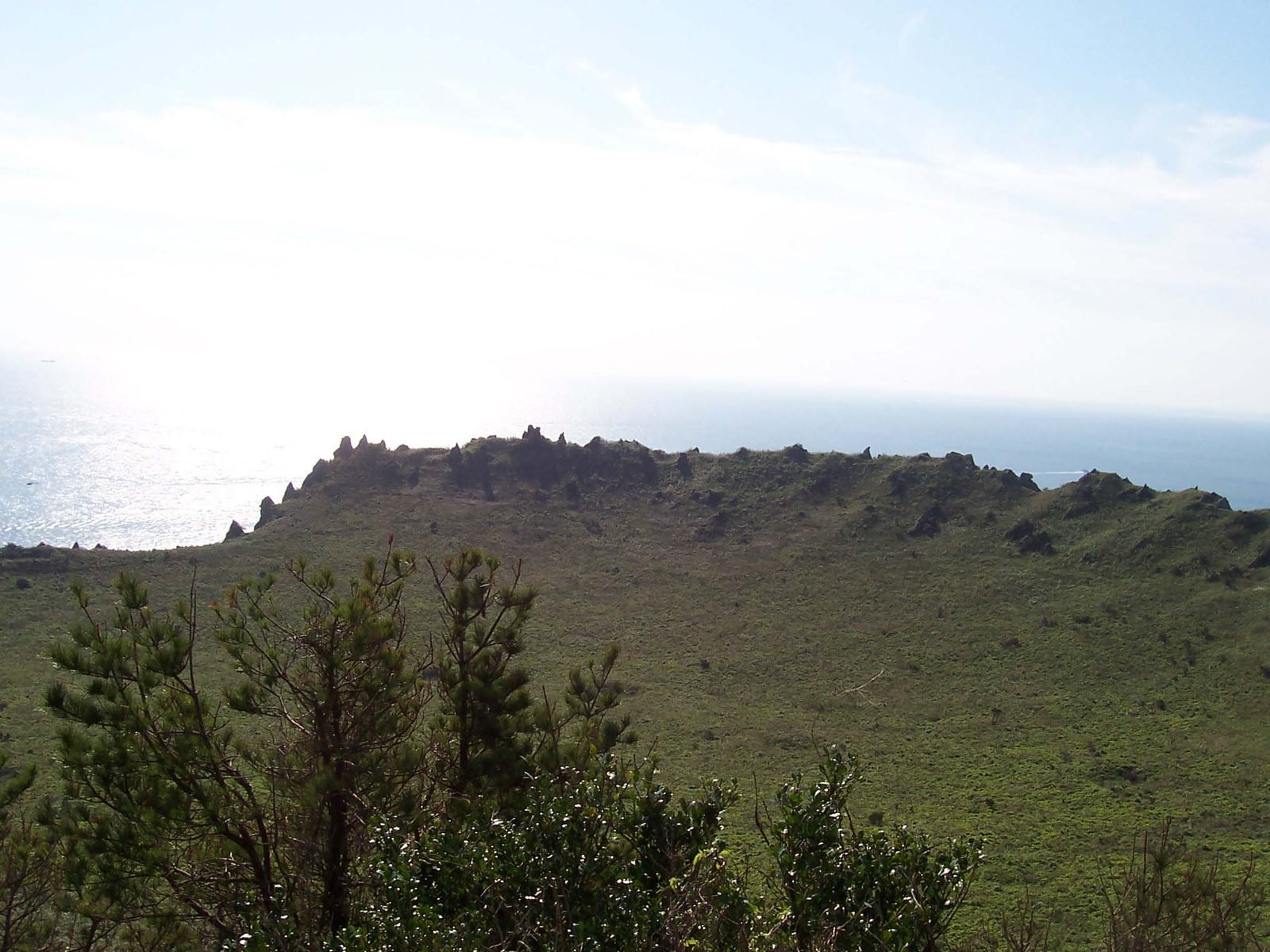
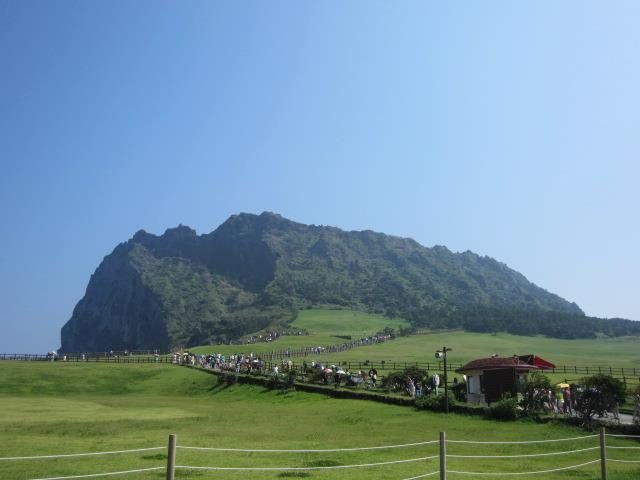
VisitKorea’s entry for the peak says the tuff cone rose 180 m above sea level as magma flowed under the sea more than 5,000 years ago. It began as a separate island, and a build-up of sand and soil has since joined it to the main island. A large crater, formed where hot lava met cold ocean water, sits at the top, about 600 m across and 90 m deep. It has been featured in films and was once used for agriculture; it is now a field of silver grass, and the tuff cone area was designated a natural reserve on 19 July 2000.
The peak is also one of the Jeju sites that make up Korea’s first UNESCO World Natural Heritage listing, together with Hallasan and the Geomunoreum lava tube system, which a VisitKorea feature on Jeju describes as the island’s volcanic heritage. The feature repeats the origin story, an underwater eruption in shallow seas, and calls the peak one of Jeju’s most popular sunrise spots. From the summit, the entry adds, you can see Udo Island as well as the sunrise, which is why the two make a natural pair. The same feature explains the setting: Jeju is a volcanic island built by eruptions that began about 1.8 million years ago, and the whole island is also recognised as a UNESCO Global Geopark and Biosphere Reserve.
The Opening-Hours Table Sets the Sunrise Plan
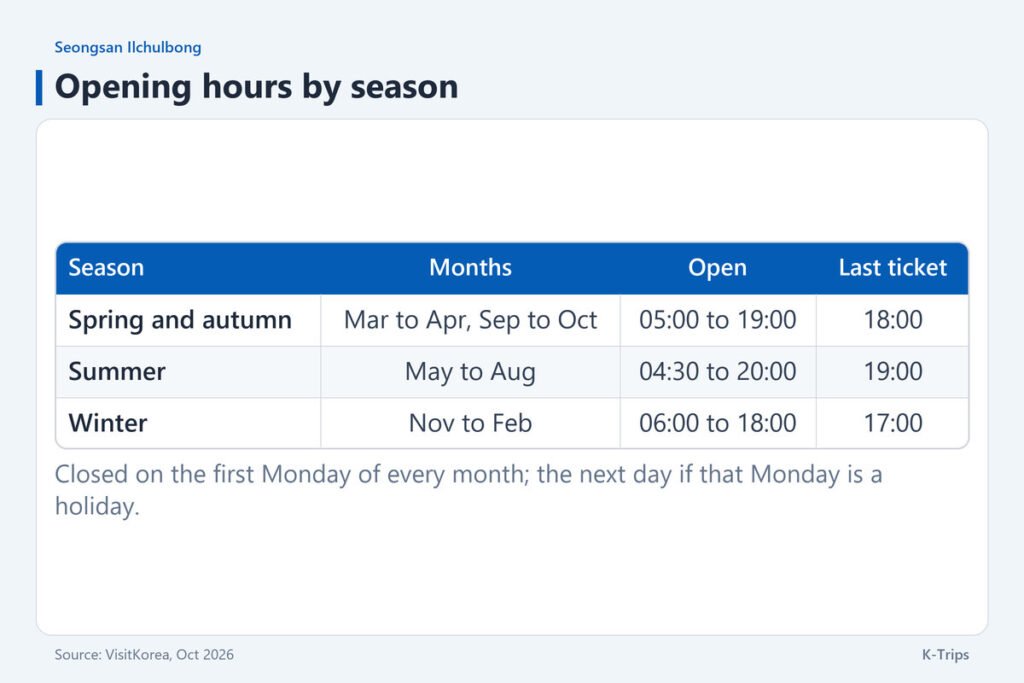
The entry gives three seasonal windows. From March to April and September to October the site is open from 05:00 to 19:00, from May to August from 04:30 to 20:00, and from November to February from 06:00 to 18:00. Last ticketing is one hour before closing, so the final tickets go on sale at 18:00, 19:00 and 17:00 in those three windows. The site is closed on the first Monday of every month, and when that Monday is a holiday it closes the next day instead.
That table is the planning tool, and it has to be read against the sunrise time for your date. The Korea Astronomy and Space Science Institute’s monthly sunrise table has an entry for Seongsan Ilchulbong itself. A note on the same page, about its New Year figures, says they assume sea level and that the sun shows earlier from higher ground, by two minutes at 100 m and three at 200 m. The cone is 180 m high, so expect the sun from the rim a couple of minutes before a sea-level time. Take the sunrise for your date, subtract the half hour the walk takes and compare the result with the gate time. If the gate opens later than that, the sunrise is out of reach on that date; if it opens earlier, you have time in hand, and the question becomes how long the queue at the ticket window is, not whether the gate is open.
Admission is ₩5,000 for adults and ₩2,500 for teenagers and children, and parking is free. The listing gives the address as 284-12 Ilchul-ro, Seogwipo-si, the inquiry line as +82-64-783-0959 and the facilities as a shop and a pergola. It lists a single adult price, with no weekday or weekend difference.
Half an Hour to the Rim
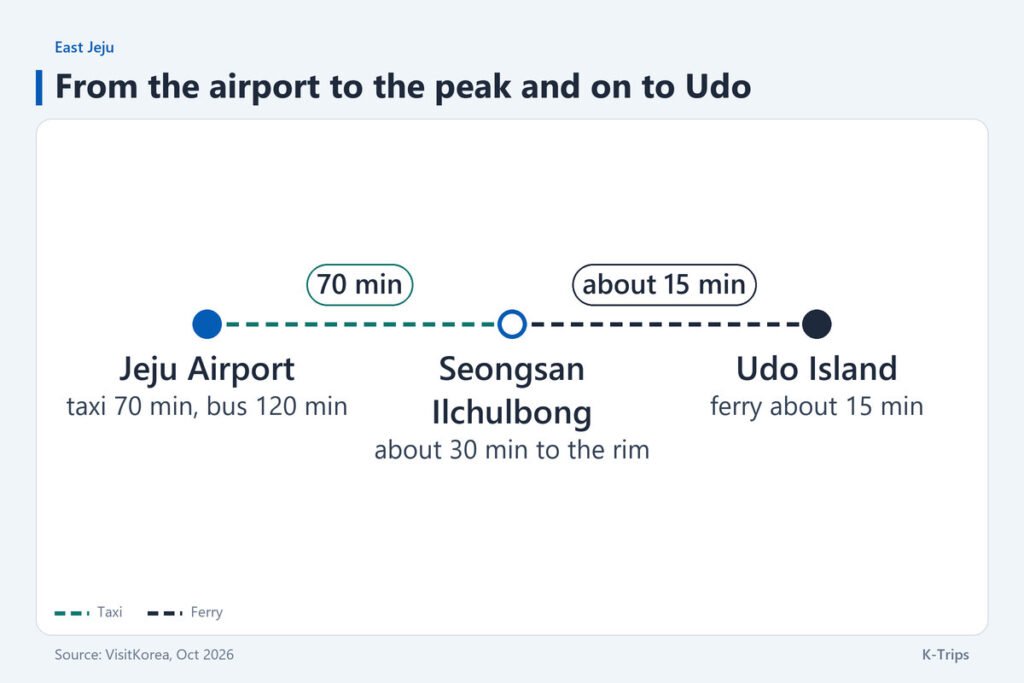
The tourism feature on Jeju puts the walk to the summit at about 30 minutes, and the cone is 180 m high, so this is a staircase and not a hike. At the top you are looking into a crater roughly 600 m across, with the sea on the other side. Plan the time around the opening hours above rather than around the walk: even a slow climb fits comfortably inside the window if you arrive an hour or more before the final ticket sale.
The listing says nothing about weather closures, so if rain or wind is forecast, ask at the gate before you climb; the listings do tie the haenyeo show and the Udo ferry to the weather.

The Haenyeo Cove Below
Beside the cone, at Umutgae Beach, is the performance site that VisitKorea lists as Seongsanpo Haenyeo Gongyeonjang. The haenyeo, Jeju’s women divers, demonstrate their skills in a sequence the listing gives as an introduction, sea diving, collecting seafood, photographs, selling the catch and tasting. Visitors can try sea cucumber, sea pineapple and conch at the Haenyeo’s House restaurant that the divers run. Entry is free with the Seongsan Ilchulbong ticket, and the schedule changes with the season and the weather, so no fixed time is safe to promise. The site is at 284-34 Ilchul-ro, parking is available, and inquiries go to the same +82-64-783-0959.
Seventy Minutes by Taxi From the Airport
The tourism feature publishes estimated journey times from Jeju International Airport, and for Seongsan Ilchulbong it gives 70 minutes by taxi and 120 minutes by bus. Those two numbers decide the sunrise question for anyone staying near the airport. Work backwards from a 05:00 gate and the taxi leaves the airport area at about 03:50, while the 120-minute bus would have to leave at about 03:00.
The feature lists seven airport legs in all, and Seongsan, at 120 minutes by bus, is the longest bus ride among them.
Staying in Seongsan, or in the east of the island, removes most of that friction. The other six legs are set out in the full-island driving day on Jeju, where the same table decides whether a loop needs a rental car. For a very different kind of sunrise stop, the BTS bus stop on Hyangho Beach is a free, open-all-night beach on the mainland’s east coast.
A Seongsan Morning, Priced and Timed
| Item | Cost | Time |
|---|---|---|
| Adult admission | ₩5,000 | Gate opens 04:30 to 06:00, by season |
| Teenager or child admission | ₩2,500 | Same hours |
| Walk to the rim | Included | About 30 min |
| Haenyeo demonstration | Free with the ticket | Varies by season and weather |
| Ferry to Udo Island | Fare shown at the port | About 15 min each way |
| Airport to the peak | Taxi or bus fare | Taxi 70 min, bus 120 min |
The money side is short. A family of two adults and two children pays ₩5,000 twice and ₩2,500 twice, which comes to ₩15,000 for the peak, and the haenyeo demonstration and the parking cost nothing extra. Ferries to Udo leave from Seongsan Port or Jongdal Port and take about 15 minutes from either; the ferry fare and any Udo transport are the only variable items, so budget them at the port.
Udo adds more time than it appears to. Its listing says the island has long been called Soseom because its shape resembles a cow lying down, and that it is 3.8 km long and 17 km around; walking the whole circuit without a stop takes 3 to 4 hours, which is why most visitors use a bus, a bicycle or an electric mini-car. The Jeju feature puts the 17 km loop at about 2 to 3 hours by electric bike, says Udo Sanho Beach gets its white sand from fragments of rhodoliths, a red alga that hardens into stone-like nodules, and adds that Udobong Peak, 132 m, looks back across the water to Seongsan Ilchulbong. The same listing recommends the morning ferry out and the afternoon ferry back, and warns that ferries depend on the weather. It also says Udo draws about 2 million visitors a year, is open 24 hours, charges nothing to enter and is known for its Eight Scenic Views, so a day there is a different kind of outing from the peak and deserves its own morning if you have one to spare.