
It is tempting to treat a Korean taxi ride as a negotiation, but the price comes from a published meter, and Seoul’s fare page says all taxis must charge by the meter, with violators subject to administrative action. VisitKorea adds that most taxis do not expect tips and accept cash, credit cards or a transportation card. The real difficulties for a visitor are elsewhere: knowing which kind of car has pulled up, knowing when the night rates start, and getting a destination across without a shared language.
Four things set the price: the meter, the kind of car, the hour and whether an app is involved. Everything else is logistics at the curb, from calling a car to showing a driver where to go.
_LPi_Taxi_by_seoul.JPG)
The Meter Sets the Price
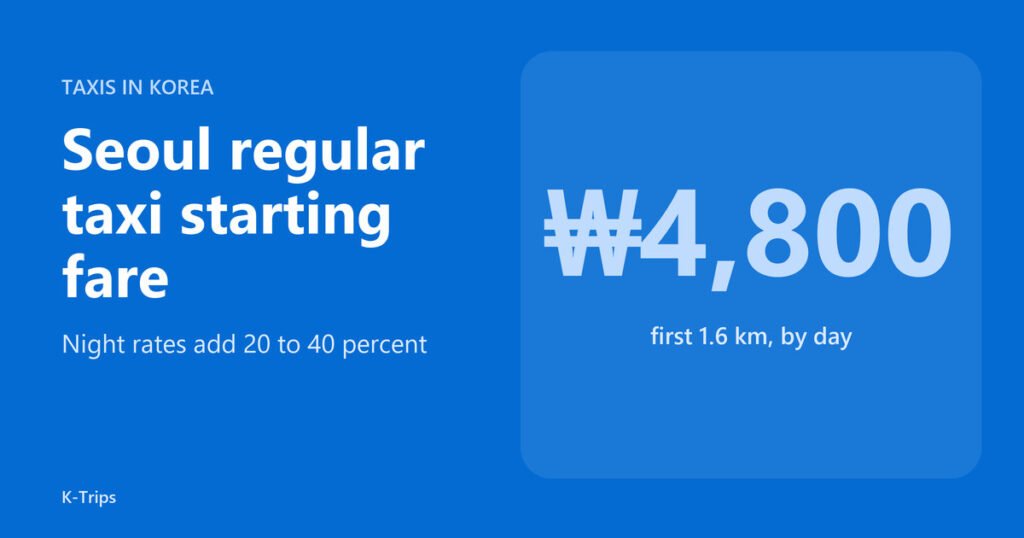
The City of Seoul’s taxi page publishes the sedan tariff in force from 4 a.m. on 1 February 2023, and that table is the one still on the page. By day, a regular taxi starts at ₩4,800 for the first 1.6 km, then adds ₩100 for every 131 meters, plus ₩100 for every 30 seconds when the car is crawling below about 15.7 km/h. The final fare is rounded to the nearest ₩10.
Payment is simple. VisitKorea lists cash, credit card and transportation card as accepted, and the transit card that pays at the reader works in most cabs. A tip is not part of the fare, so the figure on the meter is the figure to pay, plus any road toll the passenger asks the driver to take.
Which Car Pulls Up
Regular, Deluxe and Jumbo
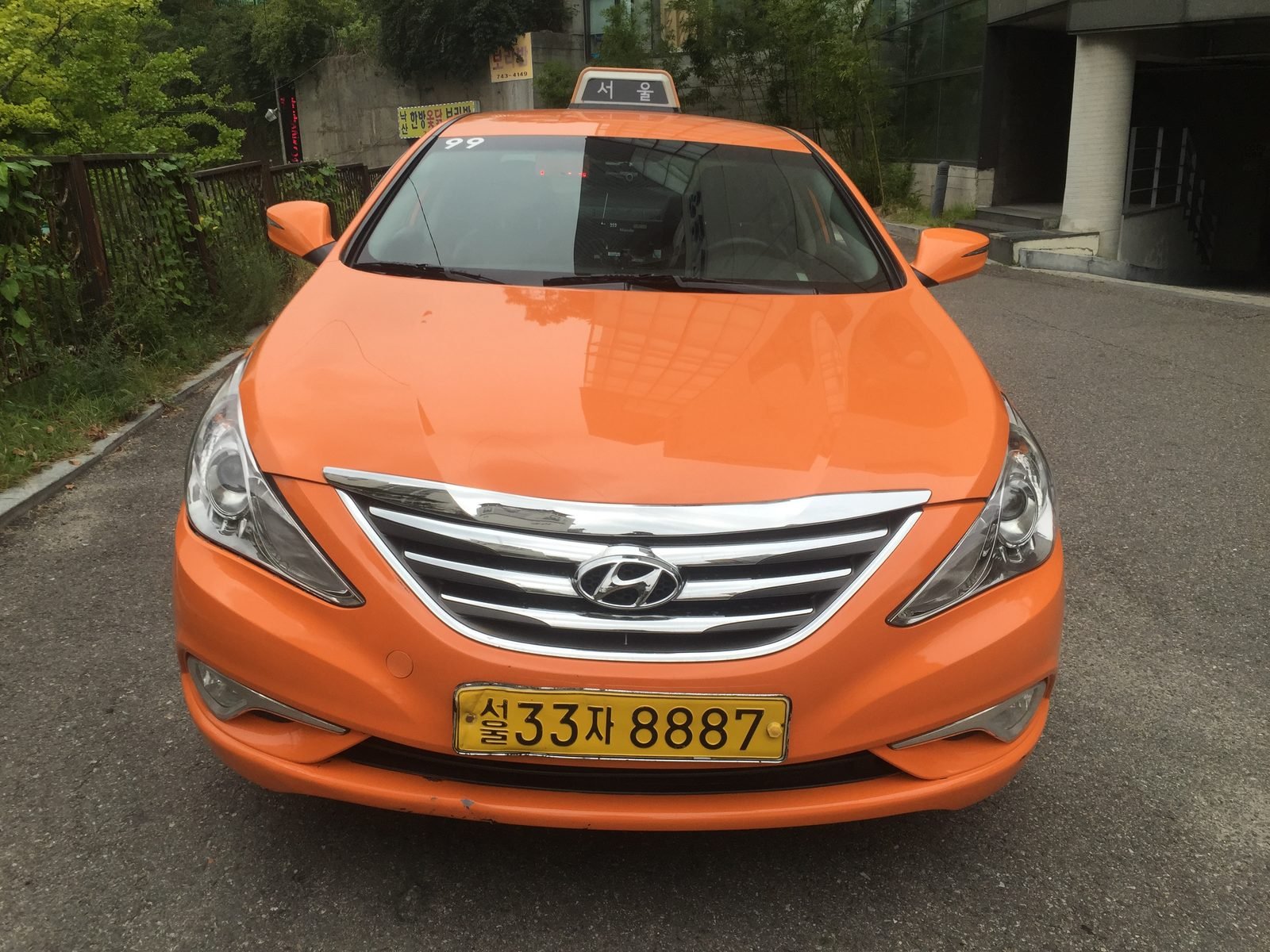
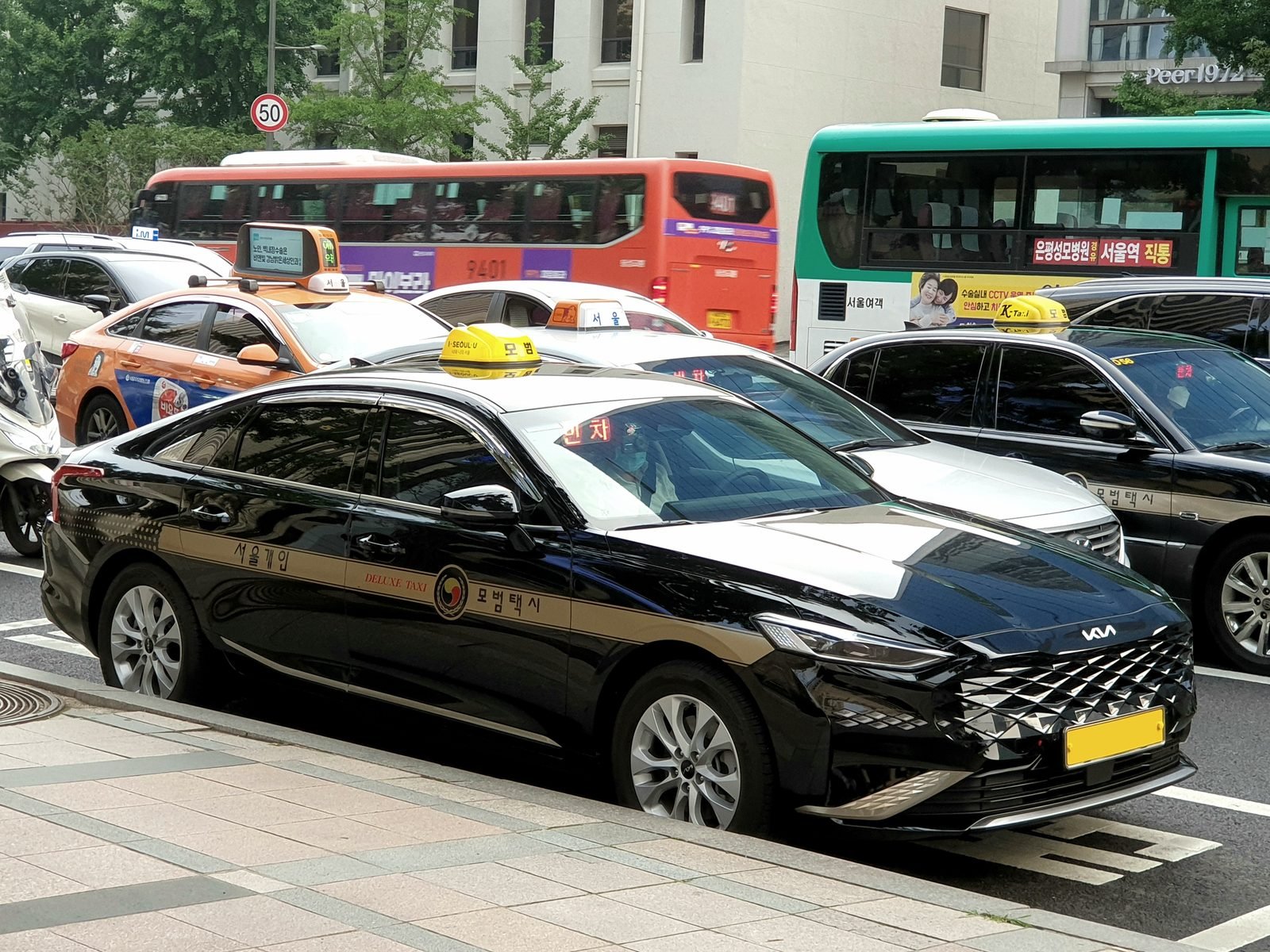
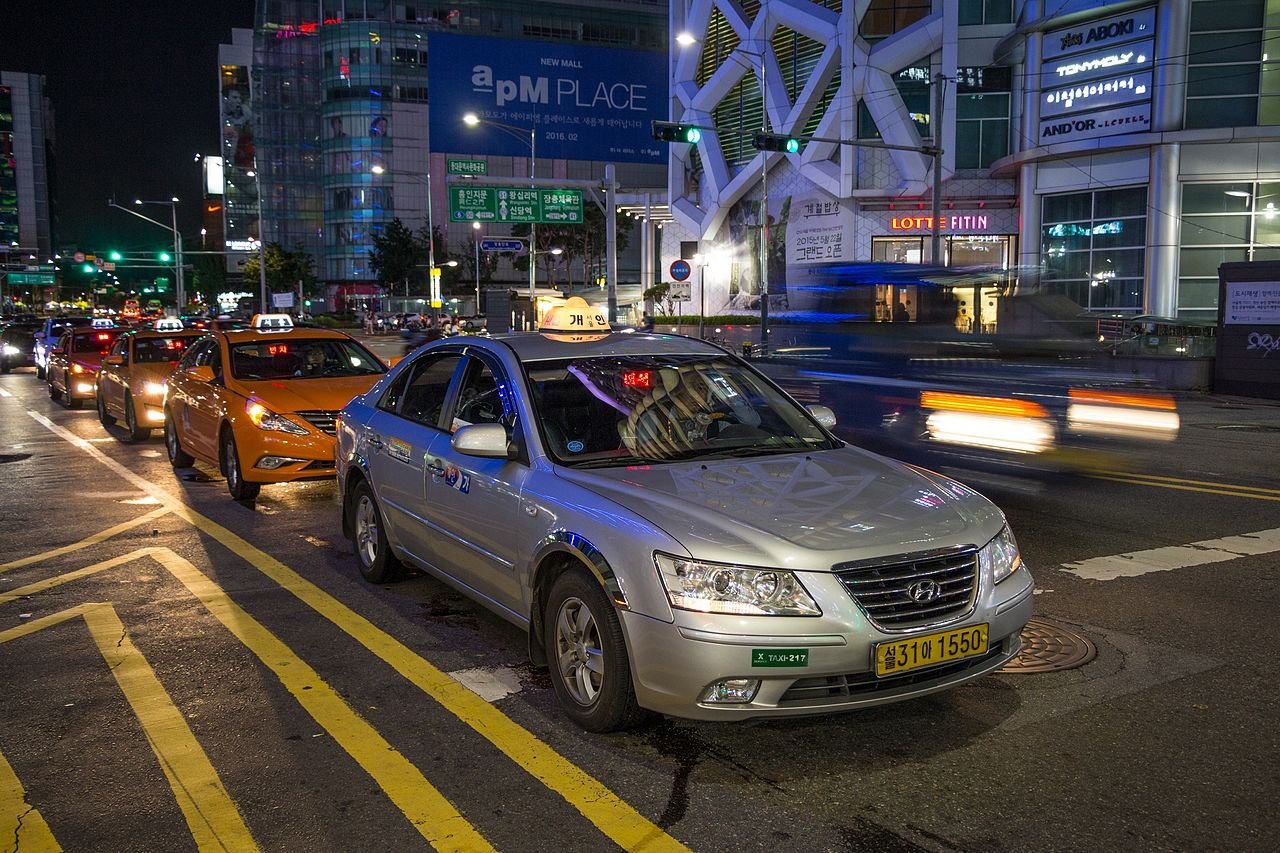
VisitKorea says regular taxis can be recognized by their yellow license plates and a roof sign reading “TAXI”. Deluxe taxis are usually black, use more expensive vehicles and offer a higher standard of service. On Seoul’s tariff, SUV, van and deluxe taxis start at ₩7,000 for the first 3.0 km and add ₩200 for every 151 meters or 36 seconds of slow driving. VisitKorea’s own taxi page still lists a deluxe base of ₩6,500; this post follows the city’s table, which is the dated one.
.jpg)
Seoul’s airport guide puts the premium for a deluxe cab at 40 to 50 percent over a regular one, and says a jumbo taxi, which seats up to eight on the city’s count and is listed by the airport as a 9-seater, costs the same as a deluxe. The practical rule is to check the roof and the color before getting in, because the tariff is set by the type of car, not by the driver.
International Taxis
International taxis are driven by people who can speak English, Japanese or Chinese. VisitKorea says Seoul introduced them in 2009 for travelers, and Seoul’s page puts the price at 20 percent above a regular taxi on the meter. Between Incheon Airport and Seoul they use fixed zone fares instead of the meter. VisitKorea’s airport page says to reserve ahead, its taxi page also lists an International Taxi desk inside the airport, and the airport’s taxi guide gives pick-up points 4C at Terminal 1 and 3C at Terminal 2. The service has its own website and app.
Night Rates, Hour by Hour
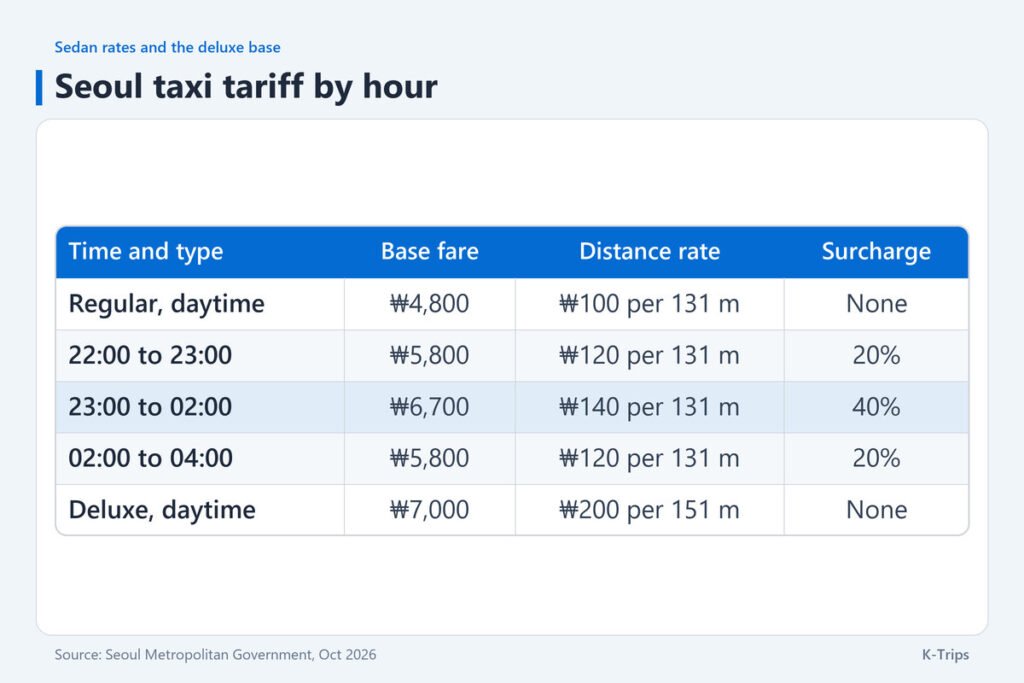
From 22:00 to 04:00 the sedan tariff rises in three bands, and the extra shows up as a higher starting number, not a fee added at the end. Between 22:00 and 23:00 the base fare for the first 1.6 km is ₩5,800 and the distance rate becomes ₩120 per 131 meters. From 23:00 to 02:00 it is ₩6,700 and ₩140. From 02:00 to 04:00 it returns to ₩5,800 and ₩120. The surcharges are 20 percent, 40 percent and 20 percent, and the 40 percent window starts the base fare ₩1,900 above its daytime ₩4,800.
Two more rules matter late at night. Leaving the city limits adds 20 percent, and a late-night ride outside the limits can reach 60 percent in total. Deluxe, SUV and van cabs carry a flat 20 percent from 22:00 to 04:00, which lifts their base fare to ₩8,400. The airport’s guide adds that the boundary surcharge does not apply on trips between Incheon Airport and Seoul, Incheon, Goyang, Gwangmyeong, Gimpo or Bucheon, which share a joint operating area. Because the bands are tied to the clock, the same journey costs a different amount at 21:50 and at 23:10.
Calling a Car With an App
Apps remove the two hardest parts of a taxi ride: finding a car and explaining the destination. VisitKorea notes that they show a fare estimate in advance, and that a small call fee may be added to the metered fare. Three options matter to a visitor, and they differ mostly in how a foreign traveler signs up and pays.
Which App Takes a Foreign Card
Kakao T is the most widely used taxi app. VisitKorea says it needs a Kakao account made through KakaoTalk, signed up with a local mobile number, and it lets you pay the driver in cash, by credit card or with a Tmoney card, or use auto-pay. For visitors, Kakao Mobility launched k.ride in 2024, which does not need a KakaoTalk sign-up, accepts Google or Apple login, works in English, Japanese and Chinese, offers translation of destinations and driver chat in more than 100 languages, and lets travelers register an overseas credit card. Uber Taxi is the third route: someone who already has Uber installed can call a taxi from the same app with the same payment details, and the app translates messages to the driver. The SIM and app checklist covers having data on the phone before the first ride.
Five Steps in the App
VisitKorea’s instructions for Kakao T and k.ride are the same five moves: open the app, enter the pick-up point and destination, choose a taxi type from Regular, Deluxe, Blue, Venti or Black, select “Pay to the driver”, and wait for the dispatch message.
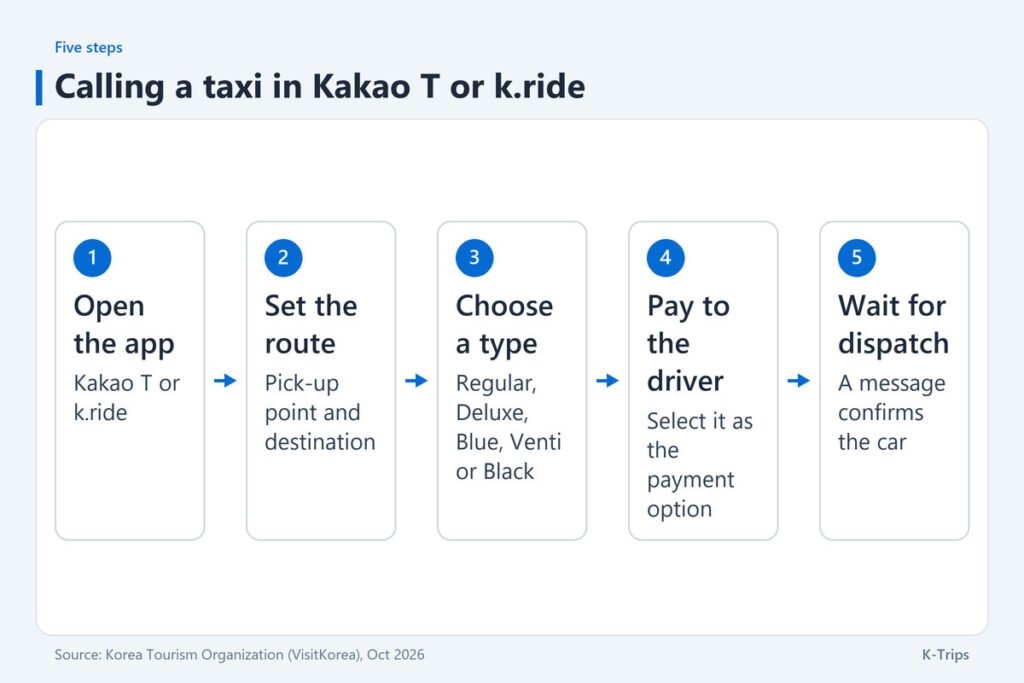
The type matters for the price. Seoul’s table lists brand taxis such as Kakao Black, with a ₩6,000 base fare, and Uber Black, with ₩8,000, under rate plans that can flex between 0.7 and 4.0 times for Kakao Black and 0.8 and 4.0 for Uber Black. The in-app estimate is the number to read before accepting.
Flagging One on the Street
VisitKorea says taxi stands are common at bus terminals, major subway stations and large shopping malls, with signposts to follow when none is in sight, and that a cab can be hailed when one is in view. Visitors in Seoul can call +82-2-120 to ask where the nearest stand is. A regular cab is the cheapest of the cars described above, so a stand or a hail is the simplest way to take one for a short daytime ride, when the app’s extras bring little.
Arriving at Incheon Airport
Seoul’s airport guide places the taxi stand directly outside the arrivals hall. The airport’s own taxi guide warns that illegal solicitation and overcharging by call vans posing as taxis are common, so it advises using a designated stand. For a regular taxi to Myeong-dong the city estimates 80 to 90 minutes and ₩47,000 to ₩52,000 on the meter, with the ₩7,900 airport expressway toll added. International taxis charge zone fares from ₩70,000 to ₩95,000 for a sedan, depending on the district. At Terminal 1 the airport lists regular Seoul-bound taxis at pickup points 5C, 6C and 6D and the International Taxi at 4C; at Terminal 2 the numbers are 7C and 3C. The airport run, priced route by route sets out the full breakdown.

Showing a Driver Where You Are Going
An app carries the destination for you, and both k.ride and Uber translate messages sent to the driver. On a street hail the safest habit is to show the name or address in Korean on the phone screen, copied from a map app or from a booking confirmation. VisitKorea also lists the 1330 Korea Travel Helpline, reachable at +82-2-1330 in several languages, as a source of help with tourist taxis and companies by region.
Street, App or Booked Car Side by Side
The ways of getting a car differ in account, payment and price basis, not in safety. The table sets them side by side using only what the sources state.
| Method | How the car is found | Account and payment | Price basis |
|---|---|---|---|
| Street hail or stand | Raise a hand or join a stand | Cash, credit card or transportation card | Meter |
| Kakao T | App, with a Kakao account | Cash, credit card or Tmoney to the driver, or auto-pay | Meter or in-app plan, estimate shown |
| k.ride | App, with Google or Apple login | Overseas credit card can be registered | Estimate shown in the app |
| Uber Taxi | Existing Uber app | Payment details already on the account | Fare shown in the app |
| International taxi | Website, app or airport desk | Booked in advance or on site | Meter plus 20 percent in Seoul, zone fares from the airport |
I would take the zone fare for a first arrival with luggage, since the price is fixed before the car moves. Late at night I would call an app, because VisitKorea says the fare estimate shows before the ride, and the 40 percent band is the one where a surprise costs most. For a short daytime hop the street is enough.