
A traveler with a suitcase stops at a Seoul subway vending machine and has to choose between a single-journey ticket, a Climate Card and a refill for the plastic card already in her hand. That plastic card is the T-money card, and it settles most of those choices.
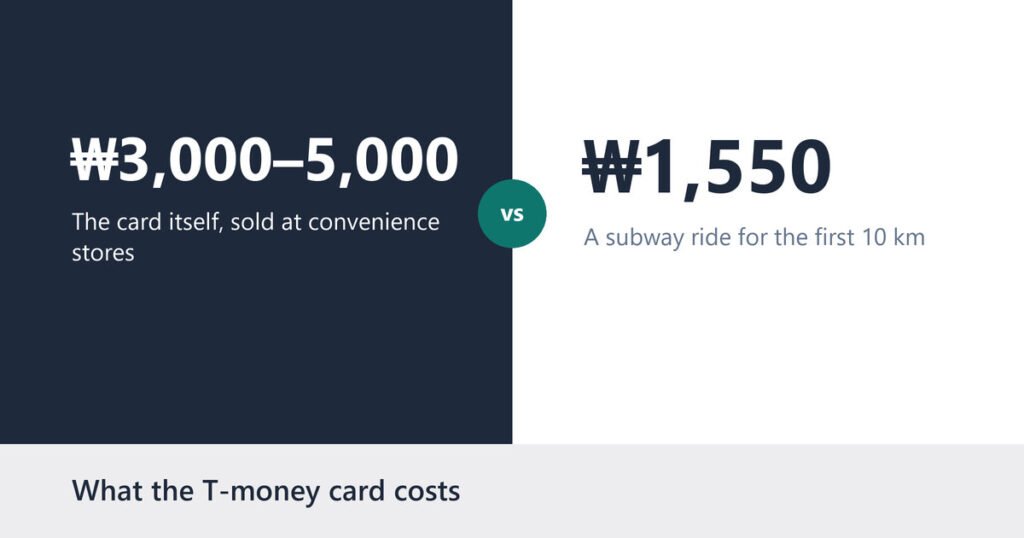
A basic T-money card costs ₩3,000 to ₩5,000, according to VisitKorea’s transportation card page. Convenience stores such as GS25, CU and 7-Eleven sell and load it, and the information centers in subway stations on Lines 1 to 8 sell it too. Station machines add value up to ₩500,000 per load. A subway ride with a card starts at ₩1,550 for the first 10 km, and the rest of this post covers where a foreign card can and cannot pay, transfers, passes and refunds.

Price, Sellers and Where the Card Works
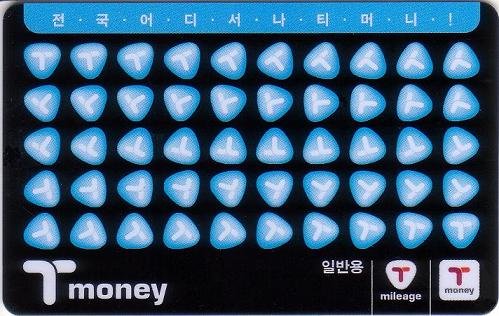
VisitKorea groups the T-money card with the EZL card, WOWPASS and the Climate Card as reloadable prepaid cards that need no account and give transfer discounts on public transport, and says most of them also pay in shops. The T-money card has the largest number of affiliated stores in Korea. Its general price is ₩3,000 to ₩5,000, and it is also issued in many designs, so the first card on the shelf is not the only choice.
The other two cards differ in what they are built for. The EZL card starts at ₩4,000, is sold at convenience stores, and works at credit-card-affiliated shops once it is loaded, but VisitKorea says convenience stores refund only amounts under ₩20,000 on it. WOWPASS costs ₩5,000, needs a passport to buy, can hold Korean won and several foreign currencies, and returns its balance as won cash at its own kiosks. VisitKorea lists transfer discounts for the T-money and EZL cards, and public transport nationwide for WOWPASS.
Travelers under 18 who want the youth fare must register a date of birth at the convenience store when buying. Away from transit the card works at expressway toll gates, public phones, and the vending machines and photo booths inside subway stations, along with shops that show the T-money logo. Taxis take it as well, and how Seoul’s taxi meter and night bands work starts from the moment the card is tapped at the reader.
Topping Up, and Where a Foreign Card Works
Convenience stores and station machines
VisitKorea says the card can be loaded at convenience stores and at the ticket vending machines inside subway stations, and that the station machines stop at ₩500,000 per load. The information centers on Lines 1 to 8 are the other place that sells a card. For a few days in one city the amount is a personal call, since a card can be topped up again at any of these points.
The foreign-card machines opened in March 2026
On 17 March 2026 Seoul began accepting internationally issued Visa and Mastercard credit and debit cards, along with Kakao Pay and Naver Pay, at 440 new transit card vending machines in 273 stations on Lines 1 to 8. The city’s announcement says this covers buying a Climate Card, loading its short-term passes of 1, 2, 3, 5 and 7 days, and buying single-journey tickets, and that an average service fee of about 3.7 percent applies to payments with foreign cards. On a ₩5,000 one-day pass plus a ₩3,000 card, 3.7 percent comes to about ₩300. It does not mention loading a T-money card.
VisitKorea’s card page, last updated in August 2026, still says Climate Card purchase and charging can be done only with cash or a card issued in Korea. This post follows the city’s announcement, and since the feature sits in the new machines, carrying some cash is the safe habit until the machine in front of the traveler is known to be one of them.

What a Ride Costs and How Transfers Work
Seoul Metro prices a subway trip by distance on one scale for the whole metropolitan network. With a transportation card, an adult pays ₩1,550 for the first 10 km, then ₩100 more for every 5 km between 10 and 50 km and ₩100 more for every 8 km beyond 50 km. A single-use ticket adds ₩100 to that fare, which makes the base ride ₩1,650. A 30 km ride, for example, works out at ₩1,950 for an adult card. Teenagers pay a ₩900 base fare, and cards earn a 20 percent early-bird discount on rides that start before 6:30 a.m.
The saving that matters most is the transfer. When a rider moves between subway and bus, Seoul Metro says the fare is counted as one trip if the next vehicle is boarded within 30 minutes of getting off the last one, or within 60 minutes between 21:00 and 07:00. The basic fare and transfers stay free up to 10 km, the highest basic fare among the vehicles used applies, and after 10 km another ₩100 is added for every 5 km. The card has to touch the reader on boarding and on getting off. Single-use tickets get no such benefit. The airport all-stop train also takes a transportation card, which is one reason the airport arrival costs worked out side by side show the train as the cheapest way in.
Passes That Compete With the Card
Two products bundle rides into a fixed price. Both are worth weighing against a plain card, because the card charges per ride and a pass charges per day.
Climate Card short-term passes
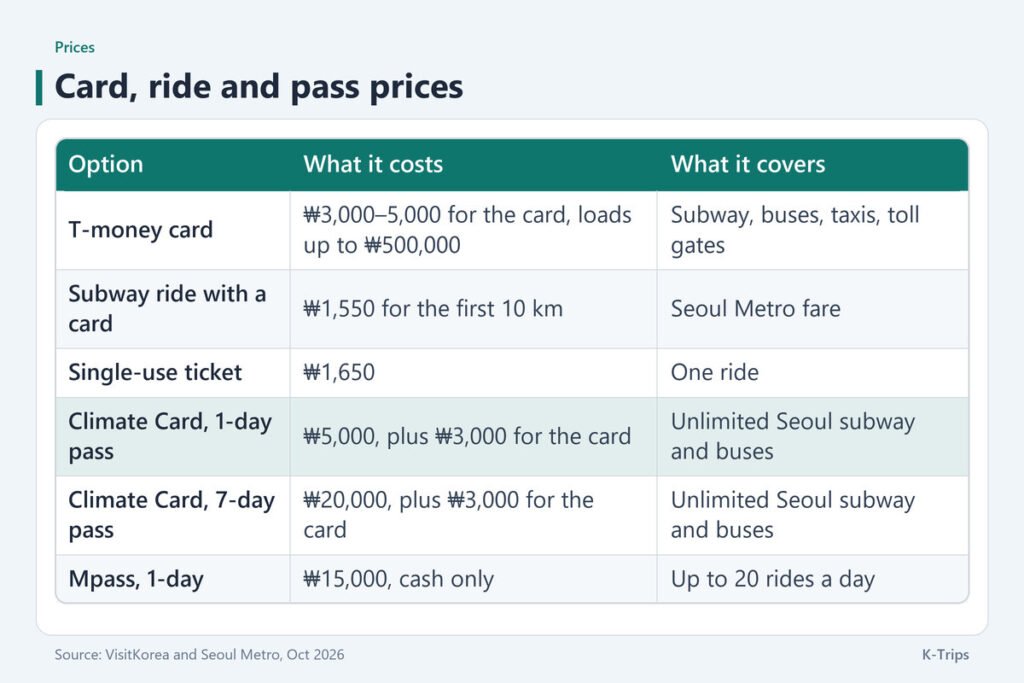
The physical Climate Card costs ₩3,000, and the passes loaded onto it cost ₩5,000 for 1 day, ₩8,000 for 2, ₩10,000 for 3, ₩15,000 for 5 and ₩20,000 for 7. They give unlimited rides on Seoul’s subway and buses, excluding the Sinbundang Line and GTX, and the city’s Climate Card page excludes airport and intercity buses. Leaving the card price aside, since a T-money card costs ₩3,000 to ₩5,000 too, the 1-day pass beats four paid subway fares (₩6,200 against ₩5,000) and the 3-day pass beats seven (₩10,850 against ₩10,000). Count paid fares, not boardings, because a transfer within 30 minutes is not a new fare. A three-day plan such as the three-day Seoul itinerary can sit comfortably on the 3-day pass or on a plain card, depending on how many paid rides it really needs.
The conditions matter as much as the price. A short-term pass activates the moment the card is loaded, and the card cannot be changed or reloaded until the pass expires. Getting off outside the service range costs an extra fare. On AREX the city lists the Climate Card between Gimpo Airport Station and Seoul Station, and since September 2024 a rider can get off at Incheon Airport Terminals 1 and 2 but cannot board there. VisitKorea adds that the 30-day Climate Card was discontinued on 1 October 2026 and that the card is limited to use within Seoul from that date, while the city’s own page gives 31 August 2026 as the last day to recharge the 30-day card.
Mpass for heavy riders
Mpass is a T-money card made for foreign visitors. It allows up to 20 rides a day on Seoul’s subway, city buses and AREX, excluding the express train, for a fixed period: ₩15,000 for 1 day, ₩23,000 for 2, ₩30,500 for 3, ₩47,500 for 5 and ₩64,500 for 7. It is bought with Korean won in cash only, stays valid for 30 days from issue, and gets an automatic ₩3,000 discount when bought after 17:00. Cards are issued and returned at Tmoney Town near Seoul Station Exit 10. Next to the ₩5,000 Climate Card day, ₩15,000 for an Mpass day is hard to justify on rides alone, because the Climate Card has no daily cap. The difference is the airport train: Mpass covers AREX all-stop trains, while a Climate Card can be used to get off at the terminals but not to board there.
Getting the Money Back Before the Flight
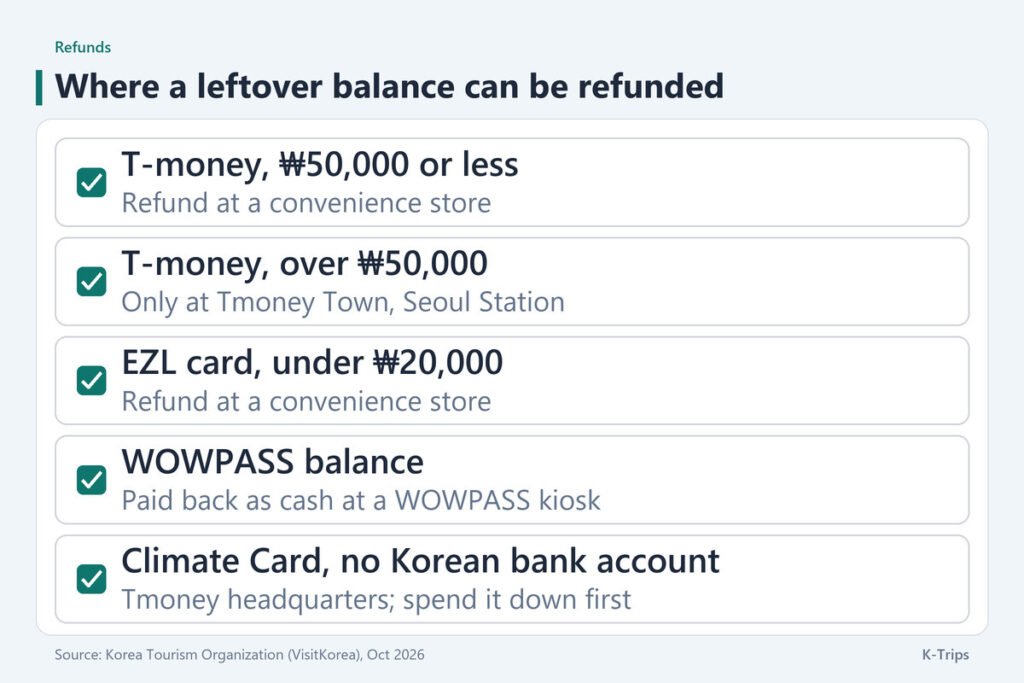
VisitKorea says T-money balances can be refunded at convenience stores for smaller amounts, while a refund of more than ₩50,000 is possible only at Tmoney Town in Seoul Station. The EZL card refunds only amounts under ₩20,000 at convenience stores, and a WOWPASS balance comes back as cash at a WOWPASS kiosk.
A Climate Card is a special case. Foreigners without a Korean bank account have to visit the Tmoney headquarters for a refund, and VisitKorea recommends spending the whole balance before leaving. Seoul Station is also where both AREX services end, so a refund stop there fits on the way to the airport for a traveler staying near it and is a detour for anyone staying elsewhere.
Slips That Quietly Cost Money
The first slip is skipping the tap when getting off. Seoul Metro states that if the card does not touch the reader on exit, the free-transfer benefit is lost and each ride is charged separately. A rider who changes from a bus to the subway and forgets the bus reader pays two base fares instead of one. Because transfers are free up to 10 km, a missed tap gives up the transfer’s full value.
The second is loading a pass early. A Climate Card day starts when the pass is loaded, not at the first ride, so a pass bought on the arrival evening burns part of the day for nothing, and it cannot be reloaded until it ends.
The third is leaving a large balance for the last day. Anything above ₩50,000 cannot be refunded at a convenience store, and the only counter that can pay it out is near Seoul Station. A traveler with a smaller balance has more options, and spending it on rides and shop purchases is the simplest of them.