
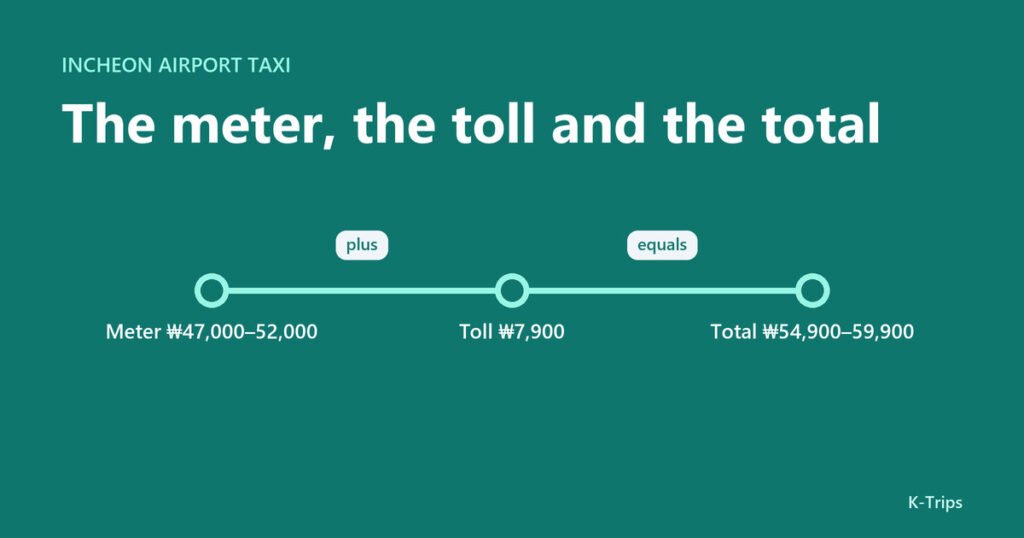
Seoul’s own estimate for a regular taxi from Incheon Airport to Myeong-dong is ₩47,000 to ₩52,000 on the meter, and the city’s airport page says the expressway toll of ₩7,900 is added to that fare. The ride therefore costs ₩54,900 to ₩59,900 before any night rate. A higher figure quoted elsewhere may describe a different car.
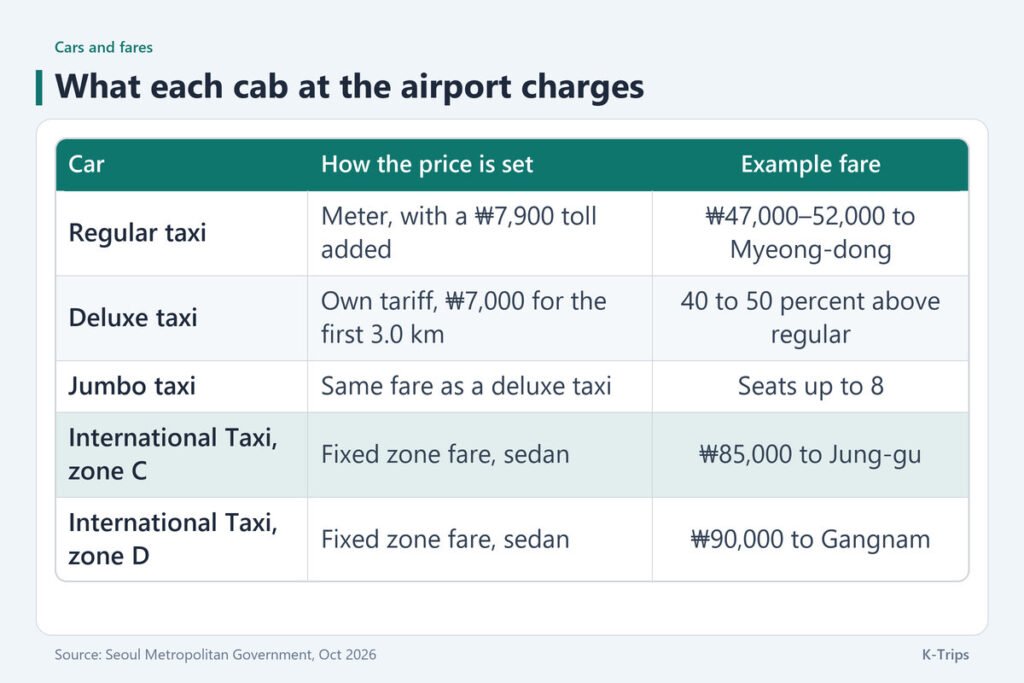
A deluxe taxi runs on its own tariff, and an International Taxi charges a fixed zone fare, ₩85,000 for a sedan to Jung-gu, the district that holds Myeong-dong. Several kinds of cab wait at one airport, and the number on the meter belongs to only one of them.

Where the Meter Number Comes From
The city publishes a table of estimated times and fares from Incheon Airport to twelve places in Seoul. Myeong-dong is listed at 80 to 90 minutes and ₩47,000 to ₩52,000. Neighboring entries show how the figure moves with the destination: Insa-dong is 70 to 80 minutes and ₩44,000 to ₩48,500, Dongdaemun Market is 90 to 100 minutes and ₩50,000 to ₩55,000, and Gimpo Airport is 40 to 50 minutes and ₩31,000 to ₩34,000. The table carries a note that schedule and fare are subject to change, so each entry is a range and not a quote.
The toll sits outside those ranges. The city states that ₩7,900 for the Incheon International Airport Expressway is added to the fare shown on the meter, which puts the Myeong-dong total at ₩54,900 to ₩59,900. The table does not say which hour it assumes, so the night figures later in this post are arithmetic done here on top of the daytime range.

The Tariff Behind the Estimate
A regular sedan in Seoul starts at ₩4,800 for the first 1.6 km, then adds ₩100 for every 131 meters and ₩100 for every 30 seconds of timed fare, with the final amount rounded to the ₩10 unit, according to the city’s taxi page. Distance charges follow the route, while the timed charge grows when the car moves slowly, so a range is the honest way to publish the airport run.
After 22:00
The sedan tariff rises in three bands. From 22:00 to 23:00 the base fare is ₩5,800 with ₩120 per 131 meters, from 23:00 to 02:00 it is ₩6,700 with ₩140, and from 02:00 to 04:00 it returns to ₩5,800 and ₩120. The surcharges are 20, 40 and 20 percent. Applied to the city’s Myeong-dong range, they give about ₩56,000 to ₩62,000 on the meter at 20 percent and about ₩66,000 to ₩73,000 at 40 percent. With the toll added, the 40 percent band comes to roughly ₩74,000 to ₩81,000. Those night totals are this post’s arithmetic, not a figure the city prints.
Crossing a City Line
Incheon Airport is a joint operating area for taxis from Seoul, Incheon and four Gyeonggi cities, Bucheon, Gwangmyeong, Gimpo and Goyang. The airport’s taxi guide says no boundary surcharge applies on a ride from the airport to any of those six cities. Beyond them Seoul and Gyeonggi taxis add 20 percent and Incheon taxis add 30 percent, and the guide’s example is Paju, where the surcharge starts at the point the taxi leaves Goyang. A boundary surcharge on a ride to central Seoul would contradict that guide.
Four Kinds of Cab at One Stand
Seoul’s airport page lists four kinds of cab. The regular taxi has the cheapest fare. A deluxe taxi, which starts at ₩7,000 for the first 3.0 km, is 40 to 50 percent more expensive than a regular one. A jumbo taxi costs the same as a deluxe and seats up to eight passengers on the city’s count, while the airport lists it as a 9-seater. An International Taxi costs 20 percent more than a regular taxi, and its drivers speak English, Japanese or Chinese.
The International Taxi is the one with a fixed price from the airport. The city splits Seoul into five zones, with sedan fares from ₩70,000 for zone A, Gangseo, to ₩95,000 for zone E, which includes Songpa and Nowon. Jung-gu, where Myeong-dong sits, is in zone C at ₩85,000, and Gangnam is in zone D at ₩90,000. SUV, van and deluxe versions of the same zones run from ₩100,000 to ₩140,000. VisitKorea’s airport page says to reserve ahead, its taxi page also lists an International Taxi desk inside the airport, and the airport’s taxi guide gives pick-up points 4C at Terminal 1 and 3C at Terminal 2. Standard and deluxe taxis wait at the platform.
Finding the Stand and the Right Lane
The taxi stand is directly outside the arrivals hall. At Terminal 1 the airport lists regular Seoul-bound taxis at pick-up points 5C, 6C and 6D, and at Terminal 2 at 7C. Deluxe and jumbo taxis load at 7C and 8C in Terminal 1 and at 7D in Terminal 2, and the International Taxi loads at the points named above. Terminal 2 also sorts regular taxis into Seoul-bound, Incheon-bound and Gyeonggi-bound lanes, so the sign above the queue is worth a glance before joining it.
The same guide warns that illegal solicitation and overcharging by call vans posing as taxis are common and advises passengers to use the designated stands. Its page shows how many cars are waiting at each terminal. For how the meter behaves once the ride is under way, from the night bands to the booking apps, see the city-wide taxi rules from meter to apps.

When the Train Is Faster
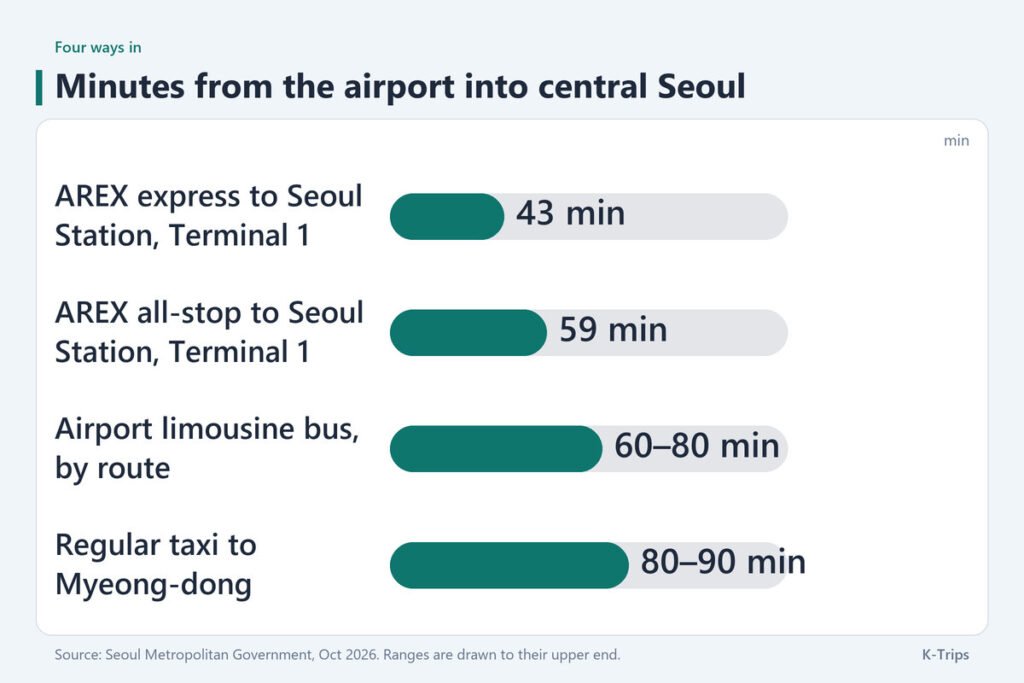
The airport railroad, AREX, runs two services. The express train goes non-stop to Seoul Station in 43 minutes from Terminal 1 and 51 minutes from Terminal 2, departs every 20 to 40 minutes and costs ₩13,000 one way, according to the city. Express tickets are sold at booths on B1F of each terminal’s Transport Center and on B2F at Seoul Station. The all-stop train takes 59 minutes from Terminal 1 and 66 minutes from Terminal 2, leaves every 5 to 10 minutes from 5:30 a.m. to midnight and costs ₩4,150 to ₩4,750, and VisitKorea says it accepts single-use cards and ordinary transportation cards.
The airport limousine bus costs ₩5,000 to ₩15,000 depending on the route and takes about 60 to 80 minutes. VisitKorea says its tickets are bought in advance at a booth or machine, and neither cash nor a transportation card pays on board. A taxi to Myeong-dong takes 80 to 90 minutes by the city’s estimate, against 43 minutes on the express to Seoul Station, but Seoul Station is not Myeong-dong and the last stretch costs extra.
Late Landings and Heavy Bags
VisitKorea says most public transport from the airport to central Seoul stops around 23:30, and that night buses, marked with an N before the route number, cover the gap with tickets bought in advance at a booth or machine. The all-stop train’s service window on the city’s page ends at midnight. After that the choice narrows to the night bus and the taxi, and the taxi is dearest in exactly those hours, since the 23:00 to 02:00 band adds 40 percent.
The case for the taxi is strongest for groups. Four passengers splitting ₩54,900 to ₩59,900 pay about ₩13,700 to ₩15,000 each, close to the ₩13,000 express fare per person, provided four people and their bags fit in one sedan. A solo traveler with a single bag has little reason to pay the meter, and I would take the express train. Whichever car it is, data on the phone matters for night arrivals, so getting mobile data sorted before the flight is worth doing early.
One Arrival, Added Up
The table below puts cost and time side by side for one arrival, using the city’s figures from the sections above.
| Option | Cost | Time | Basis |
|---|---|---|---|
| Regular taxi to Myeong-dong, by day | ₩54,900–59,900 including the toll | 80–90 min | City estimate of ₩47,000–52,000 plus ₩7,900 |
| Same taxi, 23:00 to 02:00 | About ₩74,000–81,000 | Day estimate 80–90 min | 40 percent band, worked out here |
| International Taxi to Jung-gu | ₩85,000 for a sedan | Not published | Fixed zone C fare |
| AREX express to Seoul Station | ₩13,000 | 43 min from T1, 51 min from T2 | City table |
| AREX all-stop to Seoul Station | ₩4,150–4,750 | 59 min from T1, 66 min from T2 | City table |
| Airport limousine bus | ₩5,000–15,000 | 60–80 min | Varies by route |
The taxi rows end at a hotel door, while the train and bus rows end at a station or a bus stop, so the gap in cost is partly a gap in what is included.