
Busan Local Restaurants: Start Where the Trains Do
Most lists of Busan local restaurants send you straight to Haeundae or the market stalls of Jagalchi. This one keeps you within walking distance of Busan Station, in the old harbor districts of Choryang and its neighbors — the first neighborhoods most travelers touch and the last ones they think to eat in. That is a mistake locals do not make. This is working Busan: Chinatown’s faded arcades across from the station, hillside stairways climbing toward the old port views, and decades-old kitchens that survive on regulars rather than reviews. The three picks below come from our founder’s personal eating list — no tourist filter, no sponsorships, just places worth arriving hungry for, all reachable on foot from the KTX platforms.
Brown Hands Baekje (브라운핸즈백제) — Coffee in a Century-Old Hospital
A few minutes’ walk uphill from the station stands one of Busan’s most atmospheric cafes, housed in the old Baekje Hospital — a brick building from the early 1920s remembered as the city’s first modern private hospital, now preserved as a registered cultural asset. Brown Hands, the design company running the cafe, wisely changed almost nothing: raw brick, peeling plaster, timber beams, and a century of patina do the decorating, and the effect is closer to drinking coffee inside a film set than inside a franchise. It is on the founder’s list for the space and the bake, not the hashtag — order the signature bake with a hand drip and take your time. Go before noon on weekends; the good tables and the good bakes both disappear by early afternoon.
Ppongsasimi (뽕사시미) — Raw Fish Without the Ceremony
Busan is Korea’s raw-fish capital, and this unassuming spot on the Jung-gu side of the station area is the founder’s pick for eating hoe — Korean-style sashimi — the way locals do: no aquarium theatrics, no tourist menu, just whatever came off the boats that morning, sliced thick and landed on a table already crowded with banchan. The ordering strategy is the local one we recommend everywhere seafood is serious: ask what is good today — “oneul mwoga joayo?” — and accept the answer as your menu. The banchan spread that arrives before the fish tells you everything about the kitchen’s standards. Expect little English, bring patience and gestures, and you will eat better than at any glass-fronted raw-fish palace on the beachfront.
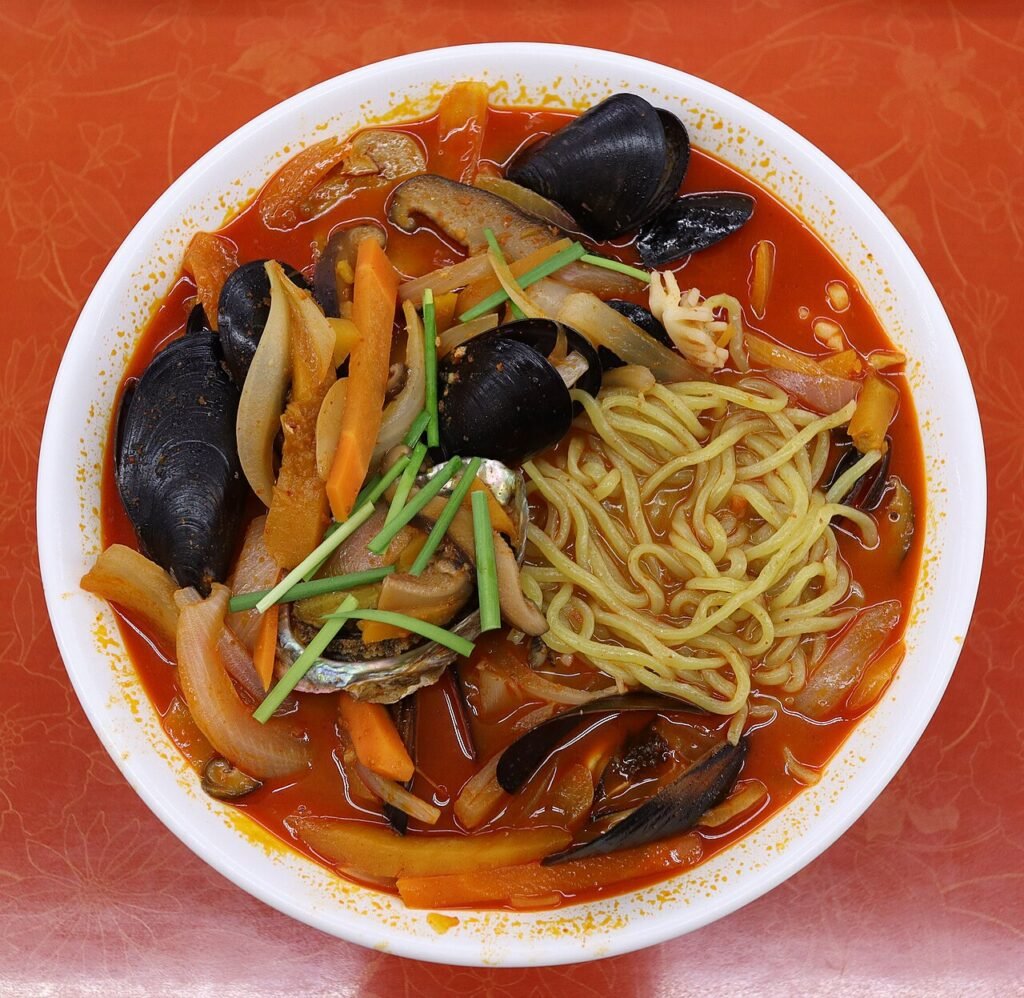
Jjampponggwan Busan Station (짬뽕관 부산역점) — The Noodle Compromise
Steps from the station, this Chinese-Korean kitchen earns its place on the list with the two dishes that define the genre: jjajangmyeon, noodles under glossy black-bean sauce, and jjamppong, the fire-red seafood noodle soup that Busan — with its harbor full of shellfish — arguably does better than anywhere in the country. The house specialty is in the name, and a jjamppong here after a rainy KTX ride is one of the city’s great small pleasures. Come with company and deploy the eternal Korean compromise: one jjajang, one jjamppong, split both — and if a third person joins, tangsuyuk (crispy sweet-and-sour pork) settles the matter. Fast, loud, cheap in the way that needs no soft-phrasing, and exactly what a station neighborhood should feed you.
Finding Them (and Making a Day of It)
All three sit within roughly ten minutes’ walk of Busan Station, scattered between Dong-gu and Jung-gu. The reliable method is to search the Korean names above in Naver Map — Korean map apps beat Google here, and showing the Korean name to any taxi driver also works. Hours at independent places like these shift often, so check the map listing the same day rather than trusting a printout; as of 2026 all three keep regular daytime-to-evening service, but midweek breaks happen. The classic combination is to eat around the station, then ride the metro to Toseong Station and bus 2-2 up to Gamcheon Culture Village — rainbow hillside in the afternoon, raw fish or noodles on your return.
Menu only in Korean? K-OREA reads a Korean menu from a photo — dish names, spice level, and a Korean order sentence you can show the staff. See how it works →
Good to Know
- All three spots are walkable from Busan Station — no metro required.
- Search the Korean names in Naver Map for exact locations and same-day hours.
- Cards are accepted almost everywhere in Korea, these included, but small independents appreciate exact-ish payment at lunch rush.
- Solo diners are welcome at the cafe and the noodle house; raw-fish spreads are built for two or more.
- Peak local lunch runs 12:00–13:00 — arrive before or after for a calmer table.
Busan Station Eats FAQ
Do these restaurants have English menus?
Assume not — that is part of the credential. Photo menus, pointing, and translation apps carry you through, and at the raw-fish house the day’s-catch question replaces the menu anyway. Staff at places running on regulars are used to helping the occasional lost-looking visitor.
Do I need reservations?
No — all three are walk-in places. The queue-management trick is timing: dodge the office lunch hour, and on weekends hit the cafe before noon.
Is the Busan Station area worth staying in for food?
For eaters, honestly yes. You trade beach views for KTX convenience, Chinatown grit, and some of the city’s most unselfconscious kitchens — and everything in this guide becomes your corner shop.
This is the first stop in our Busan eating series, with more founder picks around the city to come. If you are working through the whole list, the Seoul chapters continue in Seongsu part 3 and Seongsu part 4 — same rule everywhere: eat where the regulars are.