
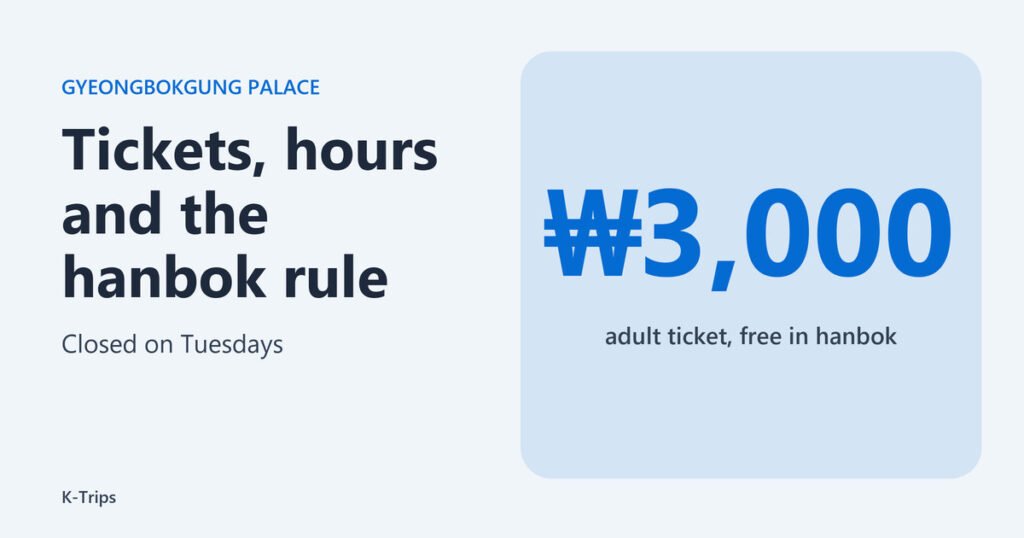
Gyeongbokgung Palace costs ₩3,000 for adults aged 19 to 64, and a complete hanbok gets you in free, as does being under 19 or 65 and over, according to VisitKorea and the palace FAQ on Visit Seoul. The palace is closed on Tuesdays, which makes the day of the week a bigger decision than the ticket price.
Those two facts settle most plans. What takes longer is the detail around them: what counts as a complete hanbok, how the closing time slides by season, when the royal guard performs, and which corners of a very large site repay the walk. This page takes them in the order a visit unfolds.
.jpg)
The ₩3,000 Ticket and Who Pays Nothing
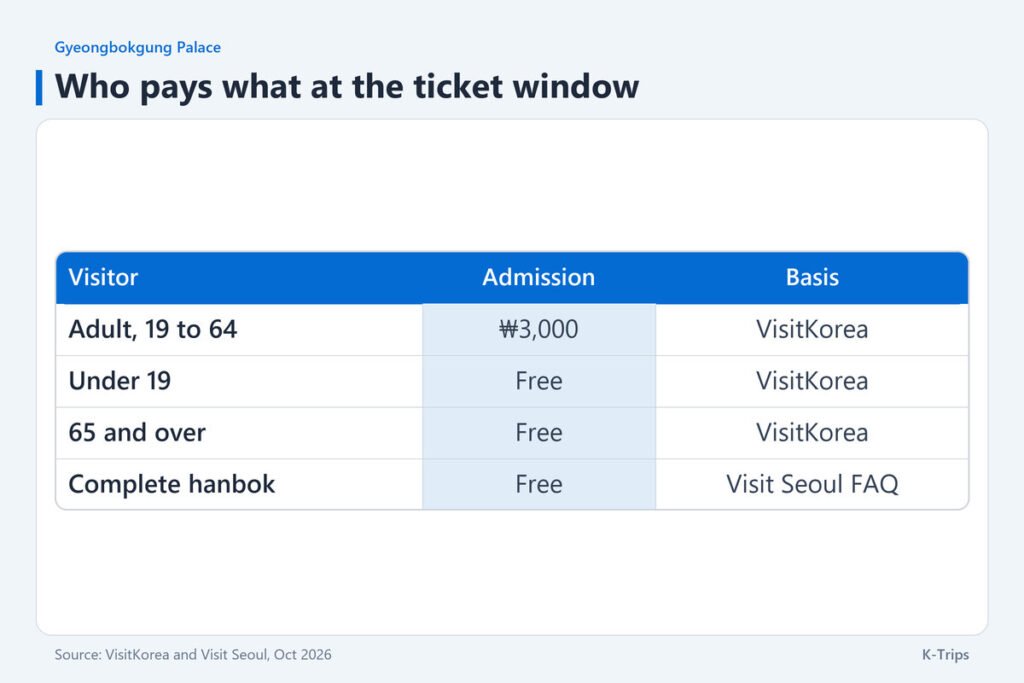
Visit Seoul’s palace page lists one foreign-visitor fee: ₩3,000 for ages 19 to 64, with group prices and other discounts left to the palace’s official site. Anyone under 19 or 65 and over is free, as VisitKorea notes. Guided tours are a separate matter. Visit Seoul says groups of fewer than ten can join the regular tour without a reservation, and that English tours run at 11:00, 13:30 and 15:30 every day except Tuesday.
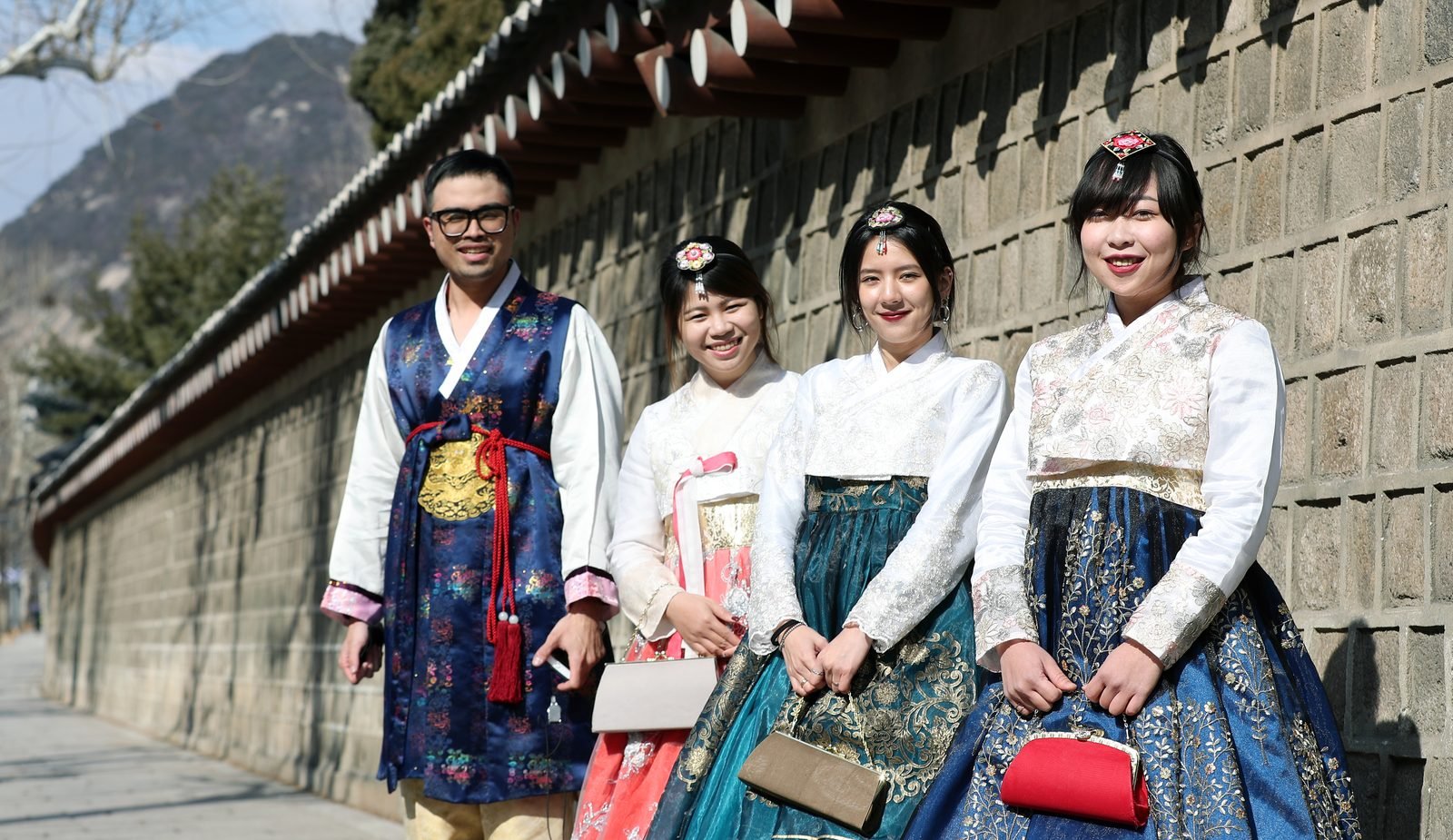
The hanbok rule is the part travelers repeat to one another, so the wording matters. Visit Seoul’s FAQ says you can enter free if you wear a complete hanbok and points readers to the palace’s detailed hanbok guidelines, dated as of 2026. A separate Visit Seoul hanbok guide adds that all five Seoul palaces waive admission for hanbok wearers, including on holidays and special event days. The FAQ says a complete hanbok, so a single accessory or a hanbok-style jacket is unproven, and the guidelines are worth reading before paying for a shortcut.
Rental fees are the real price of free entry. The same guide describes a rental that usually runs about four hours, with hair accessories and a purse included and a fur vest as an extra in cold weather. It prints a fee range, but the page is an older guide and shop prices vary, so ask the shop before you commit. It names the Eulji-ro Underground Shopping Center, near Myeong-dong and Jongno, as one place with many rental shops. Set against a ₩3,000 ticket, renting only makes sense if you want the outfit for its own sake. As a way to save money it does not pay, because a rental costs several times the ticket.
Opening Hours Shift With the Calendar, and So Does the Last Ticket
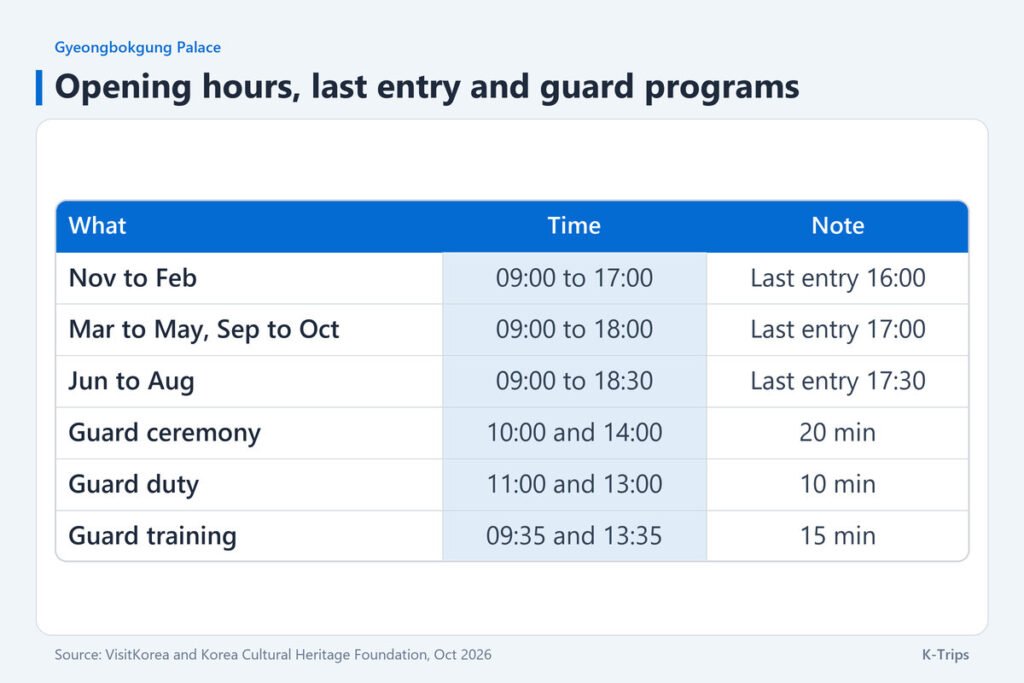
VisitKorea and Visit Seoul give the same seasonal pattern. From November to February the grounds open 09:00 to 17:00, with last admission at 16:00. March to May and September to October run 09:00 to 18:00 with last admission at 17:00, and June to August stretch to 18:30 with last admission at 17:30.
The closing rule has one wrinkle. Tuesday is the weekly closing day, but when a Tuesday is a public holiday the palace opens and the closure moves to the next non-holiday day. A holiday Tuesday can therefore be followed by a closed Wednesday, which catches visitors who read “closed Tuesdays” and stopped there.
From November the schedule is at its tightest. Under the winter hours an arrival at 16:15 is already too late to buy a ticket, even though the palace stays open until 17:00. The gap between the winter last entry and the summer one is 90 minutes, 16:00 against 17:30, so a plan that worked in July needs rethinking in December. The last English tour starts at 15:30, which means a guided winter visit has to begin in the first half of the afternoon at the latest, while the 17:30 last entry of June to August leaves a long evening for walking the grounds without a guide.
The Korea Heritage Service’s Royal Palaces and Tombs Center keeps a notice board for the palace where one-off changes are posted, such as this autumn’s restriction on access to the woldae, the raised stone platform in front of Geunjeongjeon Hall. Notices like that come and go, so the board deserves a glance in the week you travel.
The Royal Guard Ceremony and Its Smaller Companions
The guard programs run on a fixed clock, which makes them the easiest part of a visit to schedule around. They also explain why a morning arrival works better than a mid-day one, since three of the six regular program slots fall before 13:00.
Two ceremonies, one performance
The Korea Cultural Heritage Foundation’s program page lists the Changing of the Royal Palace Guard Ceremony at 10:00 and 14:00, each lasting 20 minutes, and a Guard Duty Performance at 11:00 and 13:00 lasting 10 minutes. A Guard Training Session fills 09:35 and 13:35 for 15 minutes. For a first visit the 10:00 ceremony is the sensible anchor: it is the first program of the day, it leaves the rest of the morning for the palace itself, and the 14:00 repeat is a second chance if weather or timing gets in the way.
A morning built on those times is easy to sketch. The 09:35 training session opens the day, the ceremony runs from 10:00 to about 10:20, and the 11:00 slot offers a choice between the guard duty performance and the English guided tour, which overlap and cannot both be attended. The afternoon repeats the pattern with the performance at 13:00, the tour at 13:30 and the ceremony at 14:00. Small groups do not need a reservation for the tour, so the only fixed commitments are the times themselves.
The weekend patrol that leaves the grounds
The foundation also lists a Guard Patrol Ceremony on weekends and public holidays from March to May and from September to November, between 15:00 and 16:00. On Saturdays it marches inside the palace. On Sundays it moves from Gwanghwamun to Insadong, where visitors can take photographs with the guards. The page warns that the Sunday route can be moved inside the palace when protests or rallies affect the roads, so a Sunday afternoon in October is the one slot where the guards leave the walls, and also the one most likely to change on the day.
Why So Much of the Palace Looks New
VisitKorea dates the palace to 1395, when Yi Seong-gye, the future King Taejo, built it as the official palace of the Joseon dynasty. Fire destroyed the premises during the Imjin War of 1592 to 1598, and the buildings were restored later under Heungseondaewongun in the reign of King Gojong. The assassination of Empress Myeongseong then ended the palace’s role as a royal residence, in VisitKorea’s account. Visit Seoul adds that the government has spent years rebuilding and restoring buildings that were destroyed during the Japanese occupation.
Two details from the tourism sources explain how the site is laid out. VisitKorea says the palace is commonly called the Northern Palace because it lies north of Changdeokgung in the east and Gyeonghuigung in the west, and describes it as the largest of the five. Visit Seoul’s hanbok guide adds that construction ran from 1394 to 1395, that the site was chosen with running water in front and the mountain Bugaksan behind, a setting considered auspicious, and that the main buildings and the haechi guardian statues in front of Gwanghwamun were aligned in straight lines to ward off danger.
That chronology explains what the ticket page never will. The even, freshly finished look of many courtyards is the look of rebuilt architecture, so the site reads best as a restored palace in layers rather than a set of untouched originals. VisitKorea picks out Gyeonghoeru Pavilion, the Hyangwonjeong pavilion and its pond, and the sculpture at Geunjeongjeon Hall as the strongest examples of Joseon-era work still on the grounds.
Photo Spots, the Rear Grounds and the Museums Inside the Walls
Visit Seoul’s hanbok guide names three photo spots. Geunjeongjeon Hall, the first building visitors reach after the entrance, works from almost any angle because of its sheer size. Gyeonghoeru Pavilion, once used for banquets for foreign dignitaries, is called the most beautiful spot on the grounds in any season. Hyangwonjeong is a two-story pavilion on a small round island in a square pond. Only the first sits on the main approach, so a visit that ends at the throne hall misses the other two.
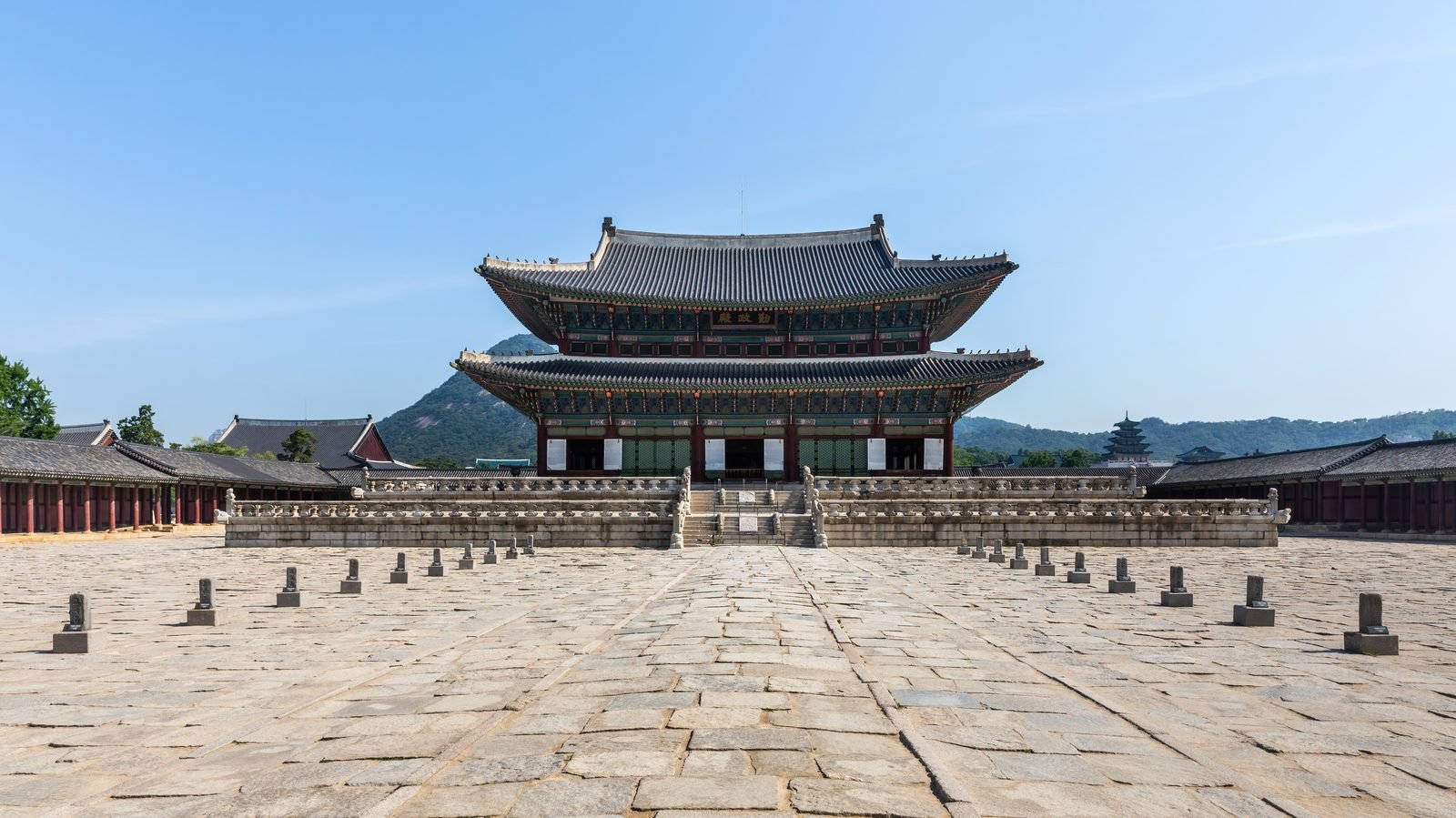

One workable route follows the layout: in through Gwanghwamun, past Geunjeongjeon to Gyeonghoeru, on to Hyangwonjeong, and out toward the east side, where the folk museum has its own entrance. That ordering ends on the side nearest the hillside lanes of Bukchon, so the next stop starts without a walk back across the grounds.
Two museums share the grounds. VisitKorea places the National Palace Museum of Korea on the west side outside Heungnyemun Gate, and the National Folk Museum of Korea east of Hyangwonjeong. Either gives a visit a roof if the weather turns.
Getting in is simple. Visit Seoul lists Gyeongbokgung Station on Line 3, Exit 5, about 492 m away, and Gwanghwamun Station on Line 5, Exit 2, about 471 m away. Since December 2018 a west gate, Yeongchumun, has also been open, ending decades in which there were only three entrances: Gwanghwamun, Sinmumun and the folk museum’s east entrance. Bukchon Hanok Village and its 5 p.m. to 10 a.m. Red Zone lies between Gyeongbokgung and Changdeokgung, according to Visit Seoul, so the two pair naturally, and a three-day Seoul plan that follows each day’s closing rules puts the palace on its first morning.
Three Slips at the Ticket Window
Three slips account for most of the trouble that reaches the ticket window, and each has a plain fix.
The first is arriving on a Tuesday. The palace is closed weekly on that day, and the English guided tours do not run on it either. Guidebooks list the closure, but a trip plan built around flights often loses track of the weekday. The fix is to put the palace on any other day and, near a public holiday, to remember that the closure can slide to the next ordinary weekday.
The second is reaching the window after the last ticket. Last admission comes an hour before closing in every season, which is 16:00 in winter and 17:30 in summer. A morning start removes the problem, and in winter an entry by 15:00 leaves room to see more than the throne hall.
The third is paying for a rental that does not qualify. Free entry is tied to a complete hanbok, and the palace guidelines decide what that means. Rent a full set from a shop that rents for palace visits, and compare the rental fee with the ₩3,000 ticket before deciding.