
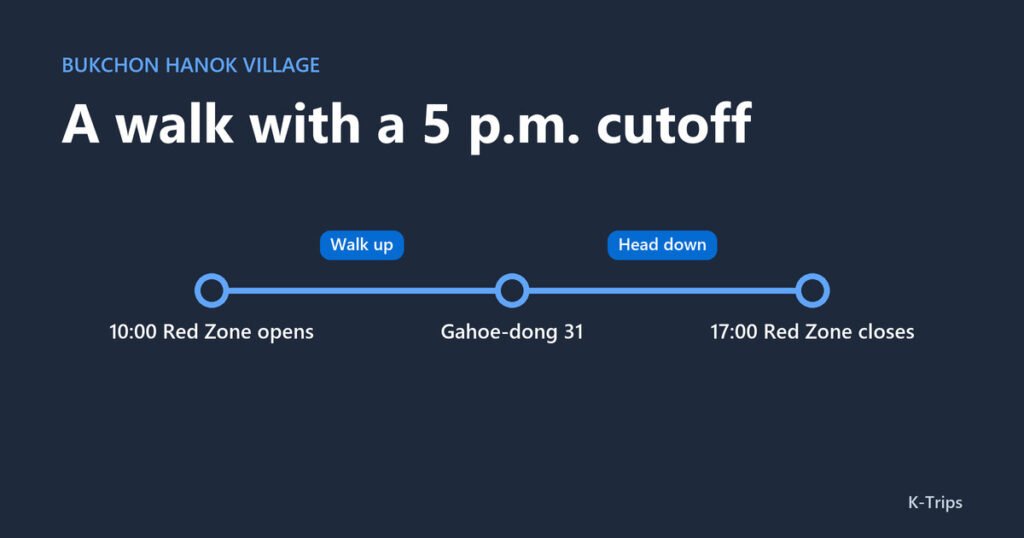
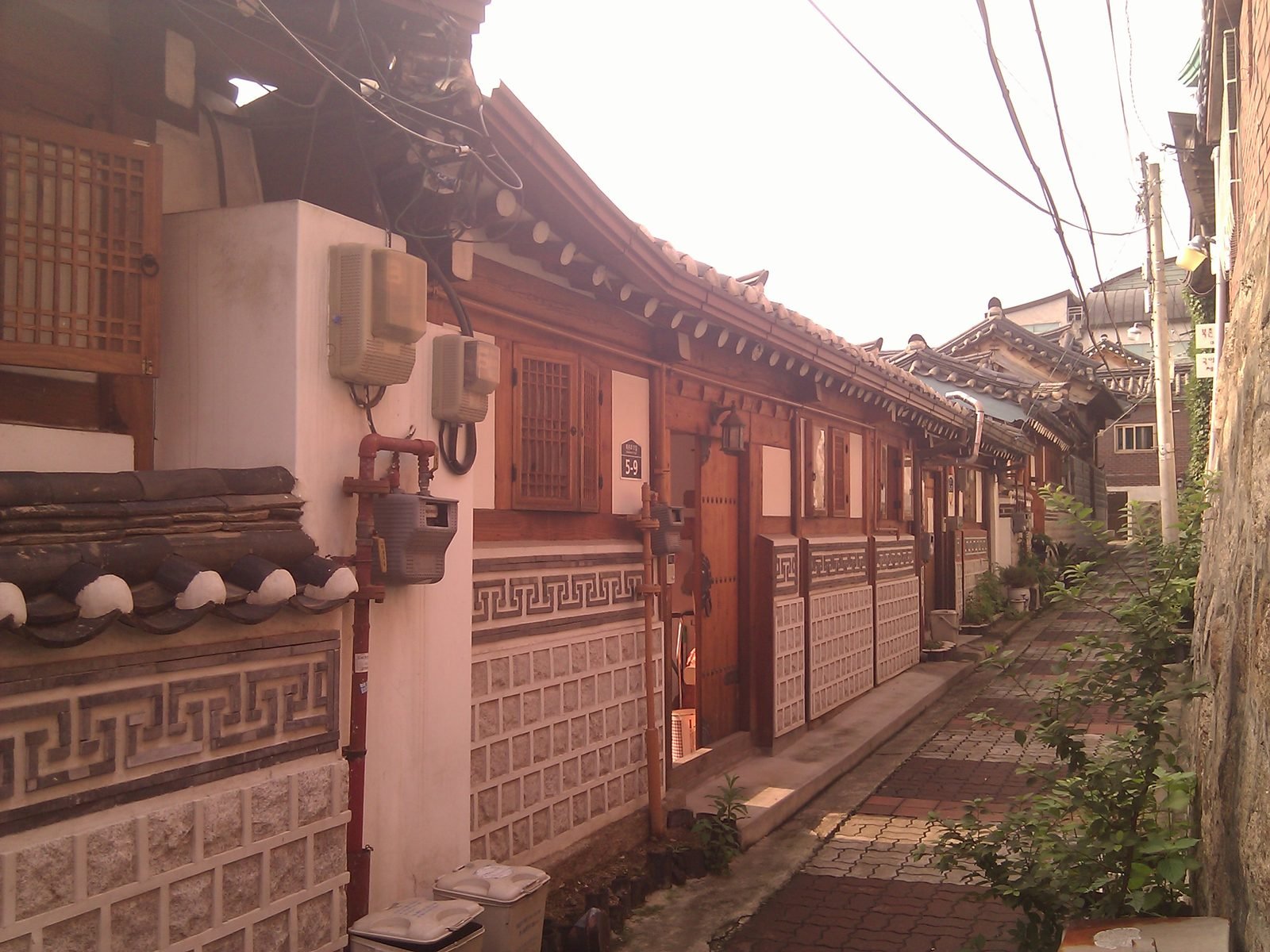
A ₩100,000 fine is what Seoul charges for sightseeing on Bukchon-ro 11-gil between 5 p.m. and 10 a.m., in a Red Zone of about 34,000 square meters of residential lanes, according to the Seoul Metropolitan Government’s notice. That rule explains most of what Bukchon Hanok Village is. It is a residential district that happens to be photogenic, so the useful questions concern timing, noise and where to stand rather than tickets.
Visit Seoul places the village between Gyeongbokgung Palace and Changdeokgung Palace and says it was not created for tourists. VisitKorea counts around 600 hanok still standing and lists admission as free. The sections below run through the rules in force, the quiet-tourism requests, a walking line from the subway and a comparison with Ikseon-dong.
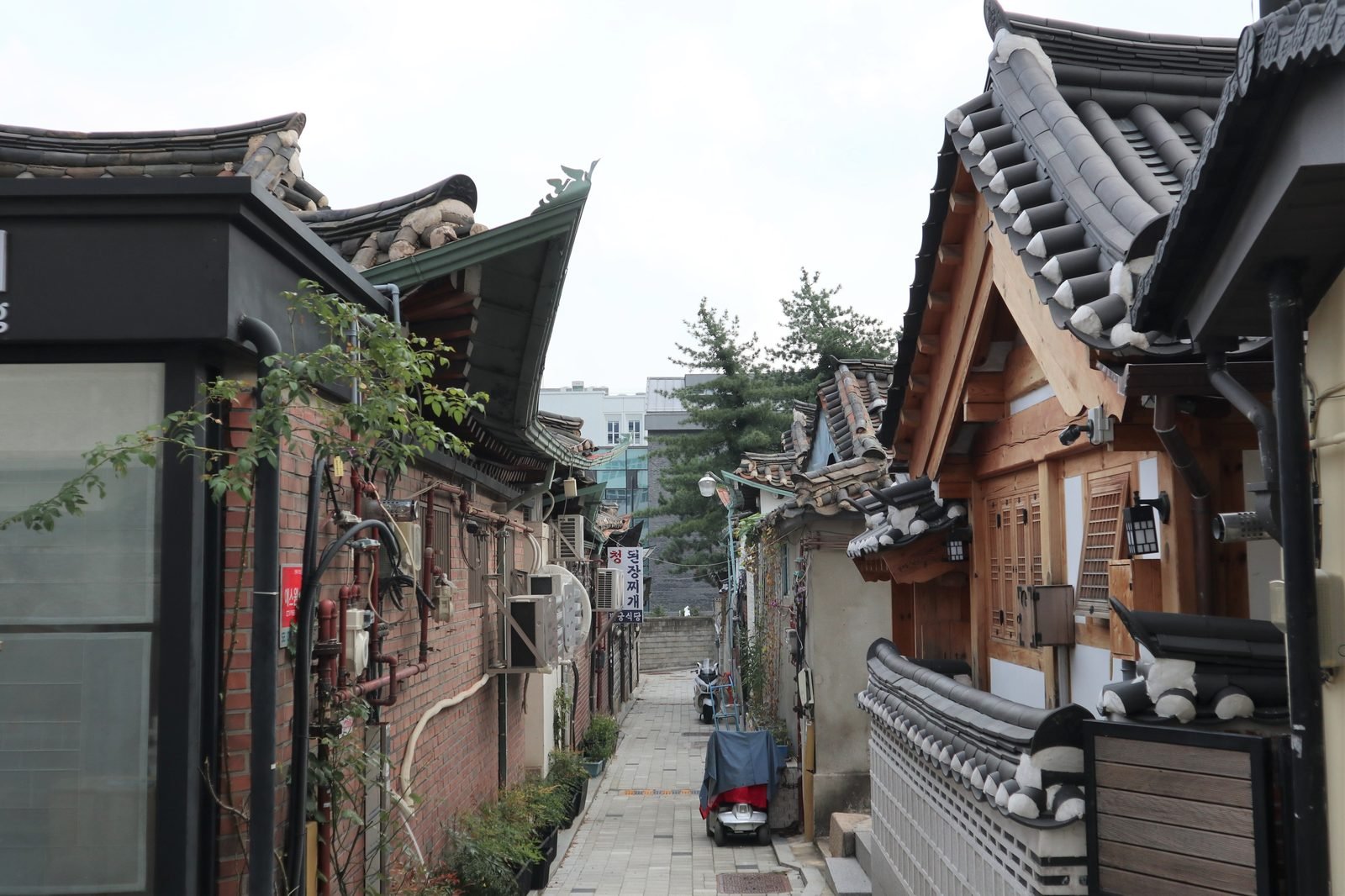

A Residential Street With a Posted Fine Schedule
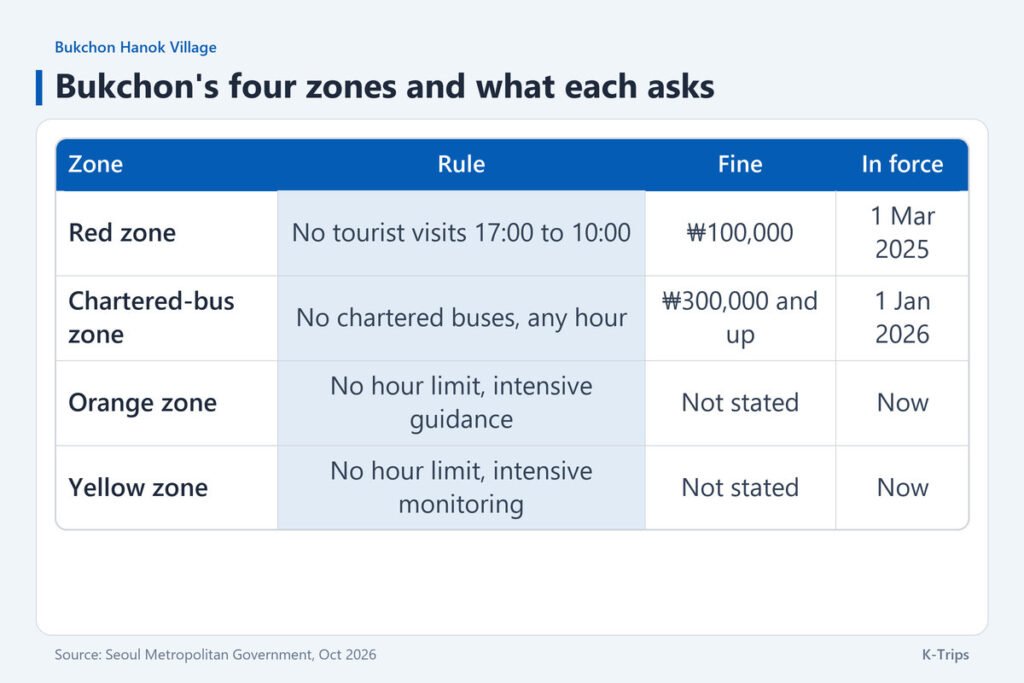
The city’s notice divides the area into zones, and only one of them closes at a fixed hour. In the Red Zone, Bukchon-ro 11-gil, tourists may not visit from 5:00 p.m. until 10:00 a.m. the next day. A guidance period ran from 1 November 2024 to 28 February 2025, and the ₩100,000 fine became enforceable on 1 March 2025. Visit Seoul’s listing for the village prints the same cutoff in its hours field, 10:00 to 17:00, and states that visitors are prohibited from entering restricted areas outside those hours.
Two other measures matter less to a walker but explain why the street feels calmer than it once did. A chartered-bus restricted zone covers about 2.3 kilometers of Bukchon-ro, Bukchon-ro 5-gil and Changdeokgung 1-gil at all hours, weekends and holidays included. Fines for operators are ₩300,000 for a first violation, ₩400,000 for a second and ₩500,000 for a third, and they apply from 1 January 2026 after a guidance period through the end of 2025. The notice also names an Orange Zone, where visiting hours are unrestricted but guidance is intensive, and a Yellow Zone under intensive monitoring.
The zones leave one practical rule. Be on Bukchon-ro 11-gil after 10 a.m. and gone by 5 p.m., and give the surrounding lanes, which sit under guidance and monitoring instead of a time limit, the same restraint. The same notice also asks visitors to treat Sunday as a rest day for the alleyways, a request made out of consideration for residents rather than a fine.
The notice cites Article 48-3 of the Tourism Promotion Act and Article 20 of the Jongno-gu Tourism Promotion Ordinance as the legal basis, and it gives the Jongno-gu Office Tourism Division as the contact for questions. In other words the Red Zone is a district rule enforced by the ward, not a courtesy sign.
Quiet Tourism, as Visit Seoul Puts It
Visit Seoul’s page for the village asks visitors to practice what it calls silent tourism, with the requests aimed especially at the 31 Gahoe-dong area. The list is specific. Keep noise to a minimum, with no loud voices, horsing around or filming. Do not litter. Keep groups to a maximum of ten. Do not use microphones, megaphones or loudspeakers. Do not photograph or film the interiors of houses, even if the doors are open. The page adds that cultural tours of the Gahoe-dong 31 and 33 area are being phased out, which matters to anyone booking a Seoul City Walking tour that promises to pass through.
The open-door request is the easiest to break, because a gate left ajar looks like an invitation and a courtyard makes a good frame on a phone screen. It is still somebody’s home. A photograph taken from the lane that happens to include a roofline is one thing, and a lens pointed into the yard is what the request rules out.
The ten-person ceiling also changes how to travel. A family of twelve or a group of friends moving as one block breaks the request before anyone raises their voice, so splitting into two parties a few minutes apart is the better plan.
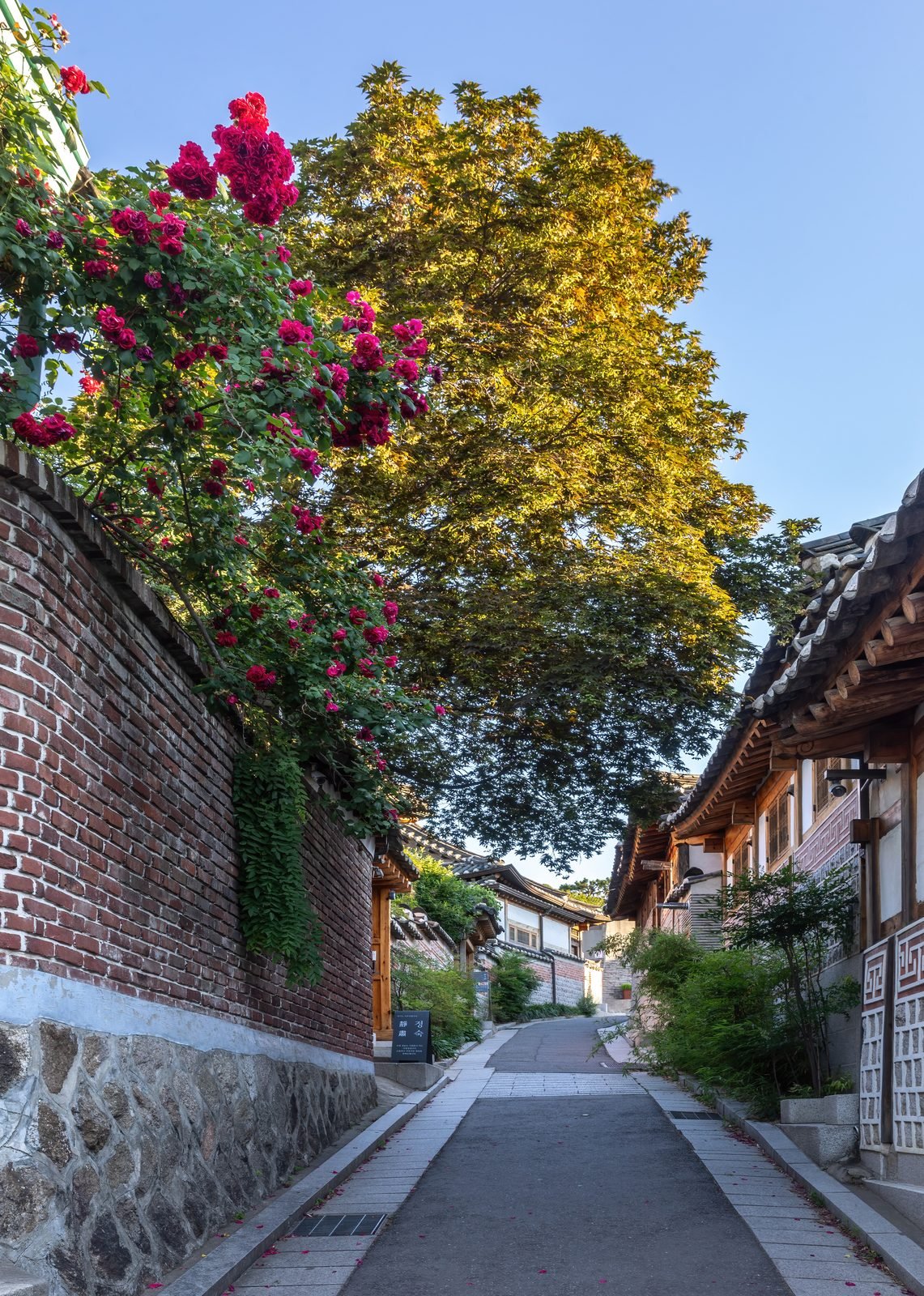

From Anguk Station Up to the Gahoe-dong Lanes
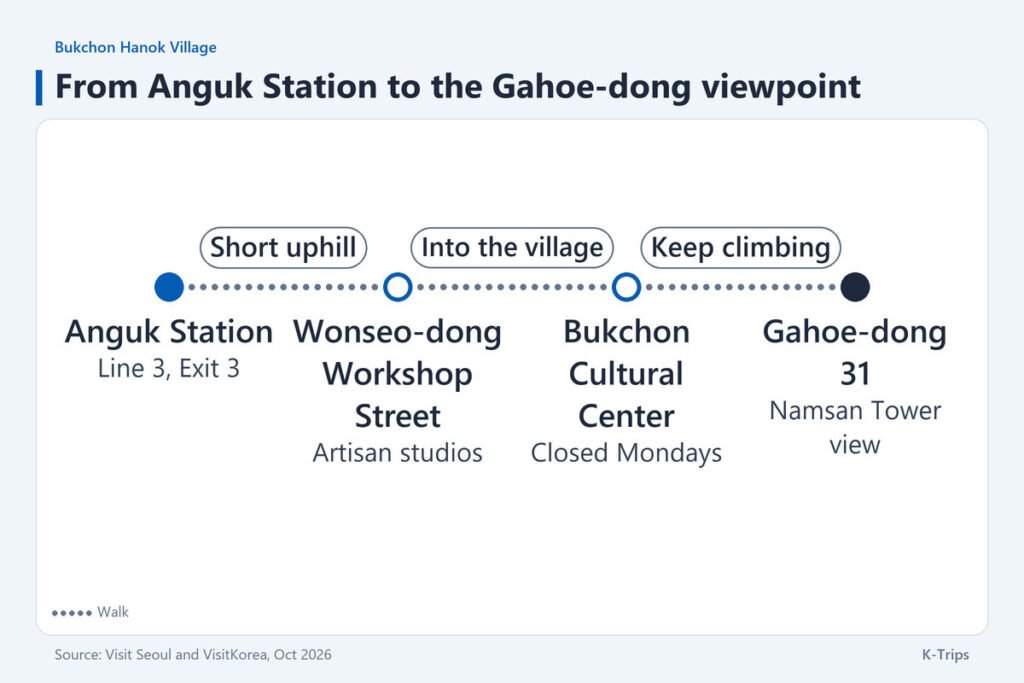
Visit Seoul gives the nearest subway access as Line 3, Anguk Station, Exit 3, 516 meters from the village. VisitKorea’s walking article starts at Exit 2 or 3 and follows the stone wall of Changdeokgung Palace uphill to Wonseo-dong Workshop Street, where traditional artisans have their studios. The lane then continues into Gahoe-dong, the part of the village where hanok stand most densely. Visit Seoul calls it the best place to feel the old atmosphere, with hundreds of houses shoulder to shoulder.
At the entrance to the village stands the Bukchon Cultural Center, a public hanok that VisitKorea describes as a source of information and a small place to rest. Its listed hours are 09:00 to 18:00 on Tuesday, Thursday and Friday, 09:00 to 20:00 on Wednesday and 09:00 to 17:00 on weekends, closed Mondays. The same article names the alley at Gahoe-dong 31 as the classic view: turn around and the hanok rooftops open out with Namsan Tower rising behind them.
Visit Seoul lists the village at 37 Gyedong-gil, Jongno-gu, the same street address VisitKorea gives for the cultural center, which is a useful anchor when a map app drops its pin on a different lane. VisitKorea calls it a 3-minute walk from Exit 3, while Visit Seoul gives 516 meters.
The walk is uphill from the first block, which argues for taking the slope early in the morning and drifting downhill afterward. Nothing inside the lanes calls for a taxi or a bus.
Palaces on Both Sides of the Walk
Because Bukchon sits between two palaces, palace hours decide the order of the day more than the village does. Gyeongbokgung opens at 09:00 in every season, according to VisitKorea’s palace page, and the Red Zone lifts at 10:00, so a morning that starts at the palace gate and reaches Bukchon-ro 11-gil after ten respects both. The palace closes on Tuesdays, which is worth knowing before the day is built around it, and the ticket details sit in the Gyeongbokgung hours and hanbok guide.
Changdeokgung borders the village on the other side. Its stone wall is the landmark VisitKorea uses to steer walkers uphill, and the palace has its own ticket rules to check before adding it to the same day.

Short Answers on Fees, Evenings and Sundays
Does it cost anything to walk through?
No. VisitKorea lists admission as free. Money changes hands only at the cafés, shops and workshops along the way.
Can the village be visited after 5 p.m.?
Not on Bukchon-ro 11-gil, where the Red Zone applies until 10 a.m. The listing for the whole village prints 10:00 to 17:00 as the visiting window, so treat that as the working schedule and plan the evening elsewhere, in Ikseon-dong for instance. The city notice sets no hour limit in the Orange and Yellow zones, but they are still residential streets.
Is the Gahoe-dong 31 viewpoint worth the climb?
VisitKorea calls the alley at Gahoe-dong 31 one of Bukchon’s most iconic views, with the hanok rooftops opening out toward Namsan Tower. It is also the area Visit Seoul’s quiet-tourism requests single out, so take the photograph from the lane and keep your voice down while you do.
Is Sunday a good day to go?
It is possible, with a caveat. Seoul’s notice asks visitors to treat Sunday as a rest day for the alleyways, the Bukchon Cultural Center closes at 17:00 on weekends, and the Samcheong-ro sticker shop opens only from 12:30 to 18:30. A Sunday visit works best kept short and quiet.
What the Alleys Offer Besides Roofs
Visit Seoul notes that some hanok have been turned into art galleries, traditional workshops and restaurants, which is why a hungry or tired walker is rarely far from a seat. VisitKorea’s article names two small shops whose hours matter for planning. A lifestyle shop on Yunboseon-gil, six minutes on foot from Exit 1, opens 11:00 to 19:30 and accepts tax refunds. A sticker shop on Samcheong-ro, twelve minutes from Exit 2, keeps Wednesday to Saturday 13:00 to 19:00 and Sunday 12:30 to 18:30, and is closed Monday and Tuesday. Both open after the village’s 10:00 start, so shopping belongs in the afternoon, and a Monday or Tuesday visit finds the sticker shop shut.
Bukchon Against Ikseon-dong, Point by Point
Ikseon-dong, which Visit Seoul describes as a street of fusion-concept cafés, restaurants and shops, is the nearest alternative for a hanok setting, and the two differ in nature more than in looks.
| Point | Bukchon Hanok Village | Ikseon-dong Hanok Village |
|---|---|---|
| What it is | A residential village between two palaces, not created for tourists | A street of fusion-concept cafés, restaurants and shops |
| Size | Red Zone core of about 34,000 square meters | A street about 801 meters long |
| Nearest exit | Anguk Station, Line 3, Exit 3, 516 meters | Jongno 3-ga Station, Lines 1, 3 and 5, Exit 4, 123 meters |
| Time rule | Tourists barred from the Red Zone 17:00 to 10:00 | None in the Bukchon notice; Visit Seoul singles out winter and night scenery |
The choice follows the clock. A day that frees up only after 5 p.m. has no Bukchon core to walk, while Ikseon-dong is the place Visit Seoul describes at its best after dark. For another preserved hanok district farther afield, there is the hanok village in Jeonju.