
A day trip and a two-day stay are two different journeys to Busan, and only the second treats it as a city. The Gyeongbu Line between Seoul Station and Busan Station runs 447.1 kilometers, according to VisitKorea, so a same-day return leaves room for a beach and little else. Two days change the arithmetic, because the eastern coast and the old western harbor lie on opposite sides of the city and each deserves a day of its own.
This plan keeps Day One on the east coast, with Haeundae, a temple on the shoreline and the bridge at Gwangalli after dark. Day Two moves to the harbor side for hillside lanes and a fish market. Two weekly rules fix the order: the drone show above Gwangalli runs on Saturdays, and Jagalchi Market closes on certain Tuesdays. A Saturday and Sunday pair satisfies both.

Boarding the KTX After the September Fare Cut
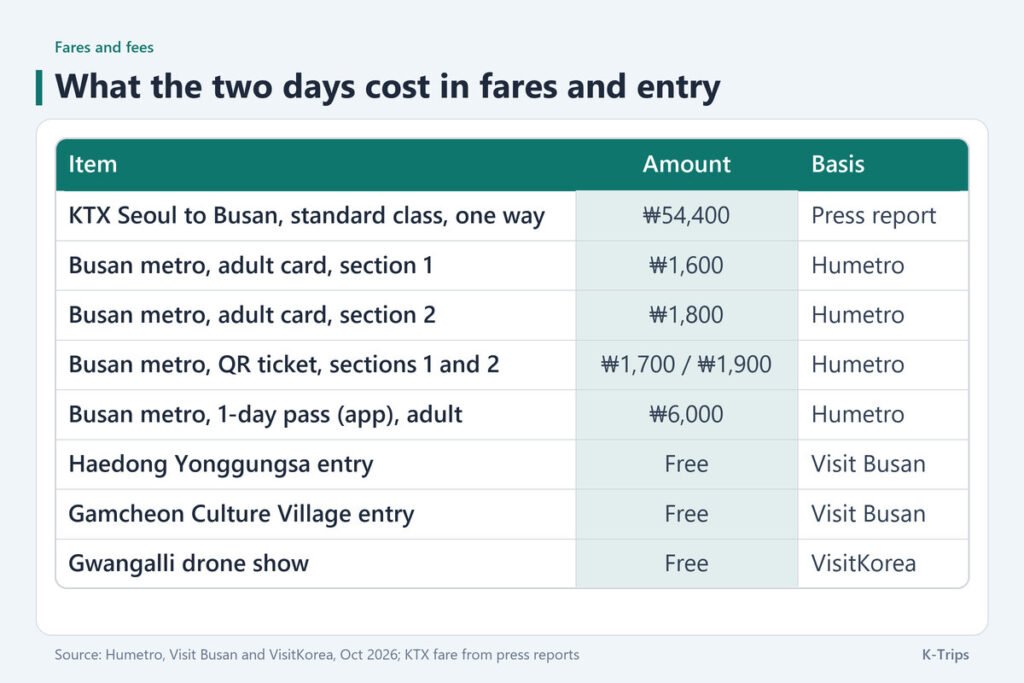
Korean press reports say Korail and SR, the operator behind the SRT trains, merged on September 1, 2026, and that every high-speed train now runs as a KTX. The same coverage puts the average KTX fare cut at about 10 percent. Press reports on the 1 September merger put a standard-class Seoul to Busan KTX ticket at ₩54,400, down from ₩59,800, so check the fare on Korail’s booking screen before paying.
Booking has been folded together as well. The coverage says the Korail+ app, launched in August, now sells the combined high-speed tickets, and that weekday seat supply rises by about 15,000 a day, with Suseo departures gaining roughly 30 percent. VisitKorea says tickets normally go on sale one month ahead at 07:00 and can be bought at counters and kiosks, on the Korail website, in the Korail+ app, or through Naver and KakaoT. For a Saturday morning departure, the sensible move is to book early and not to queue. The same page says tickets can be bought up to 20 minutes before departure, or even later on an app, which leaves some room if a morning plan slips.
Slower trains exist. VisitKorea describes the Mugunghwa as a conventional train that stops at small stations the KTX bypasses, with no figure given for its fare. Visitors flying in take another route: VisitKorea’s airport guide says the light rail from Gimhae International Airport meets Busan Metro Line 2 at Sasang Station, and lists about 30 minutes to Seomyeon, 50 to Gwangalli and 70 to Haeundae. A taxi is listed at 40 minutes to Seomyeon and 70 to Gwangalli or Haeundae.
Day One Along the Eastern Coast
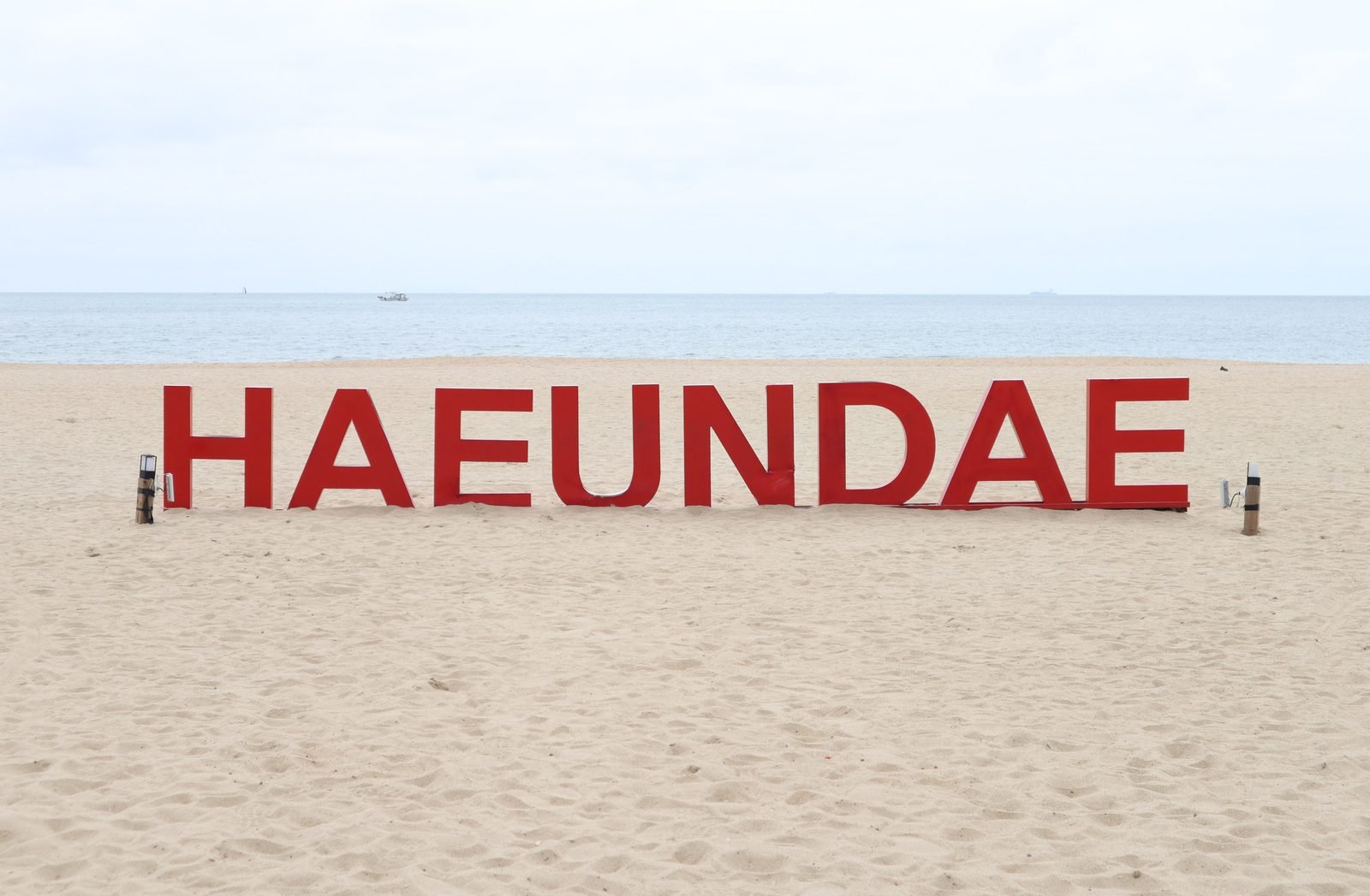
Haeundae is the obvious first stop, on Line 2 and at the water’s edge. Swimming is a summer matter, so for most of the year the beach works as a long walk beside the sea. Haeundae’s swimming dates, headland trail and coastal railway are covered in their own guide, which leaves this day free for the two stops that need a plan.
Haedong Yonggungsa Above the Waves
Haedong Yonggungsa is the one stop that leaves the metro grid. Visit Busan gives the route as Exit 7 of Haeundae Station on Line 2, then Bus 181, 100 or Haeundae 9, which stops at the temple. The name comes from a dream in which the monk Jeongam saw the Bodhisattva of compassion ascend on a dragon’s back. A temple on the shore is also a different visit from a mountain temple, with the sea directly below the halls.
The grounds are open daily from 04:30 to 19:20, with last entry at 18:50, and admission is free; parking is charged. From the gate the path passes twelve zodiac deities and the Iljumun Gate, then 108 steps through a pine grove before the halls come into view. A coastal trail leads on to the sunrise rock. Visitors are asked to lower their voices, to use the side doors, because the front door is for monks, and to keep their shoes tidy. The early opening time makes the temple flexible, since it can open the day or fill the gap between the beach and the evening. Two other routes appear in the same listing: Bus 139 from Exit 1 of Osiria Station on the Donghae Line, and the Busan City Tour Bus, which links the Red Line from Busan Station to the Blue Line’s Haeundae Beach Bus. Pets may enter in a carrier or with a muzzle.
Gwangalli After Dark
Gwangalli Beach faces the Gwangan Bridge, and the evening belongs there. On Saturdays a drone show flies above the sand, free of charge, at 20:00 and 22:00, moving to 19:00 and 21:00 from October to February, according to the VisitKorea listing. Visit Busan puts the walk at 13 minutes from Exit 5 of Gwangan Station on Line 2. The show is a bonus on the right night, not a requirement: the bridge is the main attraction.
VisitKorea describes two performances a night of about 10 minutes each, with a new theme every week and a warning that the competition for a good spot can be stiffer than expected, so the sand is worth reaching well before the lights go up. The temple’s last entry is 18:50, ten minutes before the 19:00 winter show, which puts the temple earlier in the day from October to February.
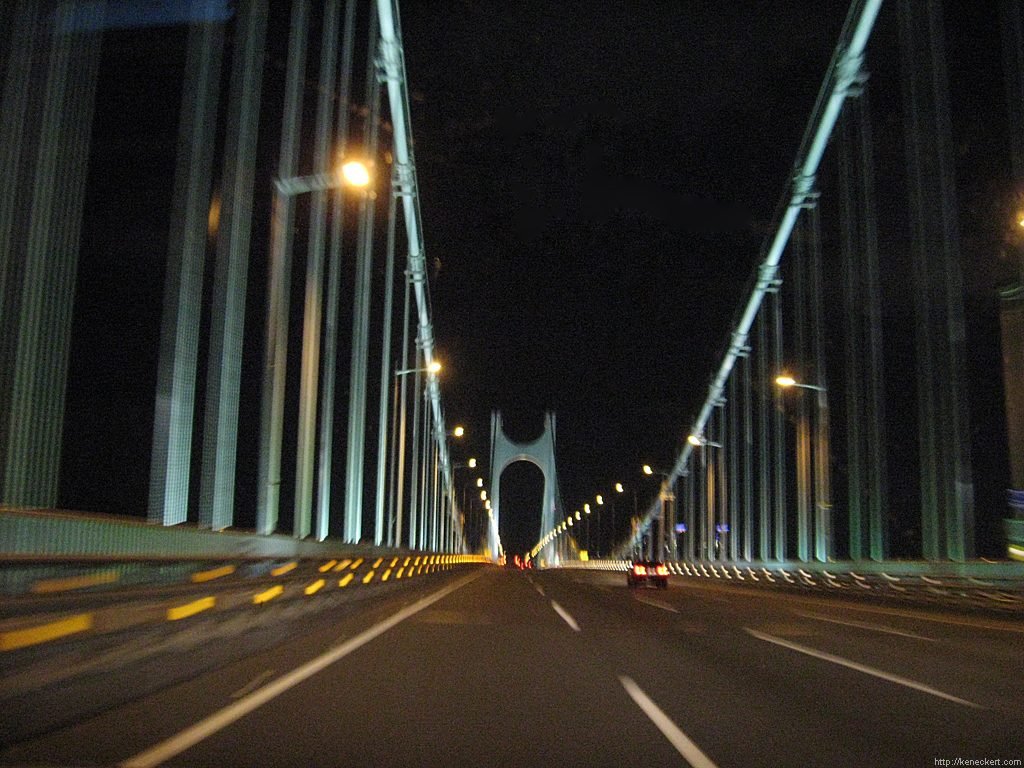

On any other night the order of the evening still works. Dinner comes first, a slow walk along the sand second, and the bridge lights third, so the plan ends the east-coast day there.
Day Two Across the Hills and the Harbor
The second day moves to the old western harbor, where Line 1 links both stops. The hillside village comes first, because its visiting window closes earliest of the day’s stops.
Gamcheon Before Noon
Gamcheon is the day’s one stop with a fixed visiting window: Visit Busan lists the village as open daily until 18:00 from March to October and until 17:00 from November to February, so it goes first. From Exit 6 of Toseong Station on Line 1 a village bus covers the climb, and tourist cars and taxis are kept out of the lanes. People live in these houses, so the village’s visiting rules and stamp map deserve a read before the lanes do, and the same guide lists the bus numbers.
Jagalchi at Lunch
Jagalchi Market is on the same line, a six-minute walk from Exit 10 of Jagalchi Station or Exit 2 of Nampo Station. It trades from 05:00 to 22:00 and closes on the first, third and fifth Tuesdays of the month, according to Visit Busan.
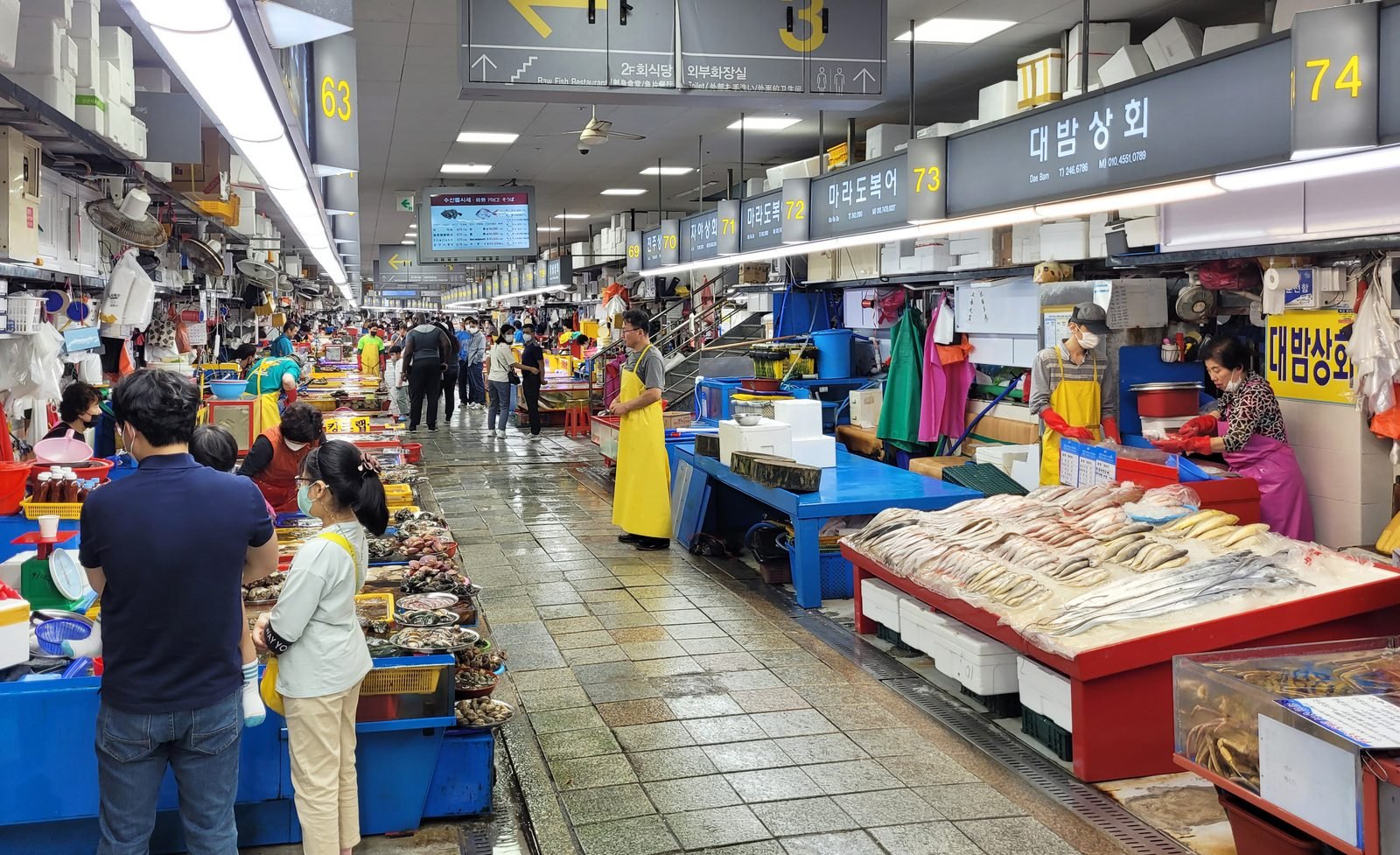

Live fish is sold from basins in the outdoor alleys and from tanks in the modern indoor hall, where restaurants serve it raw, grilled or as a spicy stew. Fees differ by store, so it pays to ask what the fish and its preparation will cost before anything leaves the tank. The market’s hours, closing days and alley-versus-hall layout are set out in full elsewhere. Visit Busan’s advice to come in the early morning is one reason a visitor after the busiest stalls might reverse the order and start here.
Gamcheon first and Jagalchi second is the order that fits both opening patterns: the hillside is timed and closes earliest, while the market keeps trading until 22:00 and can be a late lunch or an early dinner. Line 1 serves Toseong, Jagalchi and Nampo, so no line change falls between the two stops.
Metro Lines and Fares Between the Halves
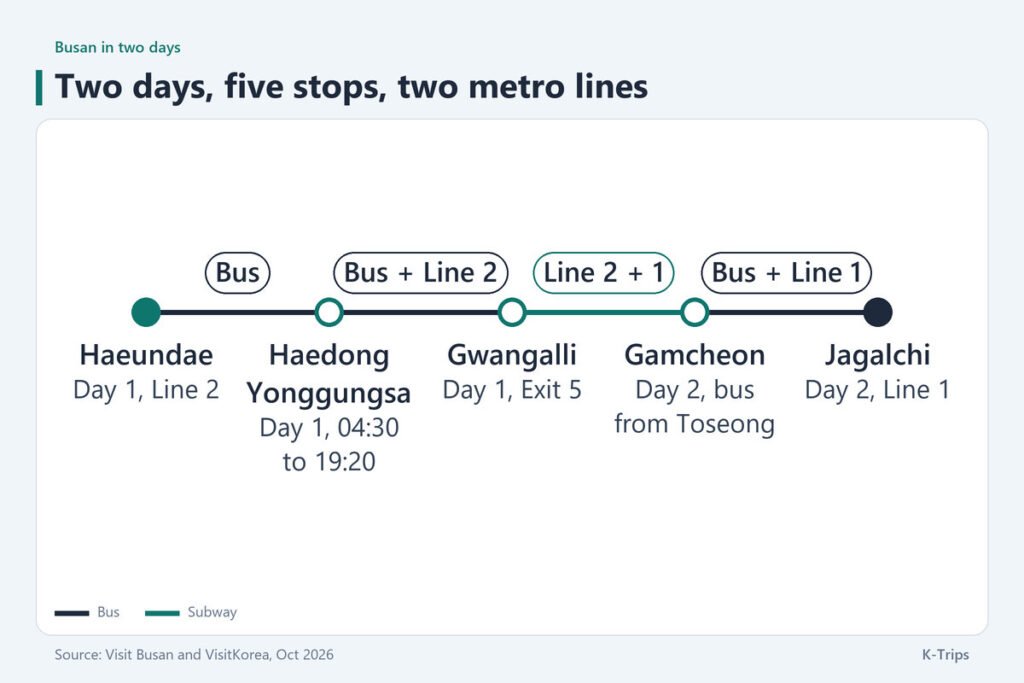
Haeundae and Gwangan stand on Line 2, while Toseong, Jagalchi and Nampo stand on Line 1. Getting from Day One to Day Two therefore means changing lines, which is why this plan groups the stops by line and not by distance.
Humetro, the metro operator, charges by section. An adult transit-card fare is ₩1,600 for section 1 and ₩1,800 for section 2, and a QR ticket costs ₩100 more at each level, ₩1,700 and ₩1,900. Adolescents aged 13 to 18 pay ₩1,050 and ₩1,200 on a card, and children aged 6 to 12 ride free with one. A day with four metro rides therefore costs ₩6,400 at the lowest card fare and ₩7,200 at the higher one. Humetro’s mobile app also sells a one-day pass, ₩6,000 for adults and ₩4,000 for adolescents, which already undercuts four card rides at the lowest fare. The pass covers the metro only, not buses.
Two legs replace the metro with a bus: the climb to Haedong Yonggungsa and the climb to Gamcheon. Both bus lists come from Visit Busan, so a glance at the stop name before boarding is cheap insurance. Humetro’s fare page adds two small protections: the fare is waived once if the wrong direction is chosen and the ticket is reprinted at the same station within five minutes, and refunds a ticket that goes unused for ten minutes if the traveler returns to the same station.
Saturday and Tuesday Set the Order
Two rules do most of the scheduling. The drone show flies only on Saturdays, so the east coast belongs to the Saturday. Jagalchi closes on the first, third and fifth Tuesdays, so in a month with five Tuesdays three of them are closing days, and a Tuesday lunch at the market is a gamble in any month.
That gives three simple patterns. Saturday and Sunday is the plan as written, with the drone show closing Day One. Friday and Saturday swap the days, harbor first and coast second, so the show closes the trip instead. A Monday and Tuesday pair also puts the harbor on Monday, because the Tuesday may be one of the market’s closing days.
Extending the Trip Along the Same Rails
With a third day, the Gyeongbu Line itself points onward. VisitKorea says the route gives easy access to culture-rich cities such as Gyeongju, and Bulguksa, the temple outside Gyeongju is the stop that most itineraries add. It makes a natural contrast with Haedong Yonggungsa: one temple on the sea, one inland.
How the Plan Bends From Month to Month
The route stays the same through the year, but a few dates change what fits.
| Months | What changes in the plan |
|---|---|
| May and June | Haeundae’s sand festival and its sculpture exhibition fill the beach stop. |
| Late June to mid-September | Haeundae’s 2026 swimming period, June 26 to September 15, turns the first stop into a swimming day. |
| October | Jagalchi hosts its festival for about four days, and Gwangalli’s Saturday shows move to 19:00 and 21:00. |
| November to February | Gamcheon closes at 17:00, so Day Two’s first stop moves earlier. |