
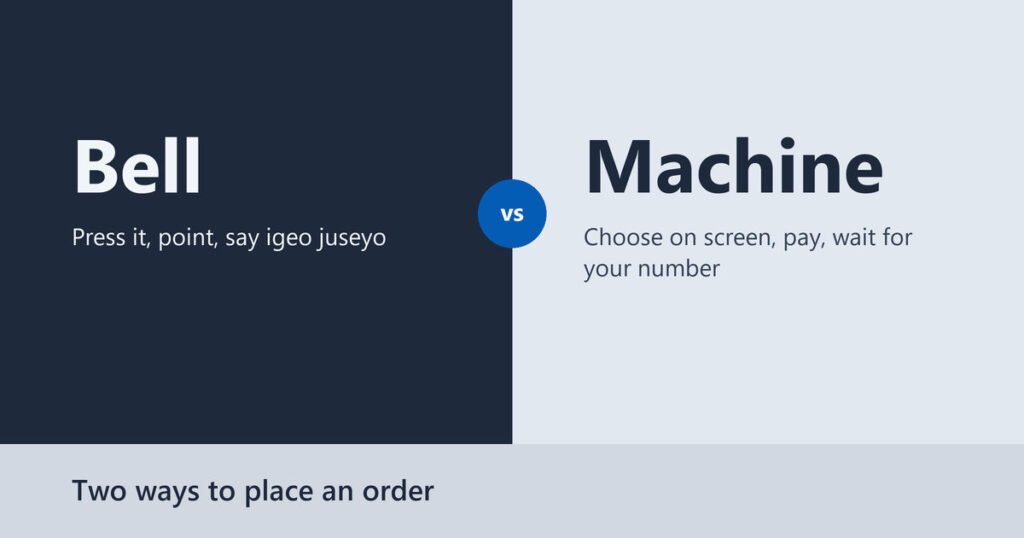
You slide into a booth and nobody comes. The menu on the wall is a grid of Hangul with no photos, a small button sits on the edge of the table, and every other group in the room is eating as if this were the easiest thing in the world. It is, once the habits behind it are clear: a call bell instead of a waiter who checks in, water and side dishes you serve yourself, order machines in place of a counter, and a few phrases that cover the rest. None of it depends on speaking Korean.
.jpg)
The Call Button Replaces the Waiter’s Check-In
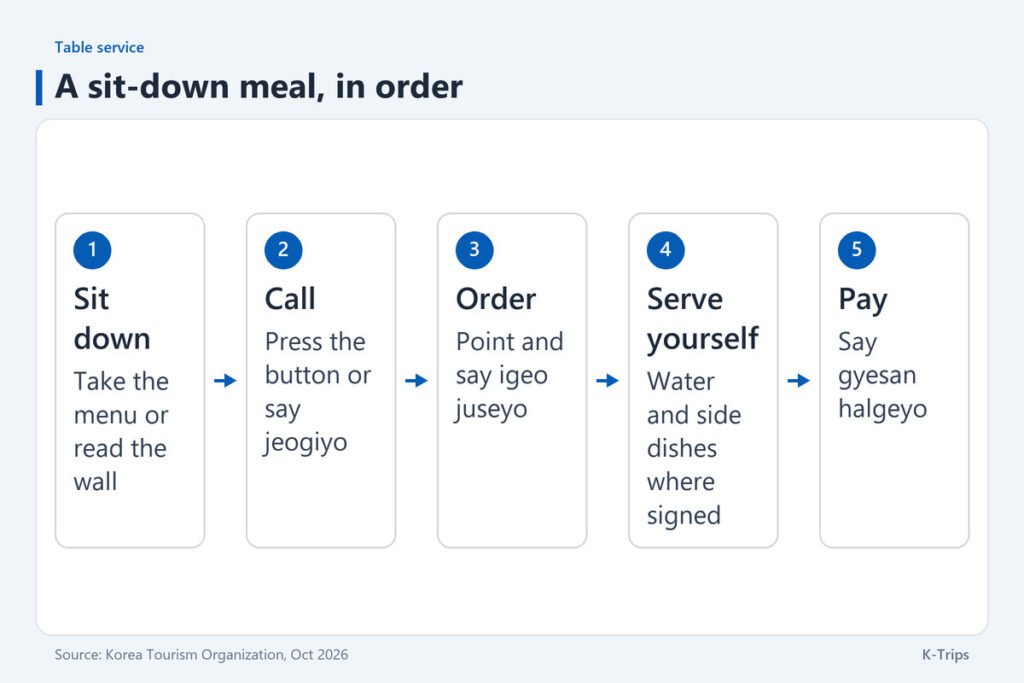
The Korea Tourism Organization’s page on Korean food lists the table call bell among the things that simply make sense in a Korean restaurant: every table has a call button, you press it when you need a server, and the sound may be louder than you expect. The practical result is that the first move is yours. Press the button when you are ready to order or when you want more water, and a server comes to the table. The page was last updated in March 2023 and itself warns that details may differ from what it describes, so treat the habits here as the usual pattern rather than a guarantee.
When there is no button
Some restaurants have no bell, and the same page says that where a restaurant offers neither self-service nor machines, the server will be kind and eager to help with questions. The usual substitute for the button is to catch a server’s eye and say jeogiyo (저기요), a word used to get someone’s attention that is close to “excuse me”. Say it at normal volume with a raised hand. Pointing at a line on the menu is easier to do with confidence once the cooking words are familiar, which is what the post on reading Korean menus with everyday words teaches.
Water, Side Dishes and the Drawer Under the Table
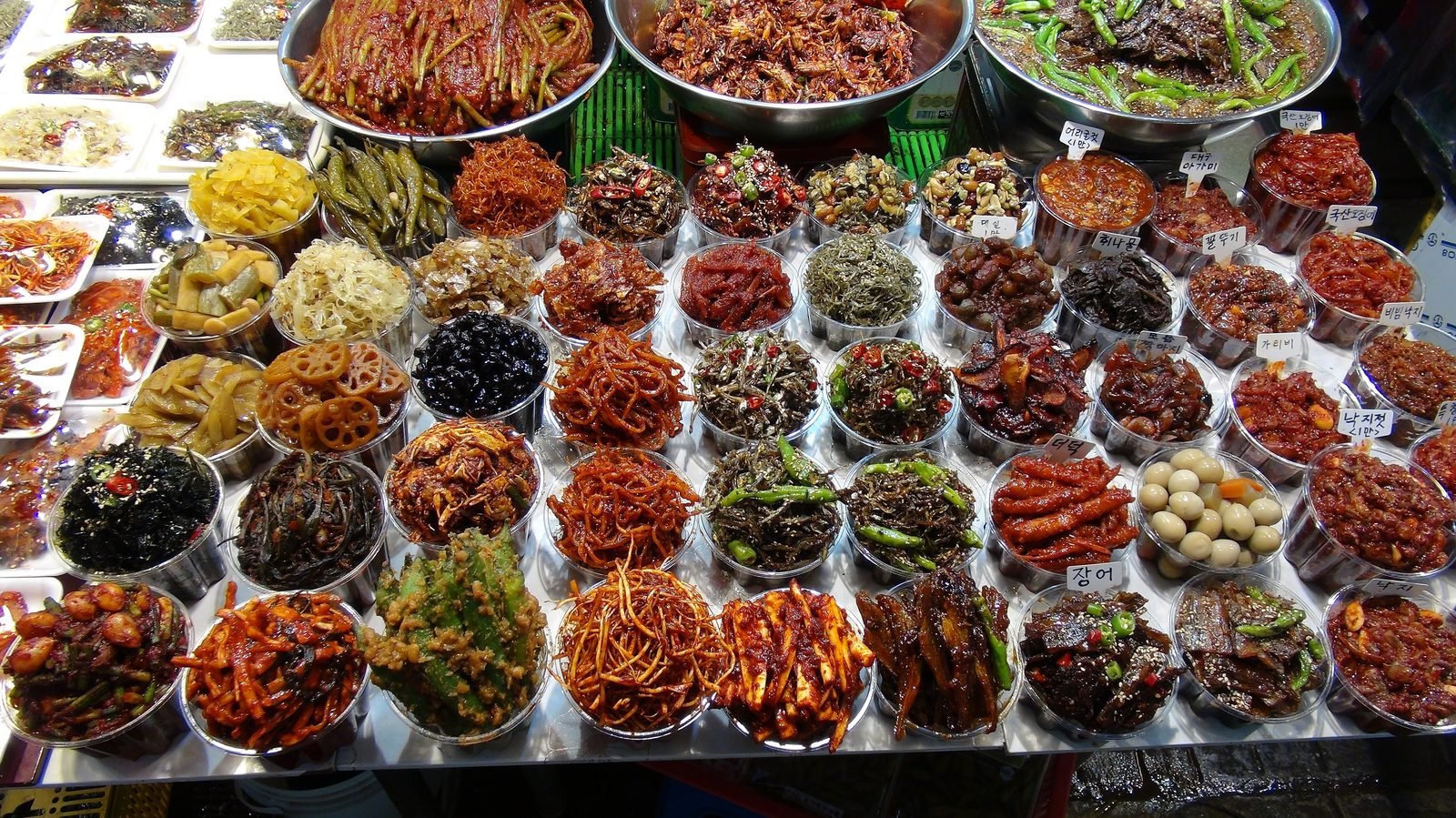
The same KTO page says tipping is not required or expected, and that asking for more water or side dishes costs nothing extra. It also notes a recent increase in restaurants where customers pour their own water and fetch their own side dishes. A sign reading 물은 셀프 (mul-eun self) means the water is self-service: look for a dispenser and cups somewhere in the dining room. The small dishes that arrive with the main order are banchan (반찬). A typical Korean meal table, according to the page, is a full setting of rice, soup, side dishes and stew, with kimchi among the side dishes, so a short menu does not mean a short meal.
Each table also tends to carry its own supplies. The KTO page mentions a small drawer attached to every table that holds spoons, chopsticks and napkins, and some tables have a charcoal grill built in. Check the drawer before asking staff for cutlery, and treat the grill as part of the table rather than a sign that the restaurant is only for groups. The page also mentions chairs with a storage space under the seat cover, meant to keep food odor off coats and to hold your belongings, so lift the cover before you drape a jacket over the back.

Order Machines and Table Tablets
The KTO page also reports a rising number of restaurants that use unmanned order machines. The screens vary by chain, which is why a fixed set of button names would mislead, so what follows is a common pattern rather than a fixed rule.
A typical kiosk sequence
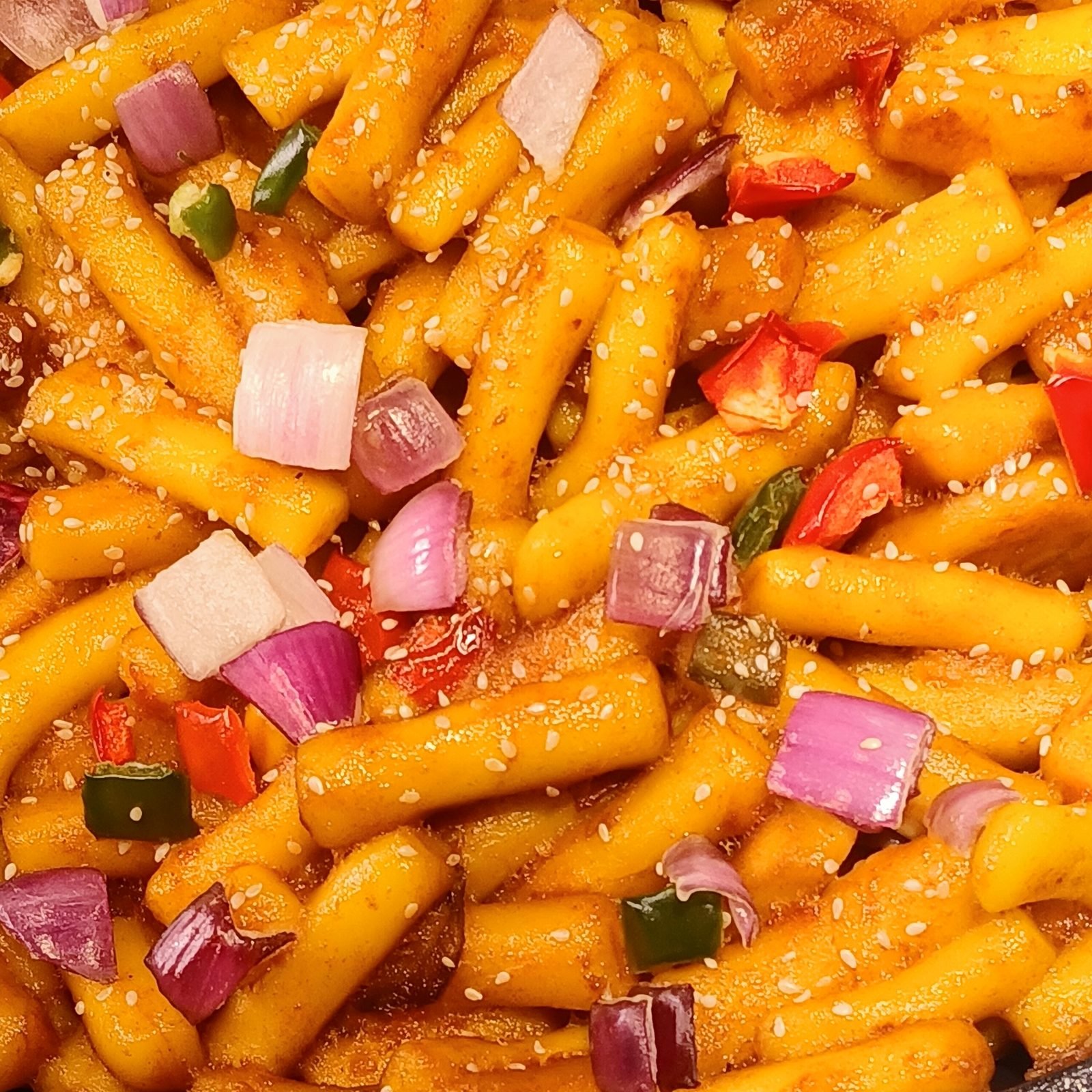
Choose a language if the screen offers one, then eat-in or takeaway, then tap the items and any options such as size or temperature. Pay at the machine, and wait for the number on your receipt to appear on the pickup screen. If a step is unclear, a staff member nearby is the fallback, and the helpline in the next section covers anything bigger.
Tablets at the table
Some restaurants put an ordering tablet on the table instead of a kiosk on the wall. The logic is the same as at a kiosk: pick items on the screen, review the list and send it. The call bell and the server remain the fallback when the screen is in Korean only, and pointing at a menu line works in either case.
Six Phrases and One Phone Number
Pronunciation matters less than pointing, and these six phrases handle almost every table situation:
- 저기요 (jeogiyo): excuse me, to call staff over.
- 이거 주세요 (igeo juseyo): this one, please, said while pointing at the menu.
- 물 좀 주세요 (mul jom juseyo): some water, please.
- 계산할게요 (gyesan halgeyo): I will pay.
- 포장해 주세요 (pojang haejuseyo): takeaway, please.
- 잘 먹겠습니다 (jal meokgesseumnida): said before eating, roughly “I will eat well”.
Visit Seoul’s etiquette page adds two more worth having: 얼마예요 (eolmayeyo), “how much is it”, and 감사합니다 (gamsahamnida), “thank you”. Its advice on pronunciation is to enunciate a little more tightly and softly than in English, and to stay formal at first whatever the setting, which in a restaurant means the polite endings above rather than anything casual. For anything the phrases do not cover, the 1330 Korea Travel Helpline is a telephone and real-time chat service run by the Korea Tourism Organization, with tourist interpretation described on its help page. Dial 1330 inside Korea or +82-2-1330 from abroad, or chat through 1330 Messenger, KakaoTalk, Facebook, Line or WhatsApp; the page says the online voice call is free over Wi-Fi, and the KTO food page lists the hotline’s languages as Korean, English, Japanese, Chinese, Russian, Vietnamese, Thai and Malay.
Manners That Change How a Meal Goes
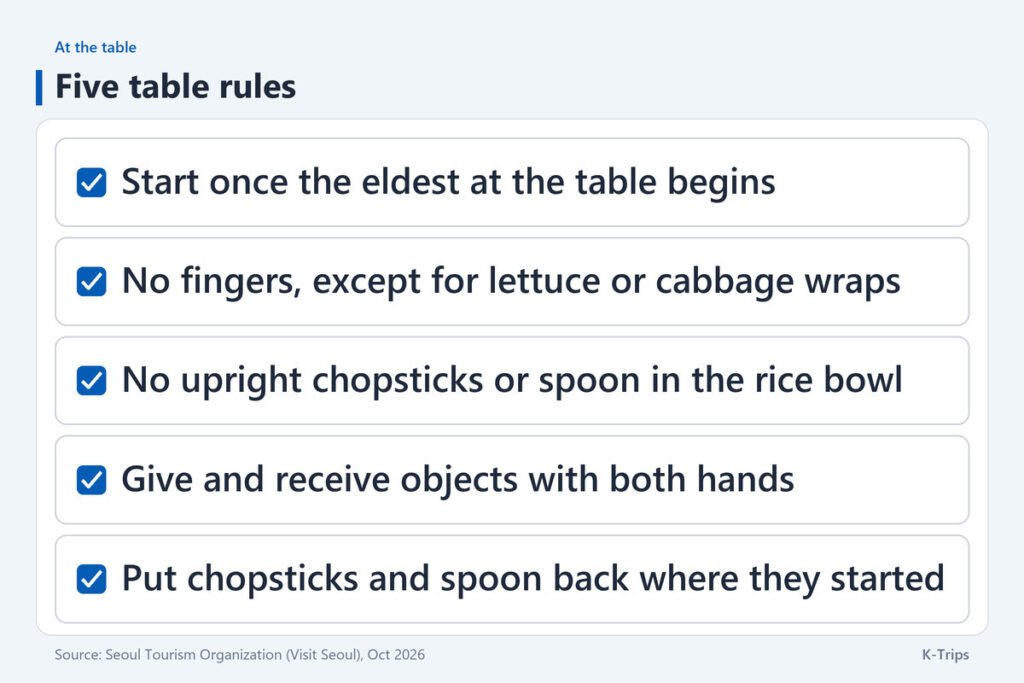
Visit Seoul’s etiquette page gives four dining rules. Start eating once the eldest person at the table has begun. Avoid touching food with your fingers, except when wrapping it in lettuce or cabbage. Do not leave chopsticks or a spoon sticking up from a bowl of rice, and use the spoon for rice. Outside the table, the page adds taking shoes off at the door of a residence, temple or guesthouse and greeting people with a short bow. At the end of the meal, put the chopsticks and spoon back where they started. The page also says to give and receive objects with both hands, and that most Koreans understand that a foreigner’s small slip is not disrespect.
The page also asks visitors to refrain from pointing during conversation. That is about gesturing at people; indicating a line on a menu is a different act, and if it still feels abrupt, say the item’s name or rest a finger beside the line instead. The slip-tolerance point is the useful one. None of these rules is enforced at the door, and a table of visitors who follow two of the four will not be remarked on. Shoes-off rules are a separate matter and come up in other places, such as the changing rooms covered in the guide to jjimjilbang and bathhouse rules.
Paying, Tipping and Allergies
Where the bill is settled differs from one restaurant to the next, at the table or at a counter, so watch what other diners do or simply say gyesan halgeyo and follow the staff’s lead. Visit Seoul’s page on money says tipping is not a Korean custom and is not expected by service staff, and its etiquette page adds that some people accept a tip while others refuse. The same page says many major hotels and upscale restaurants add a 10 percent service charge on top of 10 percent VAT, so the bill at those places can exceed the menu total. For a market meal the rule is simpler, because the price on the board is the price; market eating at Gwangjang shows how that works with a stall counter and a queue.
What an allergen label covers
The Ministry of Food and Drug Safety’s labeling page lists the ingredients that must be flagged on packaged food, among them eggs, milk, buckwheat, peanuts, soybeans, wheat, mackerel, crab, shrimp, pork, peaches, tomatoes, walnuts, squid and shellfish. That list is a packaged-food rule, so a restaurant menu is not guaranteed to flag the same ingredients. If you have an allergy, tell staff in writing: 땅콩 (peanut), 우유 (milk), 밀 (wheat) and 새우 (shrimp) are four words worth saving on a phone, and the ministry’s page explains the packaged-food side.

Bell, Machine or Tablet, Side by Side
Almost every restaurant uses one of these setups, so the rules above reduce to a short comparison.
| Setup | How you start | How you pay | What to keep in mind |
|---|---|---|---|
| Table with a call bell | Press the button | At the table or a counter, varies | The bell can be loud, and refills are free |
| Table without a bell | Catch eyes, say jeogiyo | The same, ask with gyesan halgeyo | Staff will help with questions |
| Order machine | Choose on screen | At the machine, up front | Wait for your receipt number |
| Table tablet | Order from your seat | Settled at the end, varies | The bell or a server is the fallback |
The setups mix freely, and a single restaurant may use a machine for the order and a bell for everything after it. If only one habit is worth learning before the first meal, make it the bell, or jeogiyo where there is none: it turns waiting to be noticed into a decision you control, and every later step from refills to the bill starts the same way.