
Sitting down at the first bench you see and ordering one big dish is the easiest way to waste a visit to Gwangjang. The stalls look like small restaurants, but the market runs the other way round: a pancake at one counter, a plate of gimbap at the next, a short walk in between. Visit Seoul’s market listing introduces the food as a run of small snacks rather than a menu of mains, and the stalls still work that way. Plan around that, then add three hard facts about hours and exits, and most of the wasted afternoon disappears.

Small Plates Beat One Big Order
A Gwangjang stall is built for a short stay. The same listing runs through the snacks, starting with the “addictive” gimbap and the mung bean pancake, then tteok-bokki and fish cake, and it says most dishes are reasonably priced. Nothing on that list is a dish to build an evening around. The practical reading is that one dish per stall is the unit, and a table of two or three should plan for four or five small orders in sequence rather than one large one. A workable order for three people is one pancake to share while you wait for the next counter, one plate of gimbap carried to a bench, and a third round chosen only after you have seen what the other counters are serving. The aim is to leave room, not to tick off a list.
That also removes the usual problem of choosing. If the first pancake does not suit you, you have spent one small order, not a meal, and the next stall is a few steps away. Taking the first free bench is fine. Committing to a second round there before you have seen the rest of the lane is how the afternoon goes wrong.
Visit Seoul calls the dishes reasonably priced without giving figures, so look at the sign, or ask, before you order. For the mechanics of pointing, paying and sharing a table, the sit-down version of the same skills is covered in a separate piece, and where a sign is written only in hangul, learning to read a Korean menu board takes a few minutes and covers the dish-name words that repeat from stall to stall.
The Dishes the Official Pages Keep Naming
The FAQ on Visit Seoul’s market page names six favourites: bindae-tteok, modum-jeon (assorted savoury pancakes), mayak gimbap, sundae and head meat, yukhoe, and Korean-style meatballs. Four groups of them cover most visits.
Bindaetteok, the heaped pancake
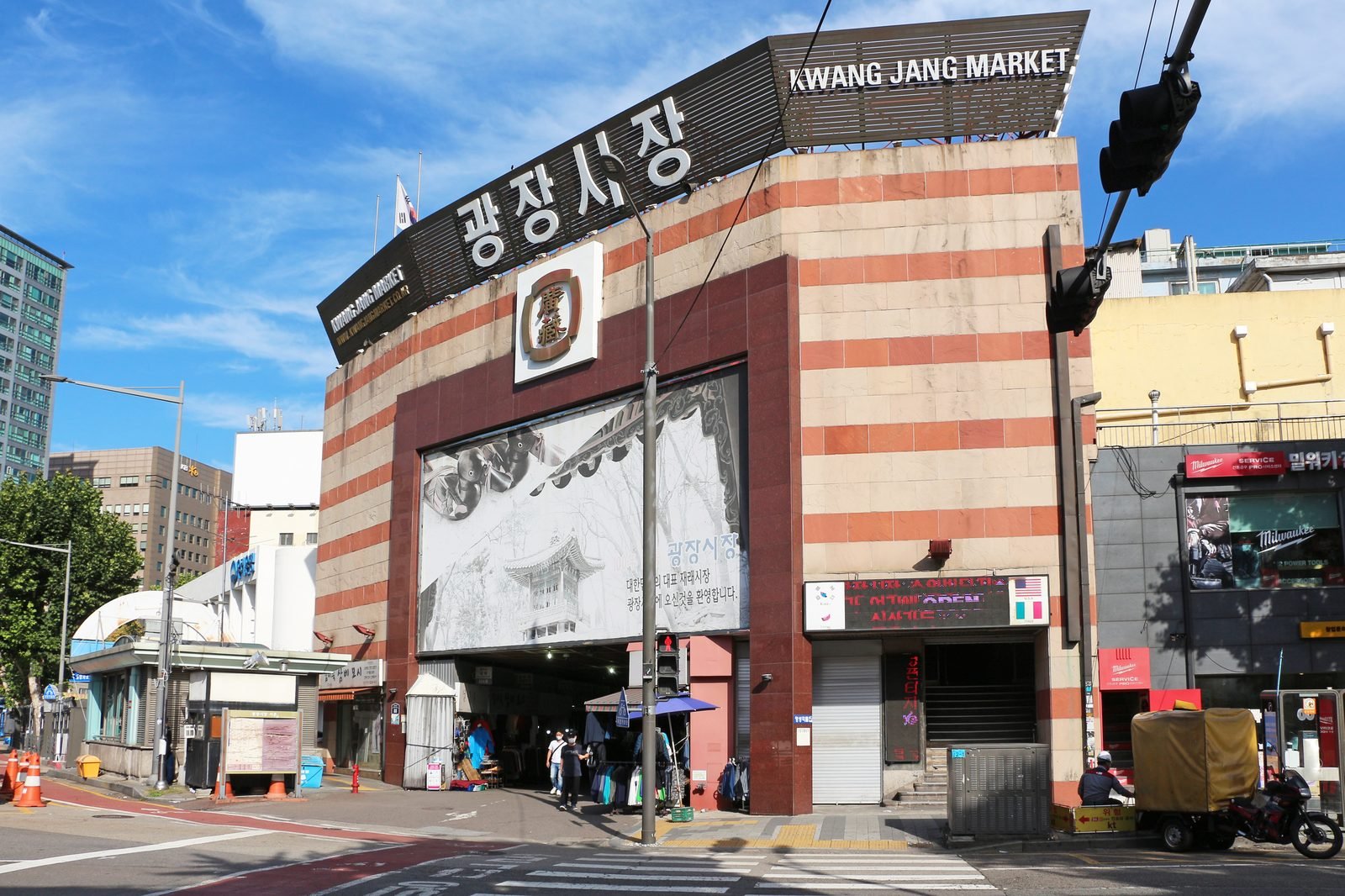
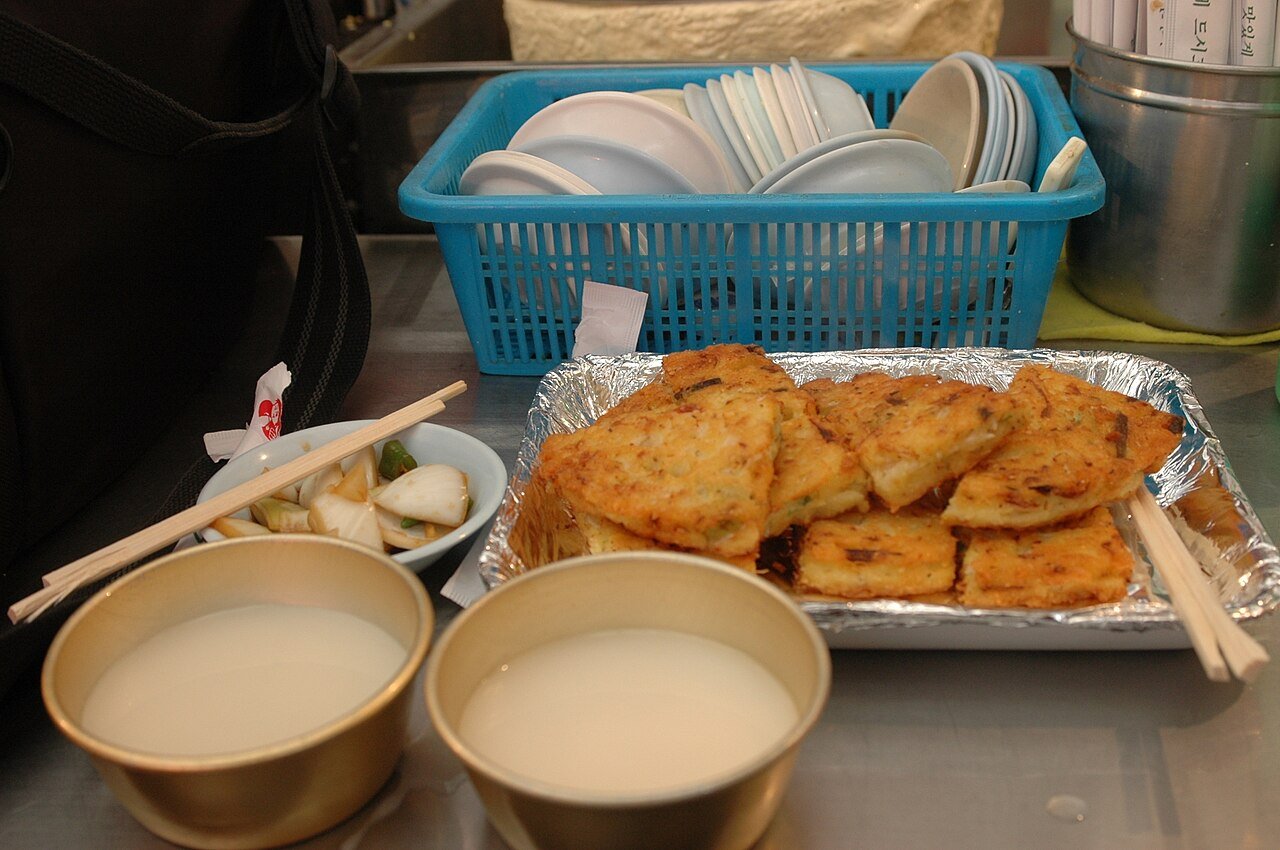
Bindaetteok is the mung bean pancake. A VisitKorea tour page calls it the most popular dish at Gwangjang and points to the pancakes heaped up like a mountain at the stalls, while Visit Seoul’s Dongdaemun feature calls it perhaps the most famous jeon in the market. Modum-jeon, the assortment of pan-fried pieces, comes off the same griddles, so the pancake counter is a natural first stop and a fair place to try the assortment too. Eat it hot. A pancake that has sat on the counter is a flatter, different thing.

Mayak gimbap, the plain roll with the big name
Mayak gimbap is the plain-looking roll, and the name is a joke worth knowing. Visit Seoul says “mayak,” which means drugs in Korean, was added to the name because the gimbap tasted so good, and its Dongdaemun feature adds that a first plate may look disappointing in its simplicity until the first bite. The name describes how fast a plate disappears and says nothing about what is in it. Plain is the useful part: one plate can be shared three ways without anyone losing their appetite for the next stall. Visit Seoul’s list of nearby places includes a stall called Mother and Daughter’s Gimbap, whose blurb claims the original mayak gimbap. Treat “original” as that stall’s own description, not an official ranking.
Yukhoe, raw beef
Yukhoe is the Korean version of beef tartare, as VisitKorea’s Seoul tour page puts it, which means the beef is served raw. It is one of the market’s famous dishes and it suits a traveller who already eats raw meat. It is a poor first experiment for someone trying raw beef only because a market is known for it. If raw beef is not for you, the pancakes, the gimbap and the rice cakes fill an afternoon without it, and nobody at the neighbouring bench will notice what you skipped.
Tteokbokki, eomuk and sundae
Visit Seoul also lists tteok-bokki, the stir-fried rice cake, and eomuk, the fish cake, among the market’s traditional treats, and puts sundae, the Korean sausage, and head meat among the favourites. These are the low-commitment orders: a small portion of any of them rounds out a plate without starting a new meal. Sundae and head meat are the two to ask about before ordering.
When Gwangjang Stopped Being a Pop-Up
Visit Seoul’s Dongdaemun feature dates the origins of Dongdaemun Market to 1905 at Gwangjang, and explains why that date matters. According to that feature, Korean markets until the late 1800s worked like pop-ups that opened for a few days at a time, and in 1905 Gwangjang became the first permanently established market open every day. It is the tourism body’s own account, so treat the year as Visit Seoul’s dating rather than a figure from the market.
That history explains the layout better than any food description does. The food lane is what visitors come for, but Gwangjang is first a market for fabric, bedding and clothing. Visit Seoul sends anyone interested in clothes to the hanbok shops and vintage stores on the second floor, and the market keeps a second-hand clothing arcade as a separate section with its own hours.
The market also has screen fame. VisitKorea’s tour page notes that a noodle soup stall inside the market featured in the Netflix series Street Food, and adds that most vendors here have more than 20 years of experience. Read that as a reason to expect a queue at the best-known counters. Neither Visit Seoul nor VisitKorea ranks one stall above another.
Hours That Differ Section by Section
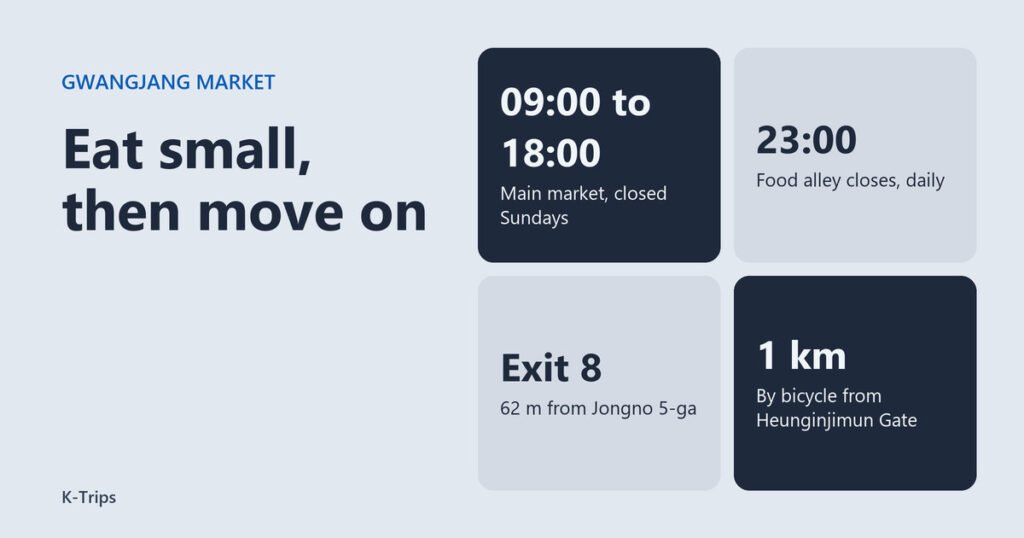
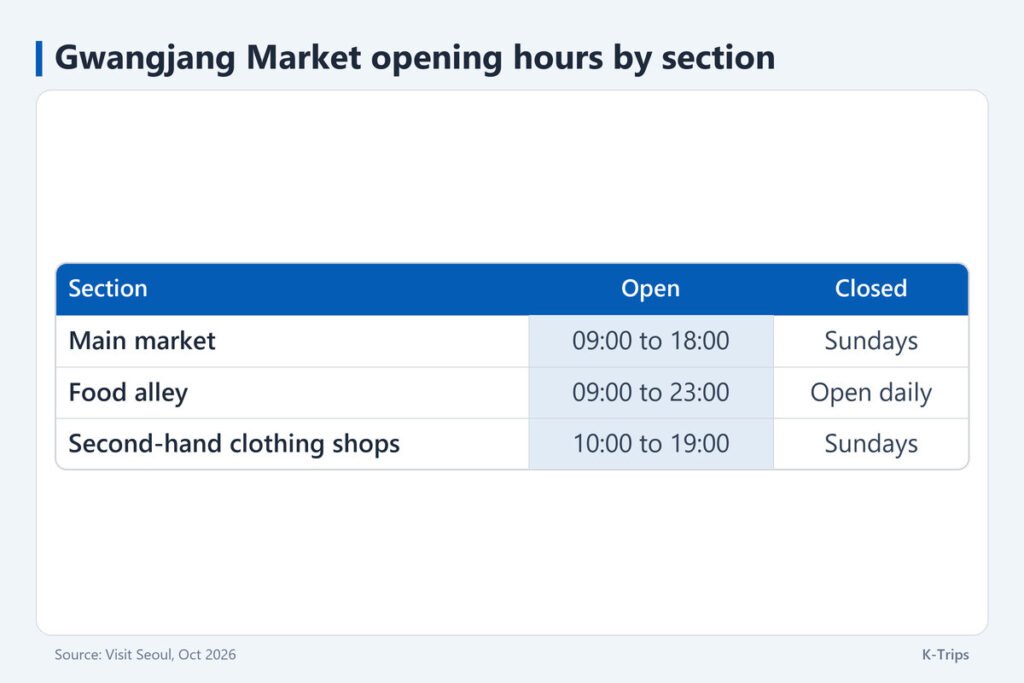
The market does not keep one set of hours but three. According to Visit Seoul, the main market runs from 09:00 to 18:00 and is closed on Sundays. The food alley runs every day from 09:00 to 23:00. The second-hand clothing shopping street opens from 10:00 to 19:00 and is also closed on Sundays. The market’s own 2017 hours notice gives the same three: the market from nine to six with Sunday closed, the second-hand arcade from ten to seven, closed Sundays but open on public holidays, and the food alley open until 23:00 all year.
The sources do not all agree. VisitKorea’s tour page lists 09:00 to 18:00 on weekdays and 09:00 to 17:00 on weekends, which matches neither of the sources above. Visit Seoul and the market’s notice both state the Sunday closing and the food alley hours explicitly, so those two are followed here, and the weekend line is a reason to check the market’s current notice before a Saturday visit.
Exit 8, Exit 3 and the Ride from the Gate
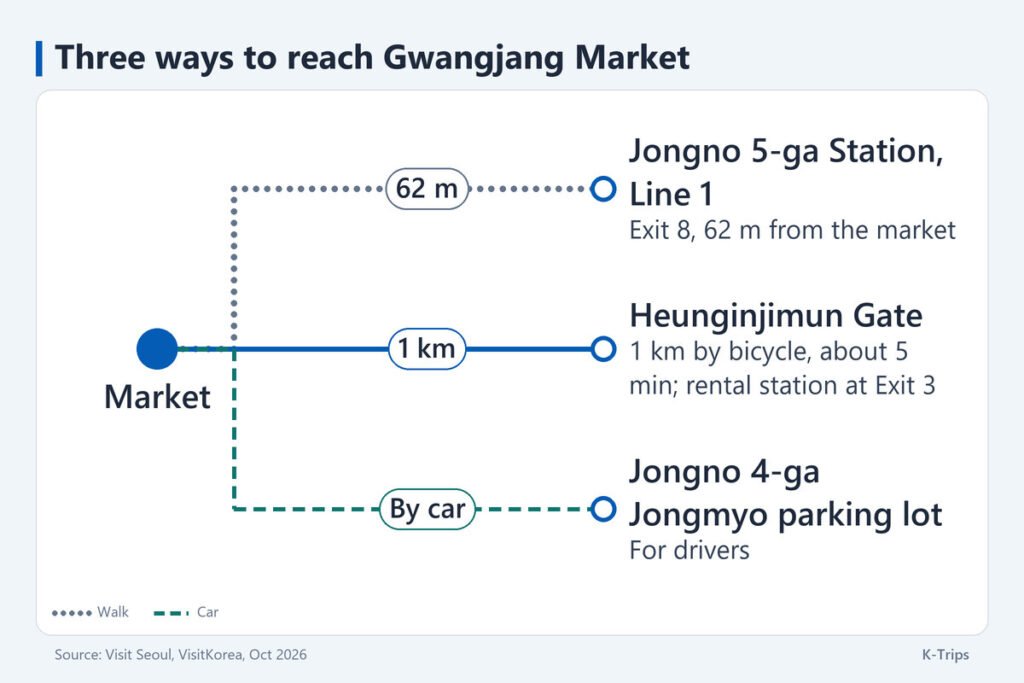
Visit Seoul gives the entrance as Line 1’s Jongno 5-ga Station, Exit 8, 62 metres from the market, at 88 Changgyeonggung-ro in Jongno-gu. At 62 metres the walk is short enough that Exit 8 is the whole route, and the address is all a taxi driver or a map app needs.
Two other ways in are named by the tourism pages. VisitKorea’s Seoul tour route cycles from Heunginjimun Gate, the Dongdaemun gate, to the market, a distance of 1 km that it times at about 5 minutes, and it puts a bicycle rental station at Exit 3 of Jongno 5-ga Station. For drivers, Visit Seoul’s listing points to the Jongno 4-ga Jongmyo parking lot. Parking beside a lane market is a clumsy plan for a food visit, so the station exit is the default and the other two are for people already in the neighbourhood.
Around the market, Visit Seoul lists Sewoon Shopping Center, Jongmyo Shrine and the Dongdaemun Design Plaza as nearby attractions. Of the three, the plaza is the one that fits a half day with lunch at the market, since it is an indoor, architecture-led stop that does not depend on the weather the way a shrine walk does.
Sundays, After Seven and the Midday Window
Because the sections close at different times, the hour you choose decides what the market is. The table sets out what the listed hours leave open at each point.
| When | What is open |
|---|---|
| Monday to Saturday, 09:00 to 10:00 | The main market and the food alley. The second-hand clothing shops have not yet opened. |
| Monday to Saturday, 10:00 to 18:00 | All three sections: the main market, the food alley and the second-hand clothing shops. |
| Monday to Saturday, 18:00 to 19:00 | The food alley and the second-hand clothing shops. The main market has closed. |
| Monday to Saturday, 19:00 to 23:00 | Only the food alley is listed as open. |
| Sunday | The main market and the second-hand clothing shops are closed. The food alley is listed as open every day. |
The choice follows from what you came for. After seven the question is the food alley or nothing, and on a Sunday the food alley is the only section the sources list as open, so fabric and vintage clothes are a weekday errand. The one stretch when all three sections trade together is Monday to Saturday between 10:00 and 18:00, and on a Saturday the sources differ on the close, as the hours section above explains, so check the market’s notice before you plan around 17:00 or 18:00.