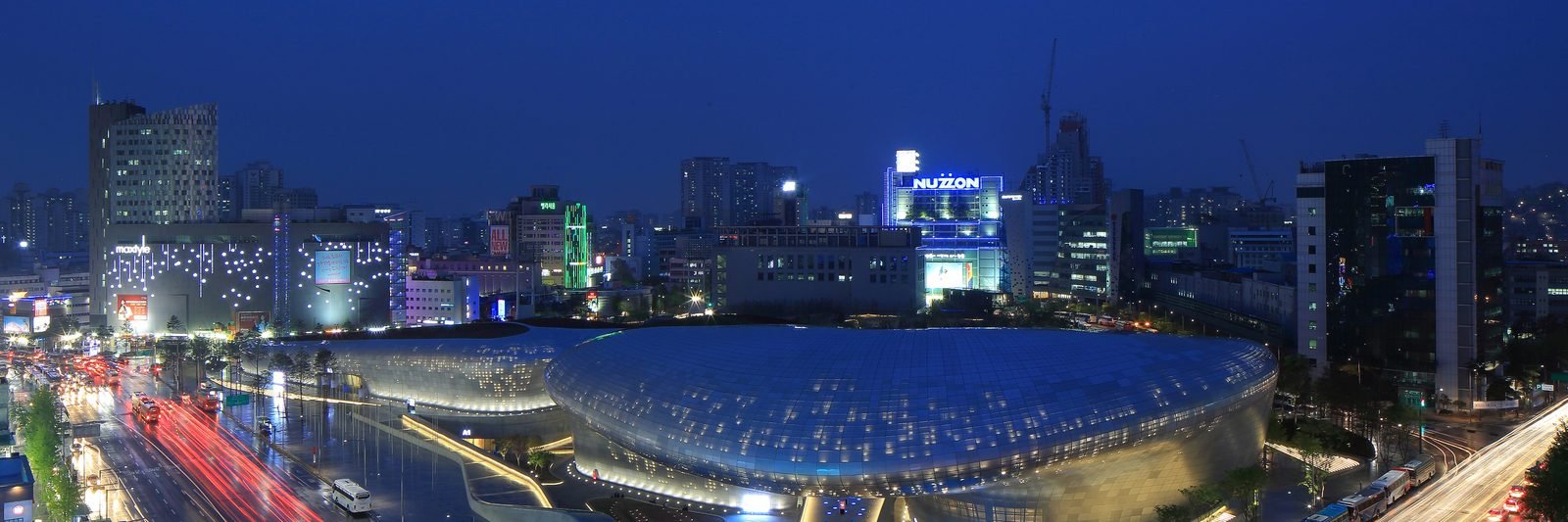
Dongdaemun Design Plaza is often described as a museum, but it is a complex of buildings and open spaces rather than one museum. VisitKorea divides the complex into Allimteo, Beaumteo, Sallimteo, the DDP Design Museum, Design Market and Eoullim Plaza, and Dongdaemun History and Culture Park, and the Seoul Metropolitan Government counts five buildings with 15 distinct spaces.
That structure explains why the plaza is hard to read from a photograph and easy to use once its parts are known. The curved silver building is the part everyone sees. The schedule, the exits and the closing days belong to the spaces inside it.
),_Seoul,_South_Korea_(Unsplash_aNSniQXO424).jpg)
A Stadium Site Turned Into a Landmark
The Seoul government’s account of the site begins with Gyeongseong Stadium, built during the colonial period and renamed Seoul Stadium after liberation. When Jamsil Stadium was built for the 1988 Olympics, the older ground became Dongdaemun Stadium. The city describes it as the largest of its kind in the Far East at the time, and the venue for Asian Games events and national sports festivals.
Its decline is part of the record too. As the stadium wore out, visitors stopped coming, and it ended up as a parking lot and a venue for small flea markets. Visit Seoul says the plaza was planned by city hall in 2006, and its listing for a nearby memorial notes that the stadium was demolished in 2007. The city page says five years of construction followed, and the plaza was unveiled on 21 March 2014.
The city page, dated February 2016, puts numbers on the first eighteen months: 12,650,000 visitors and 194 events, and a ministry survey that named the plaza the most visited public facility in Seoul in 2014. It also notes that The New York Times had listed it among its 52 Places to Go in 2015. Set beside the plaza’s own later total of 126 million, those early figures show how quickly the site became a fixture of the city.
The 45,133 Panels Behind the Curves
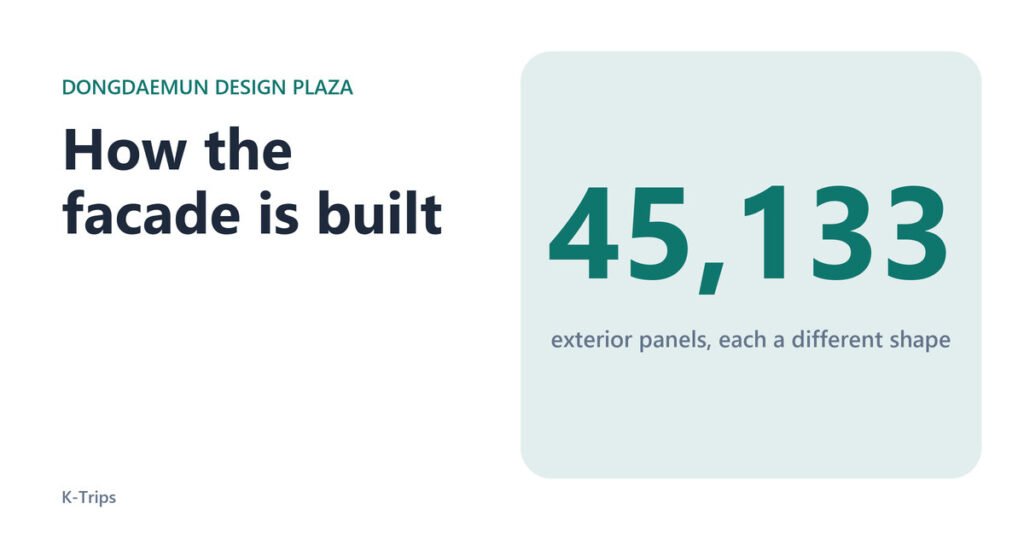
The plaza’s own overview credits the architect Zaha Hadid and gives a precise figure for the facade: 45,133 exterior panels, each a different shape, wrapped around a form the plaza calls the world’s largest three-dimensional irregular building. That is the plaza’s description of itself, and it is best read as a statement about construction rather than a ranking.
The numbers matter because the curved surface is the reason the building is hard to photograph and harder to navigate. The city page admits as much: because of its unusual layout, it says, first-time visitors sometimes find it difficult to locate an event venue inside. The same page says that layout is why the plaza has served as a filming location for more than 150 domestic and foreign productions.
Fashion Weeks, Festivals and Past Exhibitions
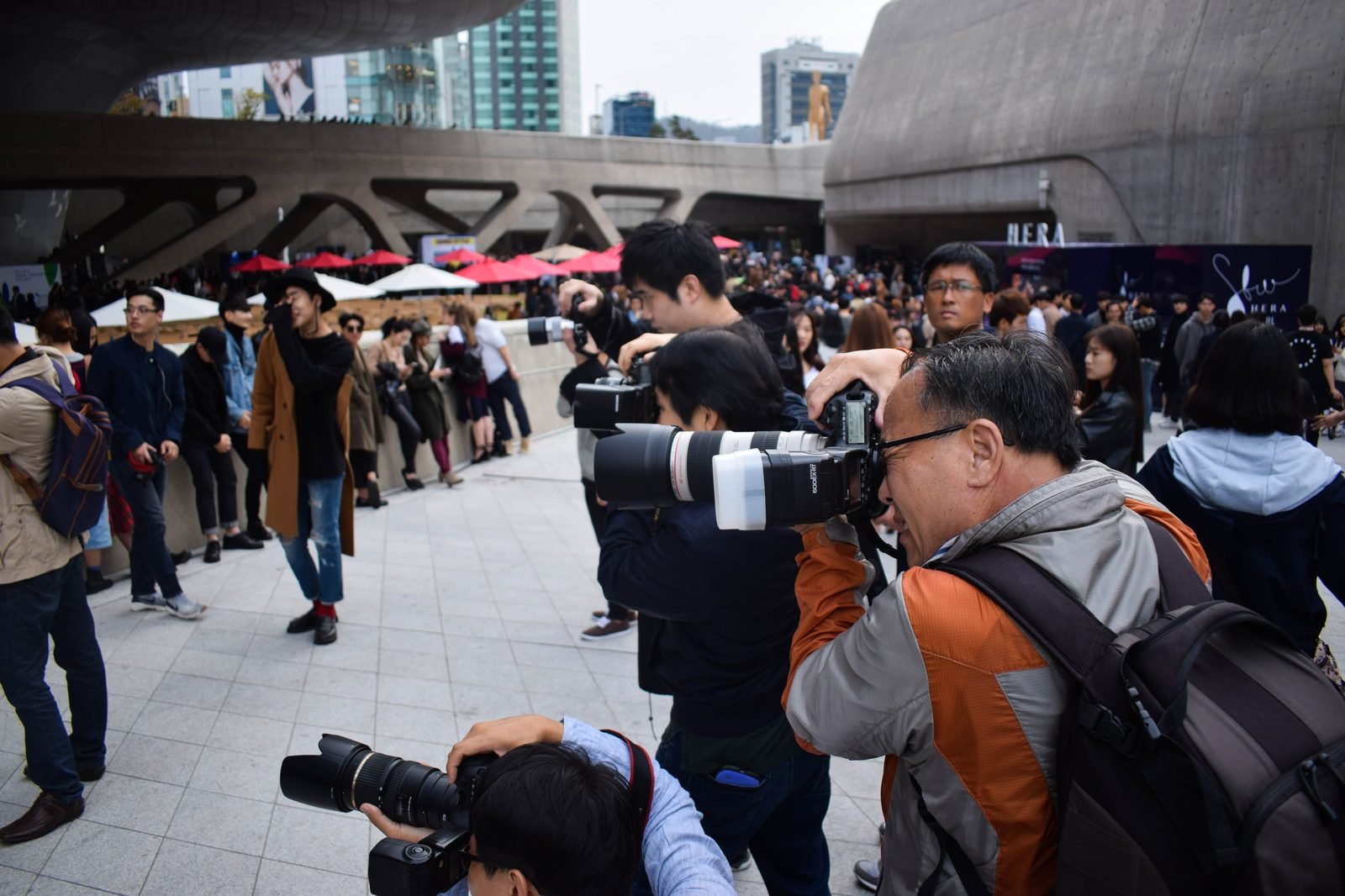
VisitKorea reads the name as Dream, Design and Play, and lists exhibitions, fashion shows, forums and conferences among the events held there. The city page names the signature events: the Dongdaemun Festival, Seoul Fashion Week, held every spring and fall, and Seoul Design Week. It also mentions exhibitions of fashion houses and artists, and product launches by global brands.
The city page ties the events to the neighborhood around the plaza. It says the Dongdaemun Festival was begun in 2014 to revitalize deteriorated parts of Dongdaemun, that Seoul Fashion Week has raised the value of local fashion brands by drawing buyers and industry visitors, and that Seoul Design Week is aiming to rank among Asia’s prominent design weeks alongside Tokyo and Beijing.
The same city page names examples from the early years: The Treasures of Kansong, an exhibition of artifacts from the Kansong Art Museum collection, fashion-house shows titled Culture Chanel and Esprit Dior, and exhibitions on Audrey Hepburn, Henri Cartier-Bresson and Andy Warhol. It adds product launches by Omega, Rolls-Royce and Hyundai. Those are records of what the plaza has hosted, not a current program, which is why the plaza’s own site is the place to check what is on.
Visit Seoul’s answer to who may enter is short: the plaza is a cultural complex open to all citizens, designers and students and ordinary visitors alike. The plaza’s overview reports a cumulative 126 million visitors since the March 2014 opening, a figure the plaza itself supplies without a date. Treat it as a scale marker rather than a statistic.
Hours, Exit 1 and the Holiday Closures
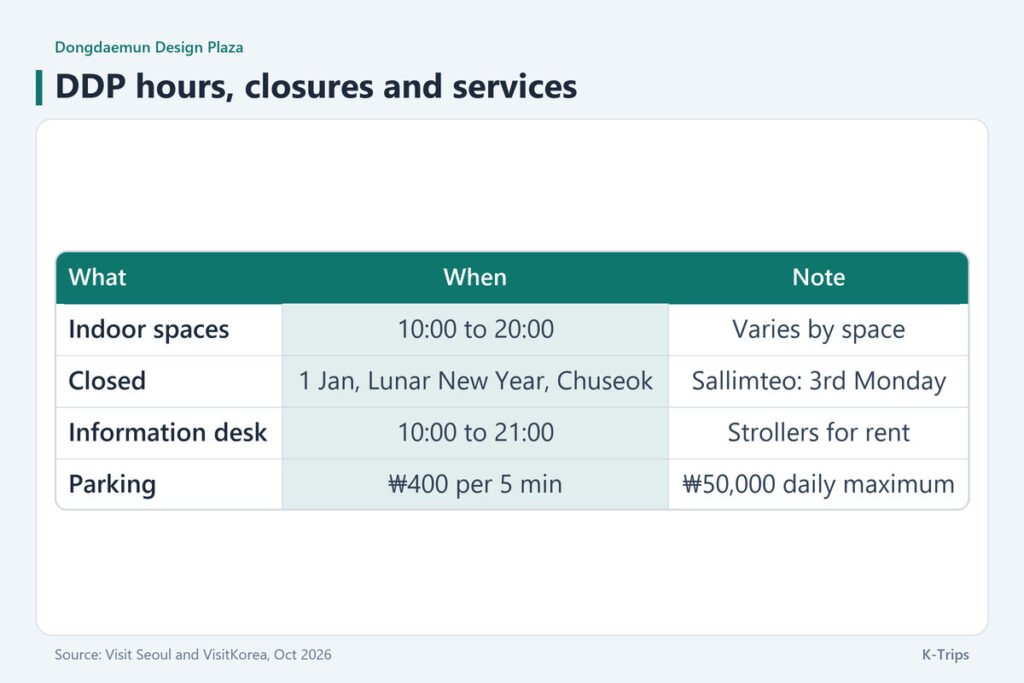
Visit Seoul lists the opening hours as 10:00 to 20:00, varying by space. VisitKorea gives the same range and adds that some spaces operate flexibly depending on the program. Both pages list closures on 1 January, Lunar New Year’s Day and Chuseok, and VisitKorea notes that Sallimteo closes on the third Monday of every month.
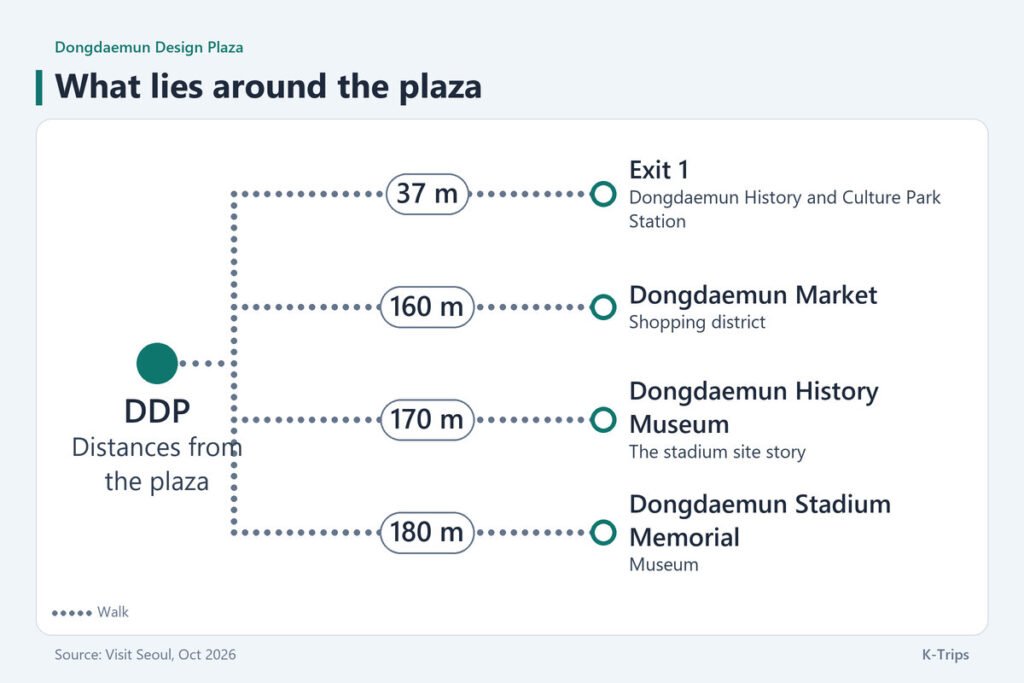
The plaza’s overview says it connects directly to Dongdaemun History and Culture Park Station. Visit Seoul lists the station on Lines 2, 4 and 5 and puts Exit 1 at 37 meters from the plaza, which is close enough that the station and the plaza count as one stop.
Lockers, strollers and parking
Visit Seoul says paid lockers are near Subway Exit 1, on the first floor of the Design Lab and inside the Art Hall, and adds that locations may change. Strollers can be rented at the General Information Desk, which keeps 10:00 to 21:00 hours; for children aged 6 months to under 36 months, rental is free from 10:00 to 17:30 with an identification, returned by 18:00. Parking costs ₩400 per five minutes, or ₩4,800 an hour, with a daily maximum of ₩50,000.
For visitors who need step-free access, Visit Seoul’s listing marks accessible restrooms, parking, pathways, elevators and wheelchair rental services. It does not specify where each one is, so the information desk is the practical first stop.
What Sits Within 200 Meters
The same Visit Seoul listing ranks the neighbors by distance. Dongdaemun Market, a large commercial district of traditional markets and shopping centers around Dongdaemun Gate, is 160 meters away. The Dongdaemun History Museum, which retraces the history of the former stadium site, is 170 meters away, and the Dongdaemun Stadium Memorial, the museum that recalls the stadium’s history, is 180 meters away. The market is the one neighbor that sells things; the two museums are there to explain how the plaza’s site came to be, so they pair naturally with the stadium story told earlier on this page.
Gwangjang Market is the other obvious pairing. Visit Seoul’s page for the market lists the plaza among its nearby attractions, and the Gwangjang Market food guide covers what to eat on that side. A visit that wants architecture alongside a museum might also look at Leeum, the museum three architects built together.
Daytime, After Dark and the Seasonal Programs
| Time | What the sources say |
|---|---|
| Daytime | Indoor spaces open from 10:00 and most close by 20:00, with hours varying by space; the plaza describes itself as an open square for residents and visitors by day |
| After dark | Seoul Light DDP turns the exterior into a media-art canvas, according to the plaza; Visit Seoul calls Seoul Light a seasonal event, so the program needs checking |
| Spring and fall | The city page says Seoul Fashion Week is held every spring and fall |
| Closed days | 1 January, Lunar New Year’s Day and Chuseok; Sallimteo on the third Monday of each month |
Visit Seoul calls Seoul Light a seasonal event, while the plaza’s overview describes the night canvas without giving dates, so neither source promises the lighting on every evening. Anyone planning around it should look at the plaza’s program page for the week of the visit, and should not count on the exterior lighting on a given evening until that page confirms it.