

Seventeen hours is the length of a trading day at Jagalchi Market. Visit Busan lists it open daily from 05:00 to 22:00, and the Korea Tourism Organization gives the same hours. A market known for its mornings is therefore also open for dinner, and the question of when to go has more than one honest answer.

Address, Exits and the Tuesday Question
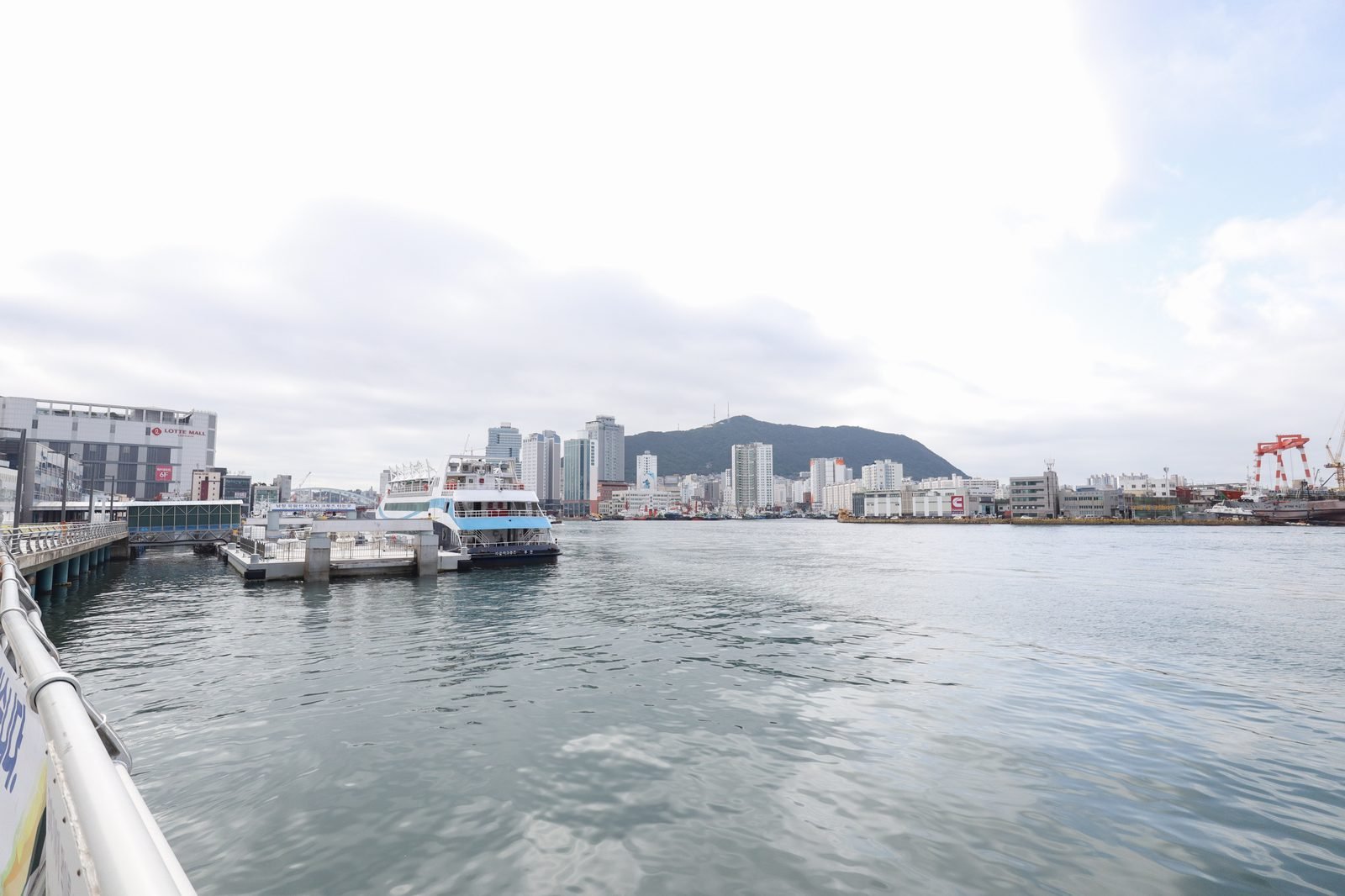
The address is 52 Jagalchihaean-ro, Jung-gu, in Busan’s old harbor district. From Busan Metro Line 1, Visit Busan lists a 6-minute walk from Exit 2 of Nampo Station or from Exit 10 of Jagalchi Station. Buses 27, 41, 5-1 and 61 stop at Jagalchi Market, among other routes.
The closing day is where the two official sources part ways. The Korea Tourism Organization gives the first and third Tuesdays of the month. Visit Busan, the city’s own tourism body, gives the first, third and fifth Tuesdays. The dates used below are Visit Busan’s, which means that a month with a fifth Tuesday adds a closed day, the safer reading for anyone planning around a single Tuesday morning.
Practical details are modest but useful. Parking is available, and the market lists an accessible parking lot, an elevator and an accessible bathroom. The inquiry lines are +82-51-245-2594 and +82-51-713-8000. For a visitor with luggage or limited mobility, those three facilities decide whether the indoor hall is a realistic stop.
Pebbles, Refugees and a Market Built Stall by Stall
The name comes from the ground. Visit Busan says Jagalchi originates from the physical form of the area, which had many big pebbles, called jagal, on the seashore. Fish street stalls appeared there from the Japanese occupation, and the Korean War brought refugees to Busan and shanty houses to the area around the shore. The stalls multiplied until they formed the large fish market that exists today.
The Korea Tourism Organization dates the market’s identity to the years after the Korean War and notes that most of the people selling fish are women, known as the Jagalchi ajumeoni, ajumeoni meaning a middle-aged or married woman. Even now, it says, visitors can see women selling mackerel and sea squirts on wooden boxes along the road and the shore.
Maintenance work in the 1970s, according to the city’s festival page, turned the market into the form it has today. The phrase that Visit Busan treats as the market’s motto is a three-part call: Oiso, come; Boiso, look; Saiso, buy. It also happens to describe the order of a visit: arrive, look, then buy.
Visit Busan also places Jagalchi in a wider frame. Together with the nearby Gukje Market and the Bupyeong Kkangtong Market, it names Jagalchi as one of Busan’s main traditional markets, and its festival page adds that the market became popular with foreign tourists partly because a Hollywood film was shot there. That context explains why the market feels used by both Busan residents and visitors at once.
Outdoor Alley Versus Indoor Hall
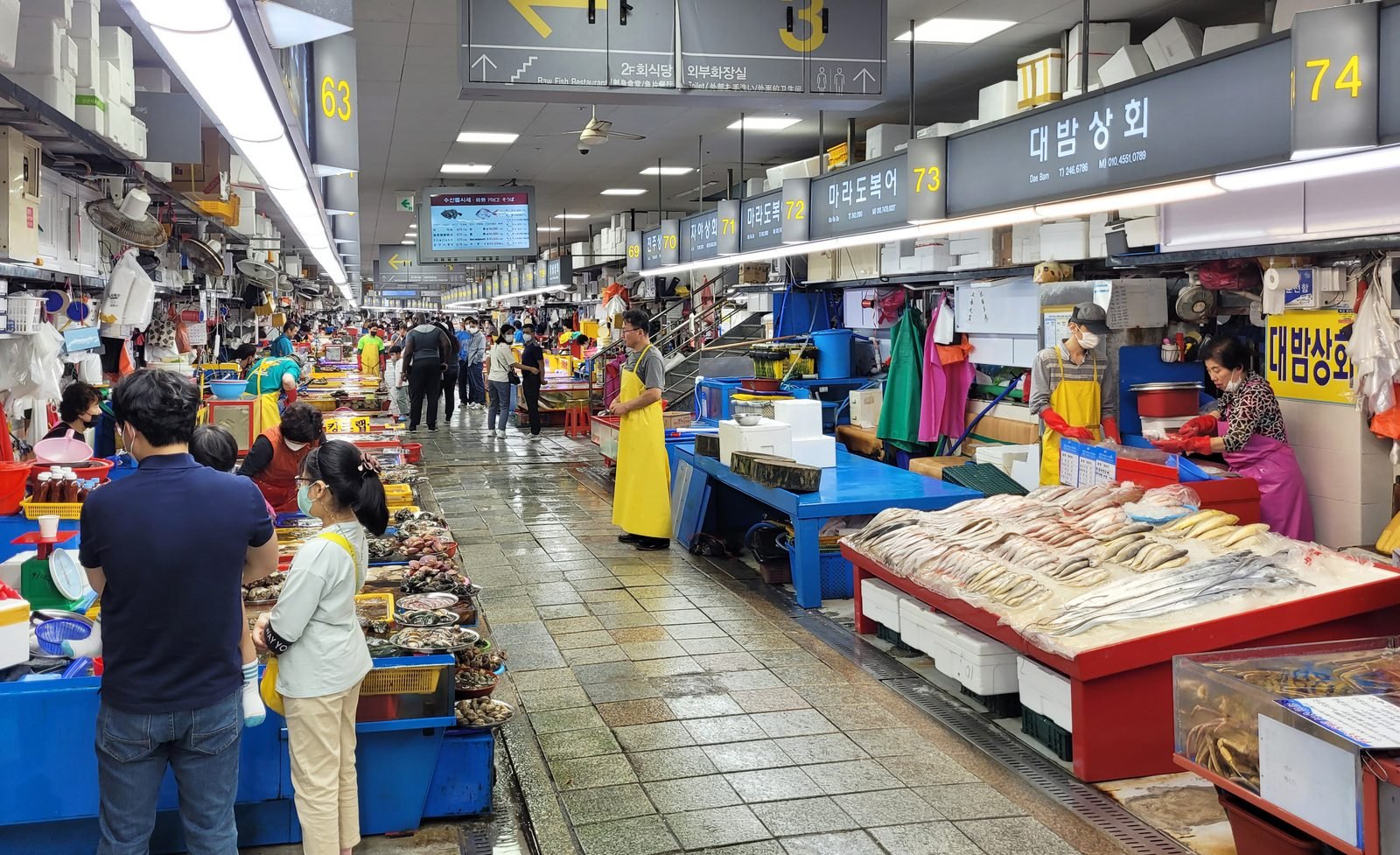
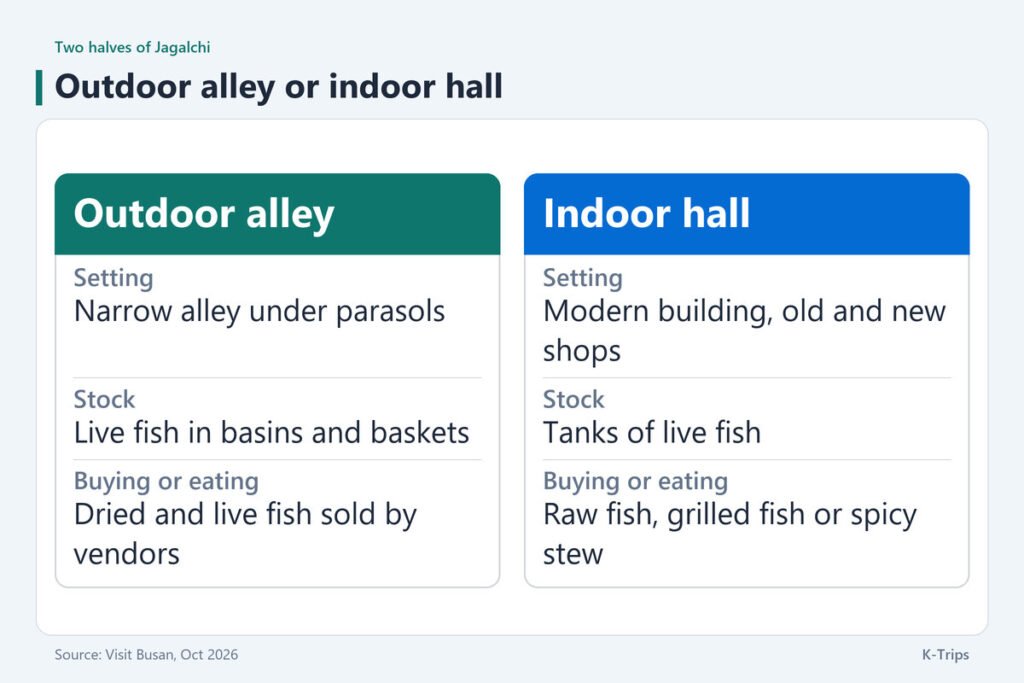
Visit Busan separates two Jagalchis. The first is the dynamic, outdoor market: cross the road in Nampo-dong toward the sea and narrow alleys open under colorful parasols, with live fish and seafood in basins and baskets, big octopuses among them, and sometimes lobsters, sharks, sunfish and large squid. The second is the neat, modern indoor market, which mixes newly opened shops with old ones and also offers tanks of live fish.

The two halves suit different visits. The alley is for watching and for buying dried or live fish from a stall. The hall is where a sit-down meal is possible, because the same listing says visitors can eat fresh sliced raw fish while looking out at the sea, or choose grilled fish and spicy stew. Visit Busan recommends the early morning for the market at full vitality, with busy merchants making the atmosphere livelier.
The Korea Tourism Organization lists the building’s amenities as a rest area, a tourist information center, an exhibition room, a terrace and a sky park. That is useful if the plan is a half-day: a morning at Gamcheon followed by lunch here, or the market first and the hillside afterward.
Choosing, Pricing and Eating
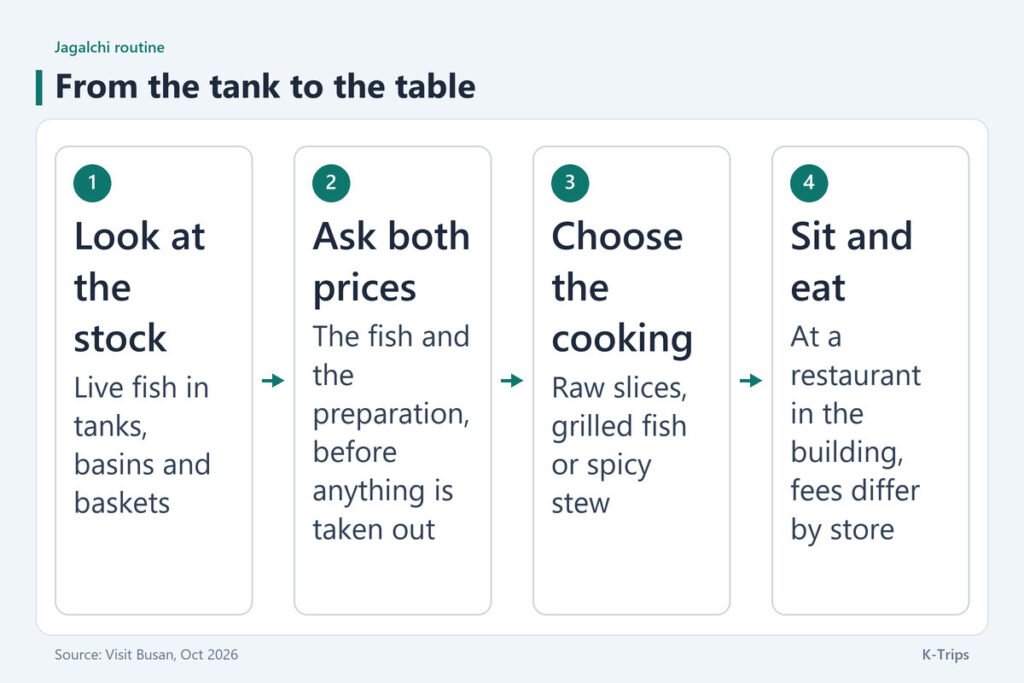
The usual routine is to look at the live stock, pick a fish, and have it prepared as raw slices, grilled fish or stew at a restaurant in the building. Visit Busan describes those three ways of eating the catch, and the Korea Tourism Organization lists fresh fish, dried fish and a raw-fish center among the specialties.
The one price fact in the official listings is that service fees differ by store. That leaves two numbers to ask for, the price of the fish and the cost of having it prepared and served, and both are worth hearing before anything is taken out of a tank.
A short loop works well for anyone doing this as part of a longer stay: the two-day Busan route places the market at lunch on the second day, after the hillside and before the evening.
The October Festival
The Busan Jagalchi Festival is held every October in front of the sea, for about four days at the market. Visit Busan says it offers fresh seafood from the market’s merchants and is organized in three madang, the outdoor programs named after the market’s motto. Oiso is for experience events, Boiso for performances and Saiso for food.
Two programs stand out in the description. One is the attempt to make the world’s largest raw fish bibimbap, which the festival tries to enlarge every year, with participants sharing the result. The other is an auction program with famous hosts at the market itself. Admission is listed as free. The listing shows dates for the previous edition only, so the current ones have to be confirmed on the festival page.
The festival’s other programs are lighter. Visit Busan describes the Jagalchi Eoroyo performance, during which the audience starts dancing along to a traditional merry tune, and a Jagalchi Hyo singing competition. The Saiso madang is where dishes made from Busan’s fresh seafood are served, and the festival runs on until night. For anyone who wants the market with a crowd rather than without one, October is the month the city organizes one.
If an evening show fits the same trip, the free drone display at Gwangalli Beach runs on Saturdays, which makes a festival Saturday a natural pairing.
Jagalchi Beside Noryangjin
| Jagalchi, Busan | Noryangjin, Seoul | |
|---|---|---|
| District | Jung-gu | Dongjak-gu |
| Listed hours | 05:00 to 22:00 daily | General fish 01:30 to 22:00; shellfish 01:00 to 22:00 (given under its auction schedule) |
| Closed | First, third and fifth Tuesdays | Open all year, per the tourism listing |
| What it is | Stalls and restaurants, outdoor alley plus indoor hall | Wholesale and retail; live fish auction from 1 a.m. to 3 a.m. |
| Price note | Fees differ by store | Retail prices run 10 to 20 percent above auction prices |
The comparison is of two different jobs. Seoul’s Noryangjin Fisheries Wholesale Market opened in 1927 beside Seoul Station and moved to its present district in 1971. VisitKorea calls it one of Korea’s largest seafood markets, says it trades 250 to 300 tons of fishery products a day, and puts the live fish auction between 1 a.m. and 3 a.m. Prices are set by quantity, and retail prices run 10 to 20 percent above the auction’s. Noryangjin’s building puts dried fish, raw fish restaurants and an auction spectators’ area on the second floor and a rooftop park on the fifth, and VisitKorea lists parking as free from 04:00 to 08:00. Jagalchi is built around the walk between stalls and the table. Choose Noryangjin for the trade floor and Jagalchi for the harbor setting. VisitKorea gives +82-2-2254-8000 for questions about Noryangjin.
Time of day settles the rest. VisitKorea’s Noryangjin listing names 1 a.m. to 3 a.m. as the liveliest hours, and Visit Busan recommends the early morning for Jagalchi too, though its trading day runs from 05:00 to 22:00. A traveler staying near the Nampo and Jagalchi stations can fit the Busan market into an ordinary day. A visitor to Seoul who wants the auction has to plan the night around it.