

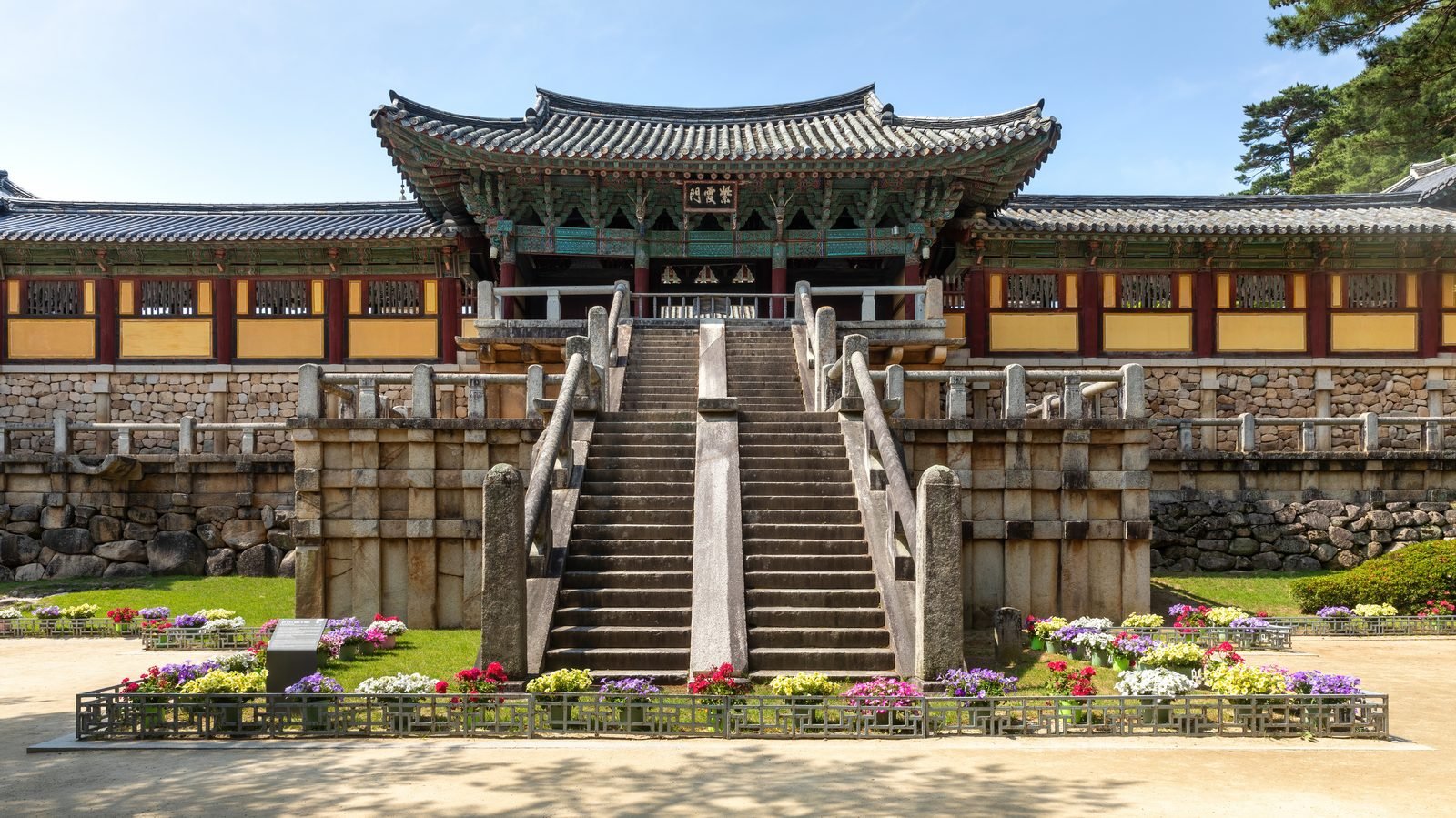
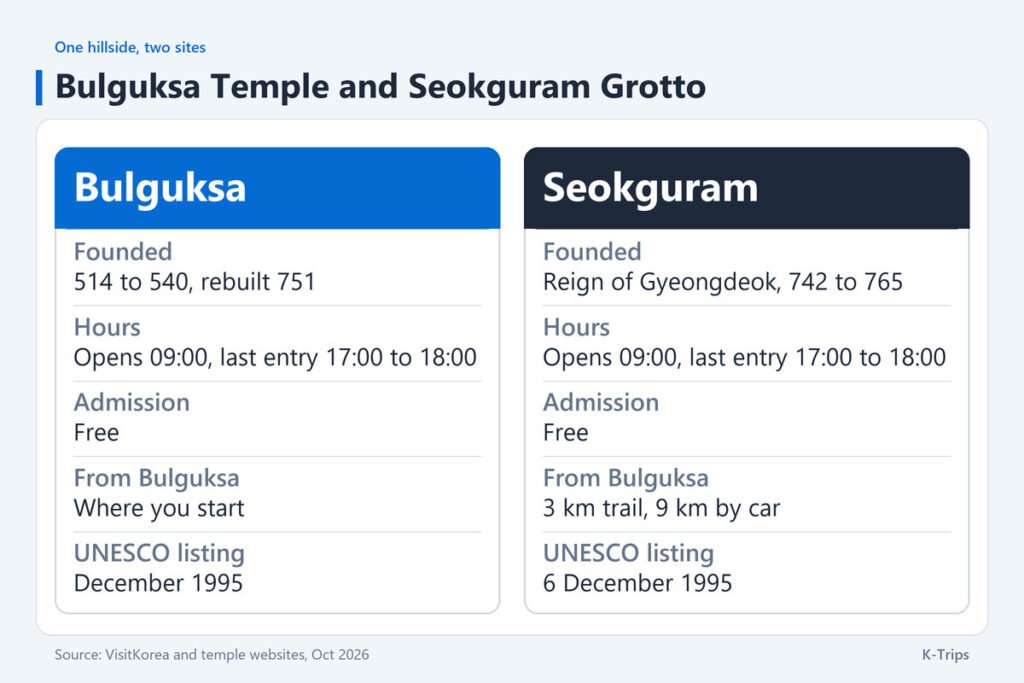
Bulguksa is a temple of stone terraces, bridges and two pagodas that you walk up through; Seokguram is a grotto on the ridge above it, 3 km away by hiking trail and 9 km by car. Both are credited to Kim Dae-seong, and the temple alone carries two founding dates two centuries apart, 514 to 540 and 751.

Two Founding Dates, One Hillside
VisitKorea’s entry for the temple says it was built in the 15th year of King Beopheung, who reigned from 514 to 540, to wish for peace and prosperity for all, and rebuilt in 751 by Kim Dae-seong. The Korea Heritage Service’s entry for the pagoda tells it differently: it describes Bulguksa as founded in 751 through Kim Dae-seong’s vow, as a place meant to express the Silla vision of a pure land where the Buddhas of past, present and future live. He had not finished it when he died in 774, and the state completed it as a temple praying for the kingdom’s good fortune. The Samguk Yusa, the entry adds, says he built Seokguram for the parents of a past life and Bulguksa for those of his present one. The two accounts can be read together, an earlier temple on the hill and the 751 project that produced the layout you see, and this post follows the VisitKorea wording while treating 751 as the date that matters for the pagodas.
The temple caught fire during the Imjin War of 1592 to 1598, and afterwards it was seriously damaged and often the target of theft. Restoration has been continuous since 1920. Today the temple holds seven national treasures and a number of other important heritage items, and it was designated a World Cultural Heritage Site along with the nearby Seokguram Grotto by UNESCO in December 1995.
A Walk Up Through the Terraces
Two stone pagodas stand in the courtyard in front of Daeungjeon, the main hall, with Seokgatap, the Three-story Stone Pagoda, to the west and Dabotap to the east. In the Heritage Service’s words they are among Korea’s most representative stone pagodas, and they are deliberately unlike each other.
Seokgatap and Dabotap
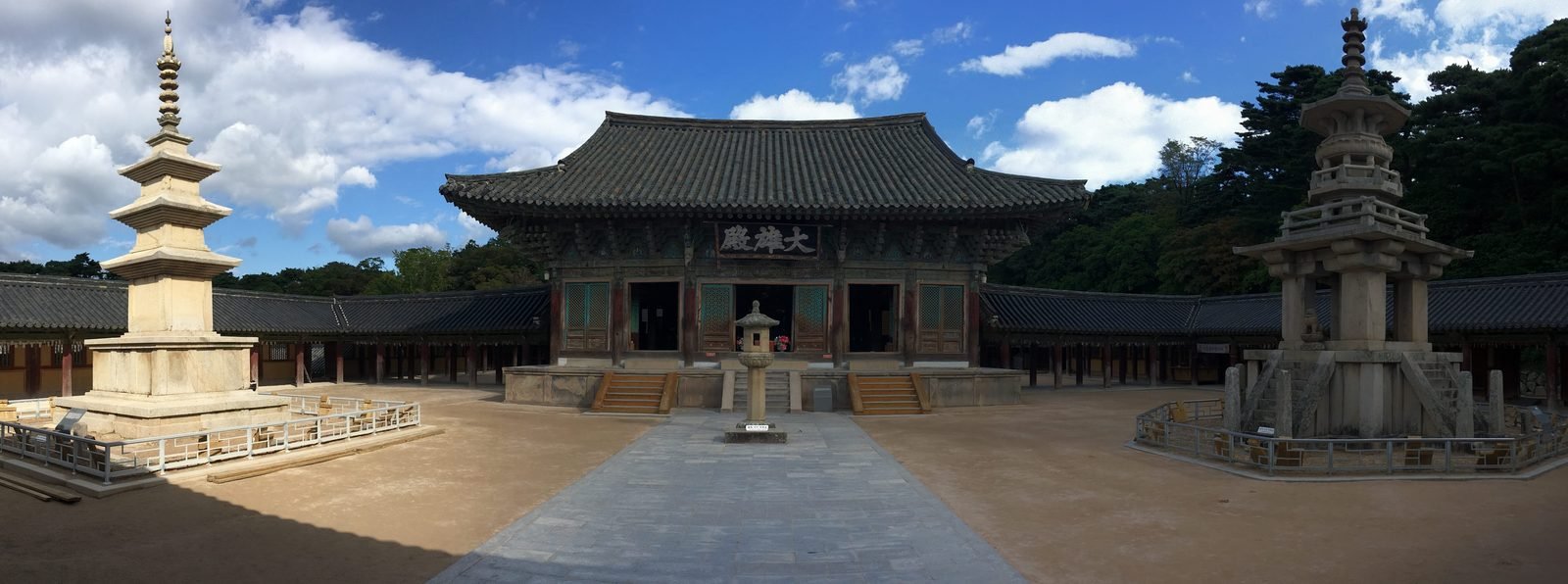

The service gives the heights as 10.75 m for Seokgatap and 10.29 m for Dabotap, which makes them a matched pair, and it numbers Dabotap National Treasure No. 20. Their forms differ. Seokgatap is the plain, regular Unified Silla pagoda: a three-story body on a two-story platform, a type the entry says peaked in the mid-8th century and ties to the twin pagodas of Gameunsa and the pagoda at Goseonsa in Gyeongju. Stone pillar shapes are carved at the corners of the platform and the body in imitation of timber building, and the roofstone corners are raised so that the tower looks ready to fly away. Dabotap is the ornate exception, a special form that the service says is hard to count in stories. Even the service dates Seokgatap loosely, to shortly after the temple was properly established, which a temple record puts at around 751.
The reason for two comes from the Lotus Sutra, in which the past Buddha, Many Treasures, stands beside the present Buddha, Shakyamuni, to prove that his sermon is right, and the pair of towers puts that scene in stone. The entry also singles out the stones carved with lotus designs that surround Seokgatap on every side, which set it apart as a place for enshrining a relic of the Buddha and which it calls rarely seen elsewhere. It adds that the tower looks settled from any direction because of its balance.
What the 1966 Repair Found
The original structure stood in perfect condition for many centuries, the entry says, until looters damaged Seokgatap in September 1966, and when it was rebuilt that December the workers found a square cavity in the front of the second-story body. Among the artifacts and reliquaries inside was the Spotless Pure Light Dharani Sutra, National Treasure No. 126, printed on mulberry paper and described as the oldest material printed from woodblocks in the world. The pagoda’s finial, assumed lost before the 16th century, was restored in 1973 on the model of the finials at Silsangsa in Namwon, which are a century younger than the pagoda, so the top of the tower is the one part that copies something later. The entry also gives the tower’s other name, Muyeongtap, “a pagoda that casts no shadow”, and links it to the legend of Asadal, a Baekje mason, and his wife Asanyeo, who came to the Silla capital to find him and drowned herself in a pond.
Kim Dae-seong’s Grotto on the Ridge
The listing for Seokguram Grotto says Kim Dae-seong built it during the reign of King Gyeongdeok, 742 to 765, that it lies 3 km from Bulguksa by hiking trail and 9 km by car, and that its seated Buddha was designed to face the East Sea. UNESCO registered it on 6 December 1995. By the Samguk Yusa account above, the grotto and the temple are two halves of one commission, which is a good reason to plan them as a single outing.
The grotto’s own website, seokguram.org, reprints the Cultural Heritage Administration’s description. It says the site was first called Seokbulsa and that the builders made an artificial granite chamber in the middle slope of Tohamsan: a rectangular antechamber, a passage and a round main chamber whose ceiling is built from more than 360 flat stones. It was carved with 40 figures around the central seated Buddha, of which 38 survive, and it is National Treasure No. 24.
The same text sets the grotto in its period: King Gyeongdeok’s reign, 742 to 765, was when Silla Buddhist art peaked, and it names Bulguksa, Dabotap, Seokgatap and the Hwangnyongsa bell among the works of those years. It also describes the order in which the figures meet you. Eight guardian deities line the antechamber walls, vajra guardians stand at the entrance to the passage and four heavenly kings in the passage itself, and in the round chamber the main Buddha sits slightly behind the centre, with an eleven-headed Avalokitesvara on the wall behind him that the text calls the most finely carved figure in the grotto.
Hours, Cost and the Bus From Gyeongju
Last Admission by Season
VisitKorea’s listings show both sites at 09:00 to 18:00, with a 19:00 exit time at the temple and a 19:00 viewing limit at the grotto, and they warn that the grotto’s hours are subject to change. The temples’ own pages are more exact. Bulguksa’s page sets last admission by season, the same on weekdays, weekends and holidays, with no closing day, and the grotto’s website publishes the same schedule. It adds that heavy-rain, typhoon or heavy-snow warnings can close the grounds for safety.
| Months | Opens | Last admission |
|---|---|---|
| March to September | 09:00 | 18:00 |
| February and October | 09:00 | 17:30 |
| November to January | 09:00 | 17:00 |
Pets are not allowed at either site, and parking is ₩2,000 for a car and ₩4,000 for a bus. If you have just come from the shrine ticket in the Jeonju Hanok Village day, this hillside will feel different, because nothing is charged at the gate.
Bus 10 or 11, Then Bus 12 Up the Hill
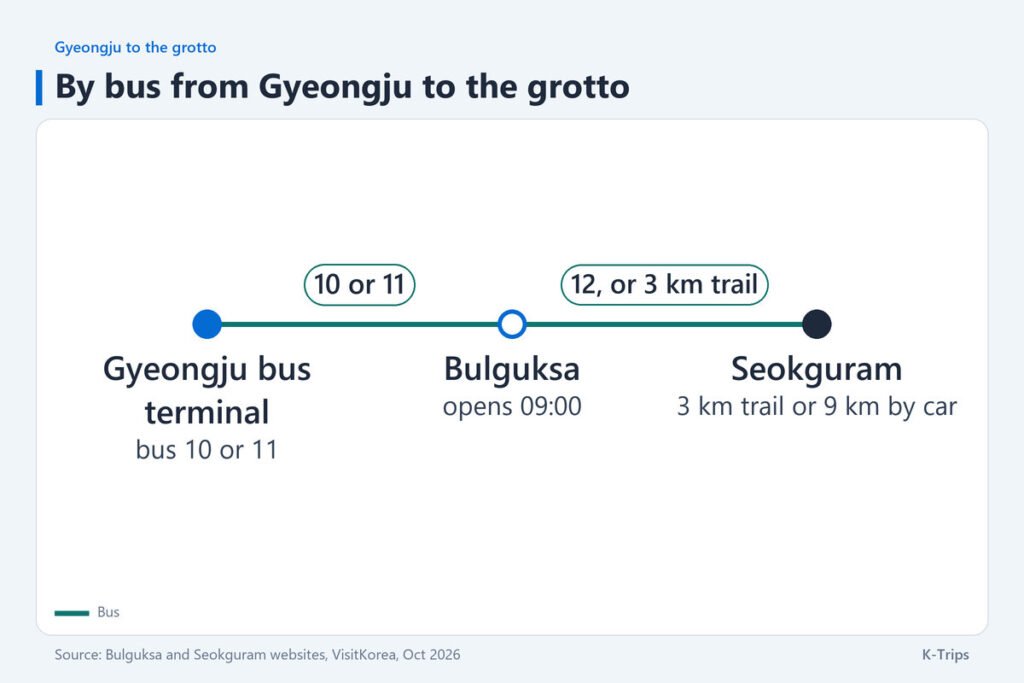
Bulguksa’s getting-there page names buses 10 and 11 and says they leave often from downtown Gyeongju, the railway station and the bus terminal. The grotto’s website adds bus 700 from Singyeongju Station, four times a day, and says you change to bus 12 at Bulguksa for Seokguram; the bus back leaves the grotto on the hour. Bus numbers and times can change, so read the stop on the day.
By car, the temple’s page gives two approaches from downtown. One follows National Route 7 toward Ulsan to the Gujeong-dong junction in front of Bulguksa Station, then turns left onto Local Road 902 for 2.5 km. The other takes Route 4 past the Bomun resort area toward Gampo and turns right at the junction before Deokdong Lake. The grotto’s site puts the climb up Tohamsan at about 20 minutes from the temple, plus a 10-minute walk from its car park to the grounds.
| Way up to Seokguram | What the sources give |
|---|---|
| Hiking trail from Bulguksa | 3 km |
| Road from Bulguksa | 9 km, about 20 minutes’ drive, then a 10-minute walk |
| Bus | Bus 12 from Bulguksa; the return bus leaves on the hour |
Keep the Korean addresses on your phone for a taxi or a map app. The temple is at 385 Bulguk-ro (불국로 385), Gyeongju, with an inquiry line at +82-54-746-9913. The grotto is at 238 Seokgul-ro (석굴로 238), with its own line at +82-54-746-9933.
A sensible order follows from the hours. Reach Bulguksa at 09:00, give the terraces the morning and head up in the early afternoon; in winter, with last admission as early as 17:00, a late start leaves no margin. Walking the 3 km trail up pairs well with the hourly bus down. If you are weighing Gyeongju against other southern stops, the two-day Busan plan shows what else competes for the same days.
Does Bulguksa Charge for Entry?
No. The temple’s own page says that since 4 May 2023, under a revised heritage-protection law, entry has been free, and VisitKorea lists the fee as free for both sites. What still costs money is the car park. The gate has gone but the clock has not: last admission still moves with the season, from 17:00 in winter to 18:00 from March to September.