
Agency buildings are the wrong unit for planning a K-pop trip, and that is the mistake that costs fans the most time. Headquarters are working offices, and the one public exhibition that turned HYBE’s Yongsan tower into a pilgrimage stop closed in January 2023. What stays open is a shorter list: shops with posted hours, fan-made displays in subway stations and a broadcast audience system that rewards early planning. Build the trip from those, group the stops by neighborhood, and the days stop colliding.

Which Agency Buildings Have a Public Door
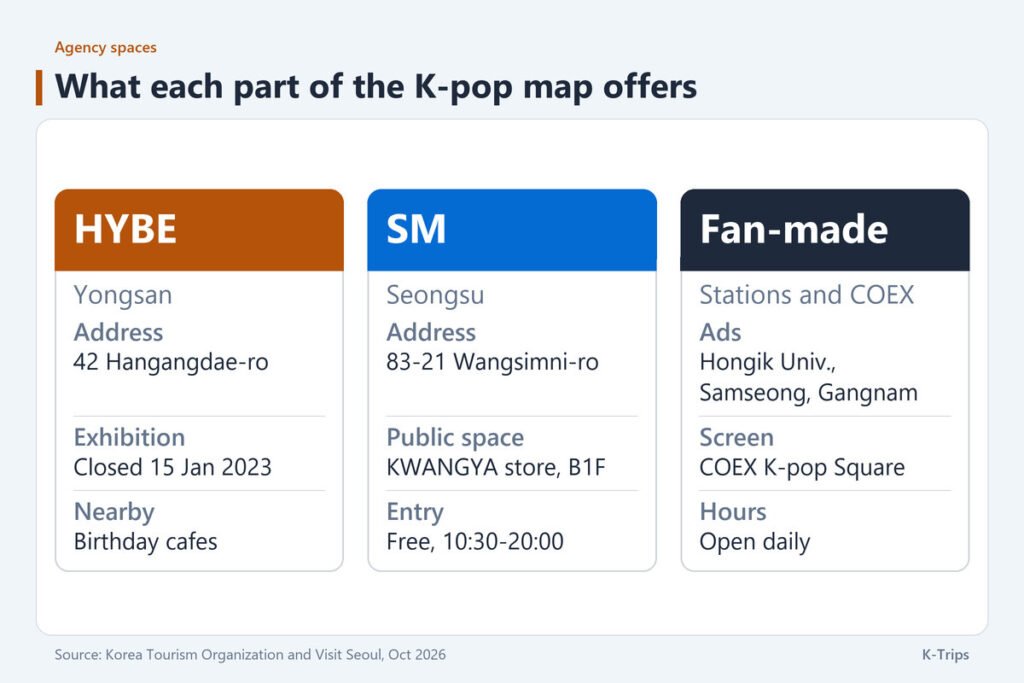
Only one agency has a documented public door. SM Entertainment’s flagship fan store, KWANGYA@SEOUL, is listed by Visit Seoul as a free K-pop experience space with a media zone and an AR guestbook. HYBE’s headquarters is at 42 Hangangdae-ro in Yongsan-gu, and the Korea Tourism Organization’s fan-culture feature gives that address as the spot around which HYBE birthday cafés are organized, but the exhibition that once drew visitors inside has closed. Neither organization lists a public area for YG or JYP, so treat both as exteriors until the agency says otherwise.
HYBE: an address, not an exhibition
HYBE INSIGHT opened inside the Yongsan building in May 2021 and closed to the public on 15 January 2023, when the space was set to become dance studios and production rooms; the Bandwagon report quotes the museum’s own announcement promising a new location without naming one, so a listing that shows visiting hours for a replacement deserves suspicion. What remains is the neighborhood: the KTO feature says birthday cafés for HYBE artists are organized year-round near the Yongsan headquarters. For what can be seen from the pavement, see the write-up of HYBE’s headquarters and its street view.
SM: the one with a door
KWANGYA@SEOUL is on the first basement level of 83-21 Wangsimni-ro in Seongdong-gu. Visit Seoul lists free admission, daily hours of 10:30 to 20:00, and closures on Lunar New Year’s Day and Chuseok, announced on the store’s Instagram. Seoul Forest Station on the Suin-Bundang Line, Exit 5, is 73 meters away. The store has its own walkthrough in the KWANGYA@SEOUL store walkthrough, and the point here is that it is the one agency stop where a visitor can walk in without a ticket.
Store Hours That Set the Order of a Day
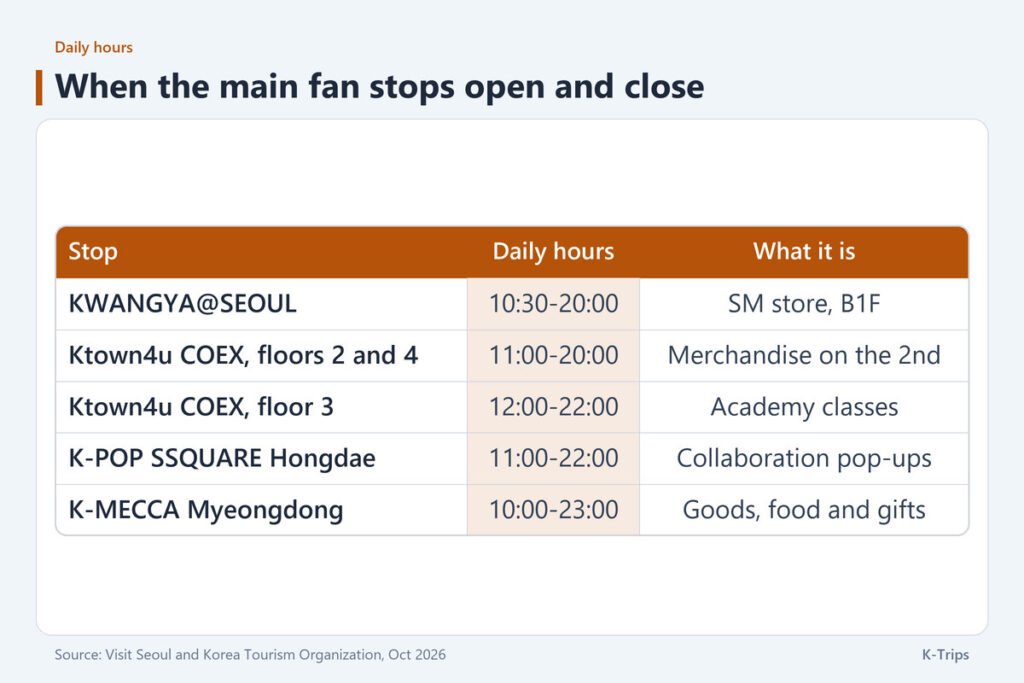
Hours decide the order of a day more than distance does, because the shops do not close at the same time. The KTO feature and the KTO page for Ktown4u COEX, a column last updated in June 2024 that itself advises confirming details before a visit, give these figures:
- KWANGYA@SEOUL, Seongsu: 10:30 to 20:00 daily.
- Ktown4u COEX: the 2nd and 4th floors run 11:00 to 20:00 and the 3rd floor 12:00 to 22:00. The 2nd floor, called SQUARE, holds the merchandise; the 3rd houses an academy with one-day dance and vocal classes.
- K-POP SSQUARE Hongdae, at 142 Yanghwa-ro: 11:00 to 22:00 daily. It was the LINE FRIENDS Hongdae store and now hosts K-pop collaboration pop-ups.
- K-MECCA Myeongdong flagship, in the Huiseong NH Building on Myeongdong 8na-gil: 10:00 to 23:00 daily, selling K-pop goods, Korean food and gifts.
The practical reading is that anything closing at 20:00 belongs in the daytime and anything open to 22:00 or 23:00 can take the evening. Put KWANGYA and the Ktown4u merchandise floor before dinner; keep Hongdae and Myeongdong for after dark, when K-POP SSQUARE and K-MECCA are still open. If a pop-up at K-POP SSQUARE is the reason for the trip, look up its own dates first, since the store changes its collaboration with each event.
Ktown4u floor by floor
The 2nd floor, SQUARE, is the merchandise floor: lightsticks, albums, photocards and posters, new releases alongside older ones and vinyl, plus stickers, keyrings, toploaders, apparel, accessories and cosmetics. Photo booths on one side print four-cut photos with K-pop artists on the frames, and a wall carries photographs taken by artists along with their signatures. The 3rd floor is different in kind. The academy teaches dance and vocals with trainers who work with K-pop stars, and its courses range from one-on-one audition consulting to global classes taught in different languages and one-day classes for visitors; a dance class produces a short video and a vocal class a finished recording. Enrollment goes through the academy’s website and Instagram, so a one-day class is the only item in this list that has to be arranged before the day rather than on it. The 4th floor is given over to pop-up stores and fan events, with a café in one corner that hands out a random photocard with its special drinks; the same column says the schedule is posted on Ktown4u’s website and Instagram, which is where to look before choosing a date.
Music Shows Are Applied For, Not Walked Into
A music-show taping is free to attend but not free to walk into. Visit Seoul’s answer to a visitor asking how to see SBS Inkigayo or KBS Music Bank says to apply directly on each broadcaster’s website; the process is in Korean, starting from the link labeled 방청신청 하러가기. The applicant needs a valid passport or a Korean alien registration card, and seats are very limited, so an application is not a guarantee of tickets. That answer is on Visit Seoul’s question-and-answer page and is dated April 2016, so read it as the shape of the process rather than current rules.
The current details, such as age limits, the application window and the meeting point, are set by each broadcaster’s notice for that week, which is why no weekday schedule appears here. The planning consequence is simple. Translate the broadcaster’s page before the trip, apply for the show that matches your dates, and treat a successful application as a bonus on top of a plan that already works without it.
Not being selected costs less than it sounds. A taping day is one evening, and the rest of the fan map does not depend on it: the stores keep their posted hours, the station ads stay up and the agency exteriors are always there. That is the reason to apply for a show but not to book flights around one.
Two Quick Answers Before You Book
Is HYBE’s museum open again?
Not in the Yongsan building. The exhibition there closed to the public on 15 January 2023, and its announcement promised a new location without giving one. If HYBE opens a replacement, its own channels will say so before a travel listing does.
Where can fans see fan-made ads in person?
The KTO feature names Hongik University Station, Samseong Station and Gangnam Station, where fans gather daily to photograph their favorites’ birthday and comeback ads, plus the media screen on the outer facade of COEX’s atrium, called COEX K-pop Square, at 513 Yeongdong-daero. Both the stations and the screen are listed as open daily.
What Fans Built Around the Industry
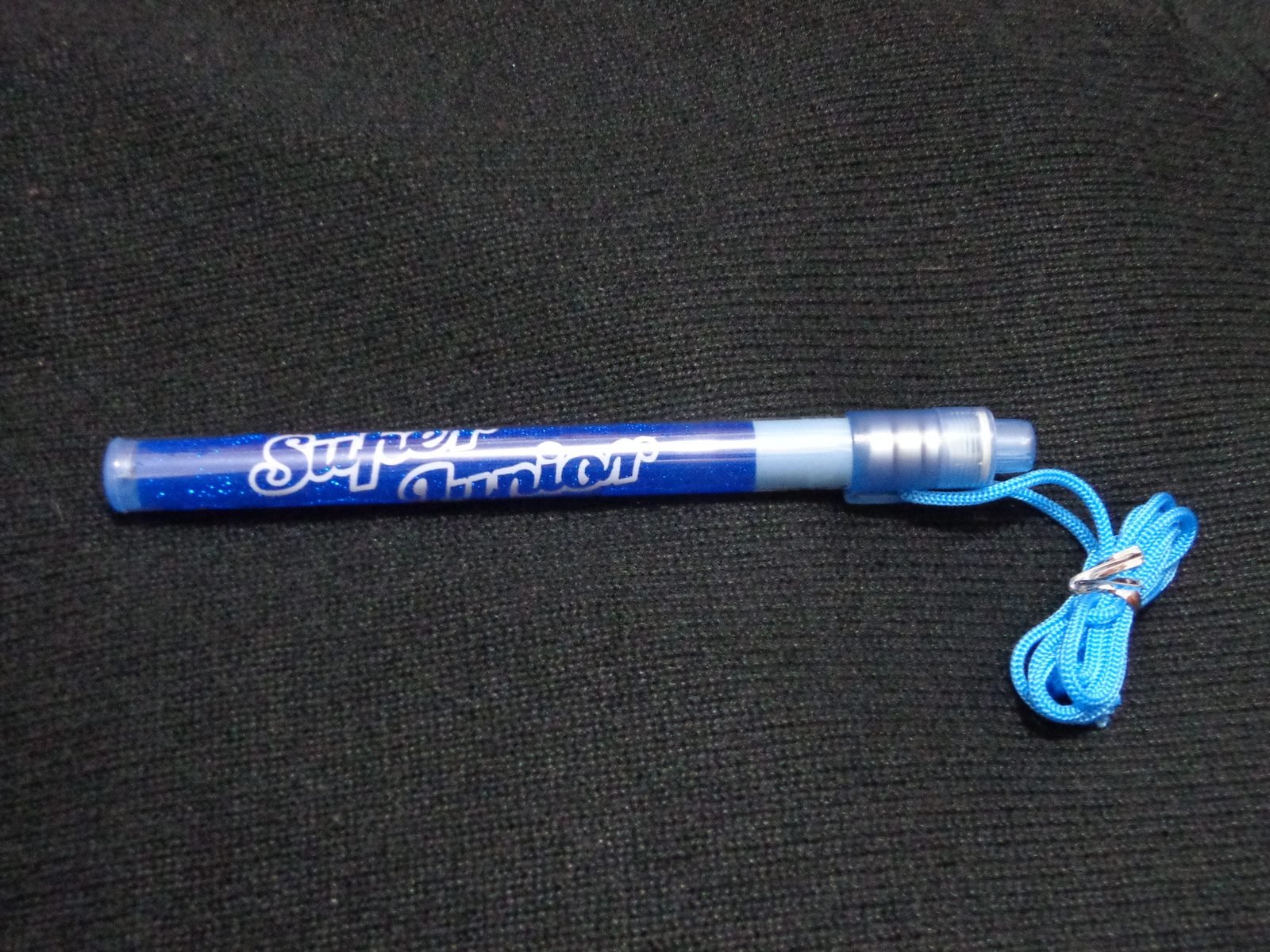
A lot of what makes a K-pop trip feel specific was made by fans rather than companies. The KTO feature traces lightsticks to the 1990s, when fans waved balloons in an idol’s signature color; as the number of groups grew, balloons could no longer tell one artist from another, and each group’s custom lightstick followed, now often with Bluetooth links to the stage. Photocards went from album extras to the main reason some fans buy several copies of a CD, which is why album shops sell so many sets.

Fan retail follows the same logic. The KTO feature describes K-MECCA as a K-culture shop selling K-pop goods, Korean food and gifts, and K-POP SSQUARE Hongdae as a space that rotates collaboration pop-ups, which means the shop name stays the same while the contents change. Both list social accounts (@kmeccaofficial and @linefriends_square), and a quick look there the day before is the cheapest way to avoid arriving between pop-ups.
The same feature describes birthday cafés, where fans rent a whole café and fill it with photo zones and letters, usually near the artist’s label. HYBE’s are organized year-round near Yongsan and SM’s frequently near Seongsu, which turns a neighborhood visit into a chance to see one. Photograph the displays and the buildings, and leave the people alone. Do not wait outside offices, studios or salons hoping to catch an artist, and do not follow anyone. Landmarks are for visiting; the people who work there are not part of the sight.

A Day Order That Avoids Backtracking
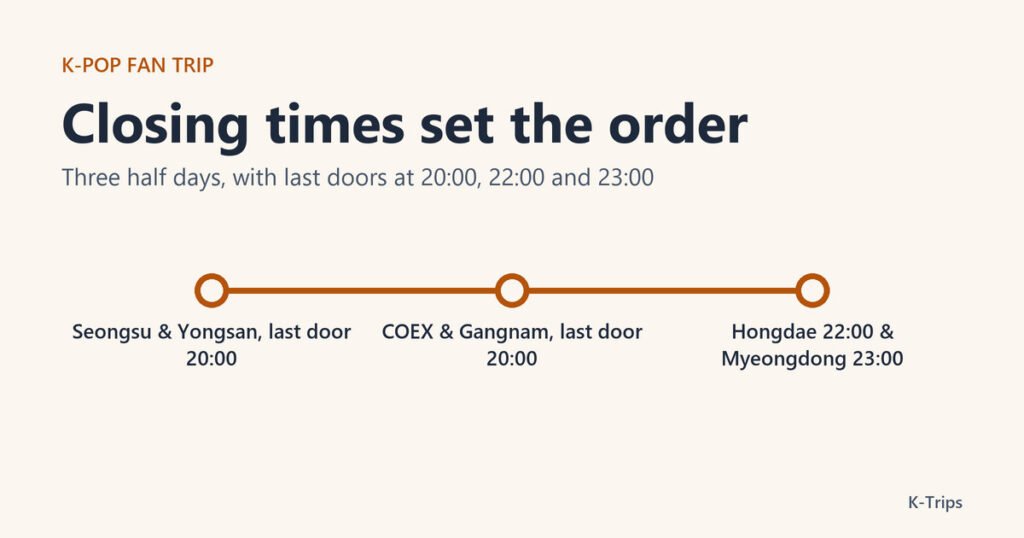
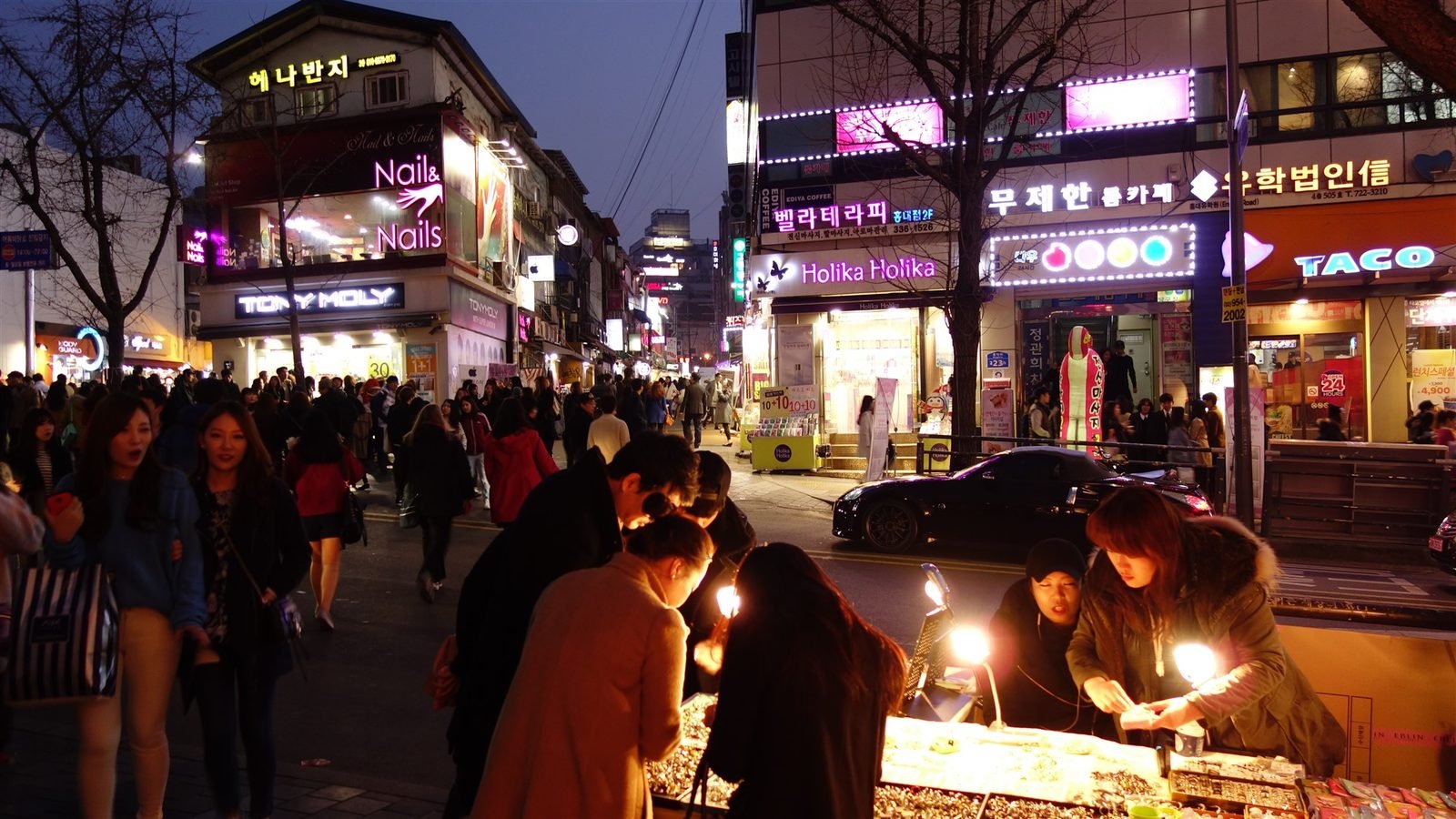
Group the stops by district and give each district a half day. Seongsu is the natural morning: KWANGYA opens at 10:30, and the Visit Seoul page lists Seoul Forest 330 meters away and Seongsu-dong Galbi Alley, a street of grilled-rib restaurants, 340 meters away. Yongsan works as a short exterior stop, with Itaewon’s Usadan-gil and the Amorepacific Museum of Art named by the KTO feature as nearby. COEX combines Ktown4u and the K-pop Square screen, and the Samseong ad station is on the same side of the city. Hongdae and Myeongdong close the evening because the stores there stay open latest.
| Half day | Stops, in opening order | What sets the limit |
|---|---|---|
| Seongsu and Yongsan | KWANGYA from 10:30, Seoul Forest, then the HYBE exterior | KWANGYA closes at 20:00 |
| COEX and Gangnam | Ktown4u from 11:00, K-pop Square, the Samseong and Gangnam ads, an academy class if booked | Ktown4u’s 2nd and 4th floors close at 20:00 |
| Hongdae and Myeongdong | K-POP SSQUARE from 11:00, the Hongik University Station ads, K-MECCA until 23:00 | K-POP SSQUARE closes at 22:00 |
I would not squeeze all of this into one day. Three districts are comfortable, four is a rush, and a fourth store usually costs more time in transit than it returns. If the east coast is on the list, the bus stop BTS fans visit is a separate day away from Seoul, covered in the Hyangho Beach bus stop write-up.
How the Fan Calendar Changes the Plan
The same city needs a different plan depending on what the artists are doing. Concerts are the clearest case, because the venues sit far from the fan districts: the KTO feature lists KSPO Dome at 424 Olympic-ro in Songpa-gu and Gocheok Sky Dome at 430 Gyeongin-ro in Guro-gu, a baseball dome that also stages concerts, and gives hours for both as varying by performance. A concert day therefore needs the venue’s own schedule rather than a district plan, and anything else on that day should be near the venue or before noon.
| When | What to book or check |
|---|---|
| A comeback week | Open the broadcaster’s audience page for that week and apply early. Shops and fan displays follow the promotion schedule, so keep the afternoons flexible. |
| Between releases | Anchor the days on stores with fixed hours: KWANGYA from 10:30, Ktown4u from 11:00, K-MECCA until 23:00. |
| A concert week | Start from the venue’s own schedule, since both domes list their hours as varying by performance. |
| Lunar New Year and Chuseok | KWANGYA is closed on the day itself. The KTO pages give no holiday hours for the other stores, so confirm them before routing a day around them. |
None of this requires knowing the schedule months ahead. It requires keeping one or two days loose until the dates are announced, then filling them with the fixed-hours stops above.