
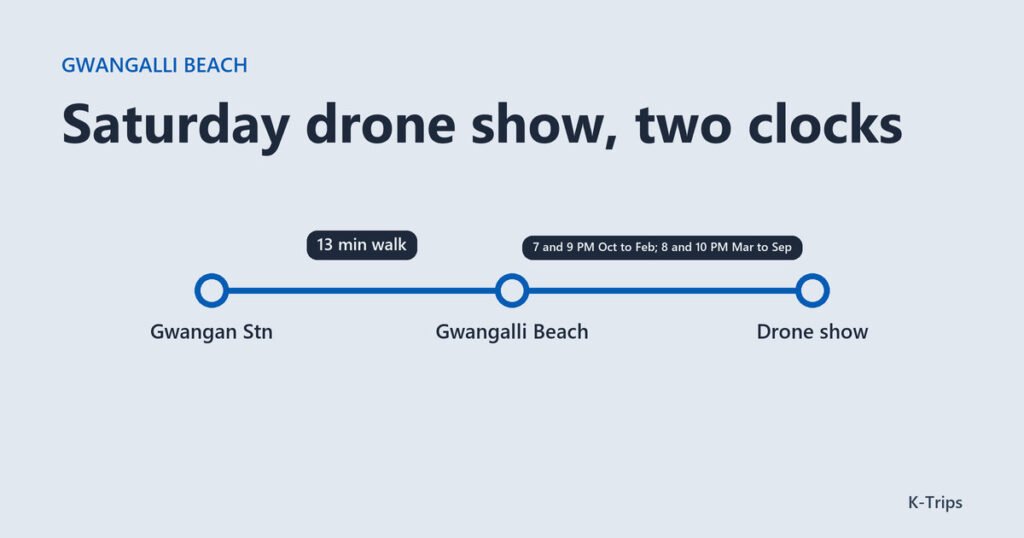
The mistake that costs visitors this show is trusting one set of showtimes for the whole year. The performance runs on two clocks, 8 PM and 10 PM from March to September, then 7 PM and 9 PM from October to February, according to the organizers’ overview page. Someone who read a summer listing and reaches the sand at 7:45 on a November Saturday has already missed the first performance, and someone who read a winter listing in June stands on the beach an hour before anything happens.
Everything else about the evening is simpler. The show is free, it takes place every Saturday, and the organizers define the viewing zone as anywhere on Gwangalli Beach, so there is no ticket line to join and no seat to book.

Two Saturday Slots and Two Clocks
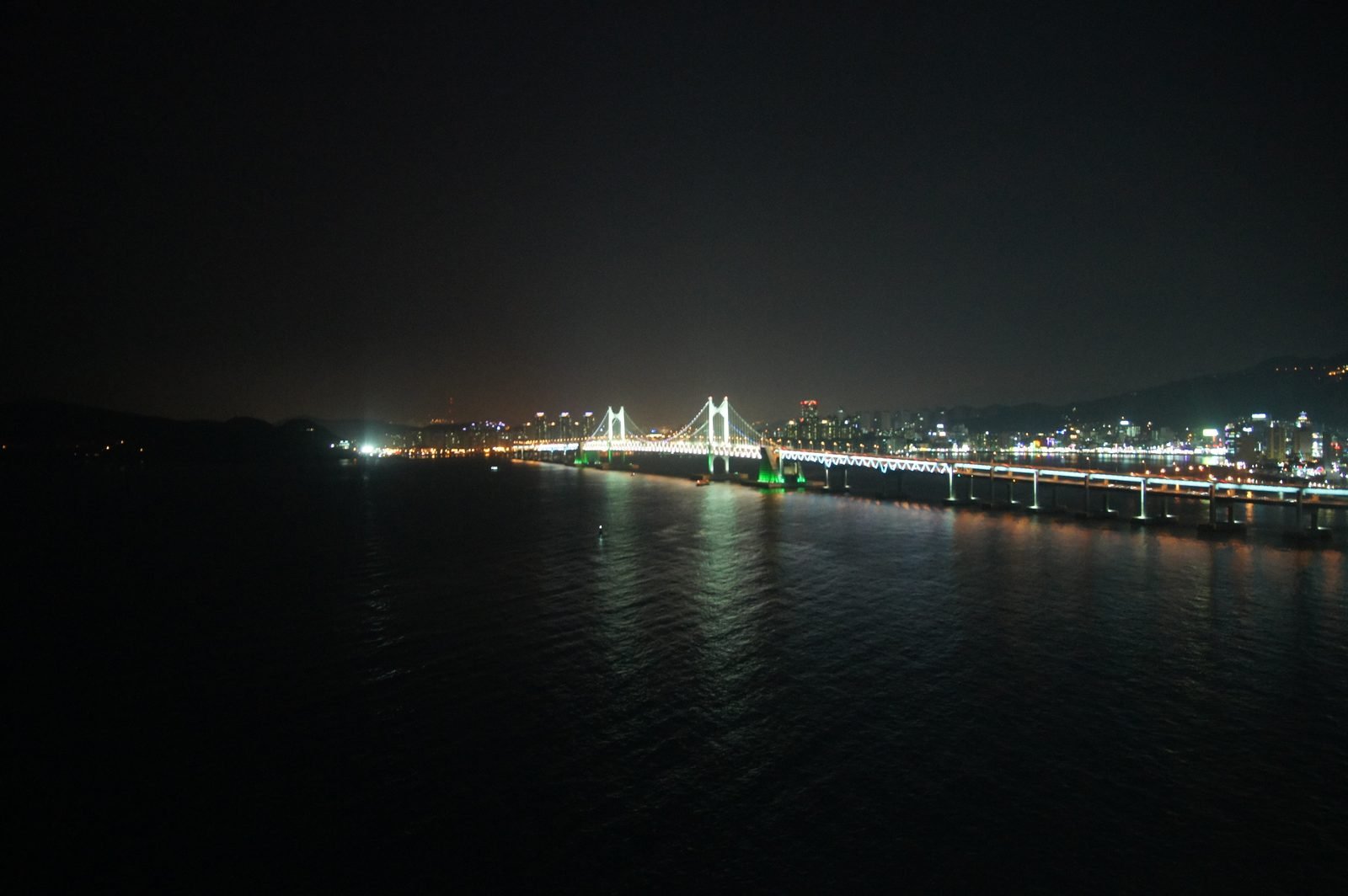
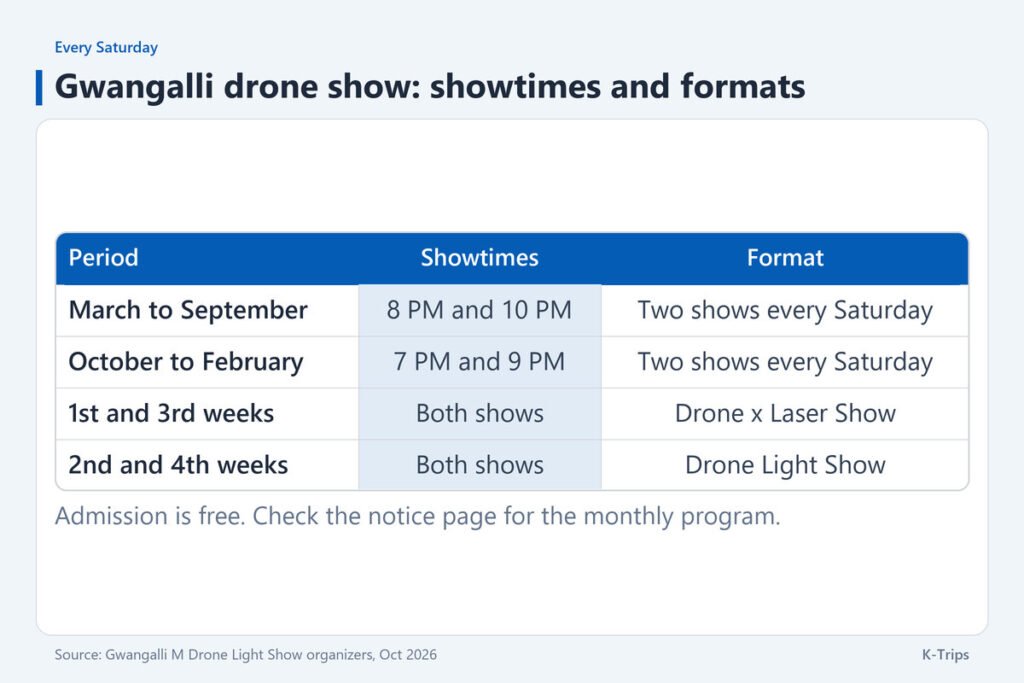
The Gwangalli M Drone Light Show describes itself as the first permanent drone light show in Korea. It is held weekly on Saturdays at Gwangalli Beach in Suyeong District, at 219 Gwanganhaebyeon-ro, with two performances each night. The summer season, March to September, uses 8 PM and 10 PM. The winter season, October to February, moves both shows an hour earlier, to 7 PM and 9 PM. VisitKorea’s listing gives the same pairs of times and lists admission as free.
The two start times are two hours apart, so a single evening can hold dinner between them. A visitor who misses the first show because of a late train still has the second one, as long as the second slot is read against the right season.
Length is the one detail the sources disagree on. The organizers write that each performance lasts over 12 minutes, while the VisitKorea and Visit Busan pages say about 10. The practical reading is to plan for a quarter of an hour on the sand and treat the listed time as the moment the drones start to rise, not the moment to start walking over.
VisitKorea adds some background on why the show exists in this form. It describes the weekly performance as turning what was once a one-day-only fireworks festival into a regular nighttime spectacle, and the same page notes that drone shows produce much less air pollution, noise and fire risk than fireworks.
The October-to-February clock is a rule about months, not a single changeover date: the organizers’ winter-schedule notice says the showtimes change to 7 PM and 9 PM for the whole season. That notice and each month’s program announcement are kept on the organizers’ notice list, which is where to look when a Saturday falls close to the end of September or the start of March.
What Flies Over the Bridge Each Week
The format changes through the month. Per the organizers, the first and third weeks carry the Drone x Laser Show, which adds about 20 lasers projected against Gwangandaegyo Bridge, and the second and fourth weeks carry the Drone Light Show without lasers. The overview does not say what a fifth Saturday gets. October 2026 has five of them, and the program the organizers posted on September 28 gives each one a theme of its own, so a month like that is worth a look at the notice list.
Themes change every week. The organizers list characters such as Pokémon and SpongeBob and commemorative days such as Liberation Day among past subjects, and say the show has filled Gwangalli’s nights with a new story each week for five years. That is why a second visit is not a repeat: the bridge and the beach stay put while the formations above the water do not.
Visit Busan also mentions programs around the main show, including events for visitors to take part in, drone experience events and special-effects drone shows. None of these has a fixed slot in the sources, so treat them as bonuses that may or may not coincide with the Saturday you choose.
Why the Drone Count Depends on Where You Read It
The organizers give 1,100 drones for a regular show and 3,000 for a special edition. VisitKorea says anywhere from several hundred to 1,500. Visit Busan reports that in June 2023 the permanent show grew from 500 to 600 drones and the special show from 1,500 to 2,000. These figures come from different dates and different authors, so they do not contradict a single truth so much as describe a fleet that kept growing.
The organizers’ figures are the ones to trust here, since they operate the fleet. For planning, the number matters less than the geometry: the drones rise from the sand and perform out over the water, with the lit bridge behind them.
Claiming a Spot on a Beach With No Seats
Because the viewing zone is the whole beach, nobody assigns places, and the crowd decides who sees what. VisitKorea warns that competition for the best viewing spot can be more intense than you might expect. A free show on a Saturday night, on a beach with cafes and restaurants along its length, fills from the sand edge backward.
Two judgment calls follow from the sources. First, an open line of sight over the water matters more than being close to the launch area, since the performance happens in the air in front of the bridge. Second, the late show is a second chance: a visitor whose first sightline was blocked can pick a better position in the two hours between performances and try again.
Since the show only happens on Saturdays, it works better as the fixed point of a Busan stay than as an add-on. A weekend that includes a Saturday evening on this beach, with the bridge lit behind the drones, is the version of the trip the organizers are describing. A midweek visit to the same beach still has its night view of the bridge, but no performance.
The beach is also a short ride from Haeundae and its coastal rail line, and the Saturday timing suits a day that began elsewhere. The longer plan in a two-day Busan route ends its first evening here, which only works on a Saturday.
Reaching the Sand by Metro or Bus
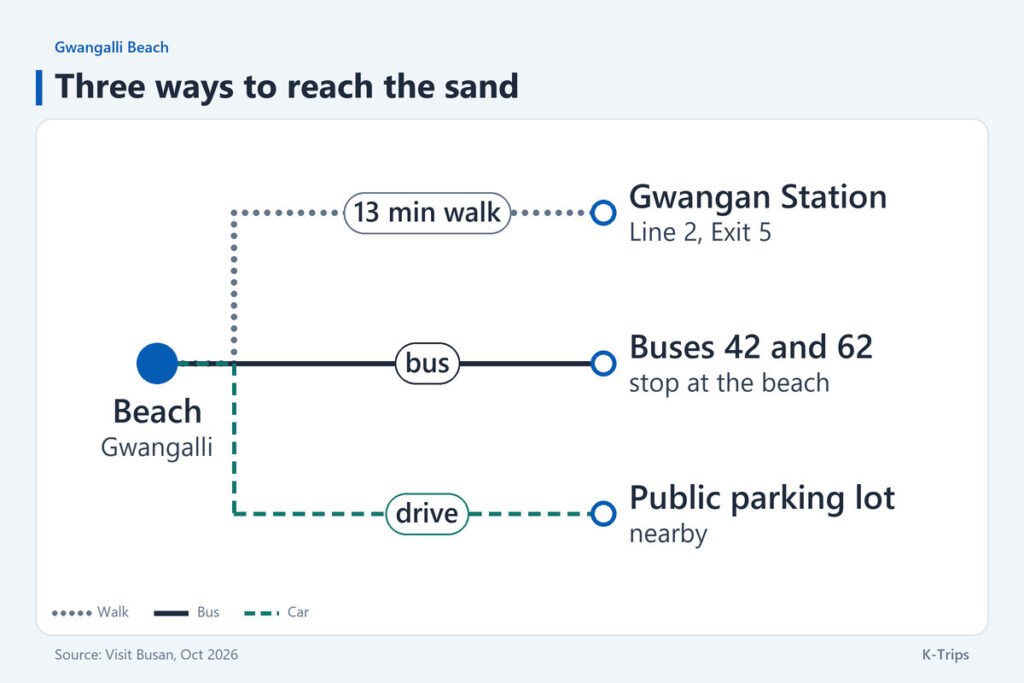
Visit Busan lists a 13-minute walk from Exit 5 of Gwangan Station on Busan Metro Line 2. Buses 42 and 62 stop at Gwangalli Beach, and a public parking lot is nearby. On a Saturday night the lot and the roads around it are the likeliest places to lose time, so the station walk is the dependable option.
A daytime stop that pairs well with the evening is the hillside village of Gamcheon, which keeps its own visiting hours, so finish there with time to spare for the metro across the city before the first show.
Read the Saturday Notice Before Crossing Town
The organizers state that a performance may be canceled or delayed, either a day ahead or on the day itself, because of rain, strong wind, a typhoon or communication circumstances. Open the organizers’ notice list on the afternoon of the show, before crossing the city.