
A Korean menu with no photos looks like a wall of unrelated words, each one a separate thing to memorize before dinner. That picture is wrong. Most dish names are short formulas, an ingredient followed by a cooking word, and the same few dozen words keep coming back. A line such as 김치찌개 is no mystery: it is 김치 (kimchi) plus 찌개 (a stew). Thirty everyday words, sorted into cooking words, ingredients and portion words, are enough to work through a board of unfamiliar dishes one line at a time.
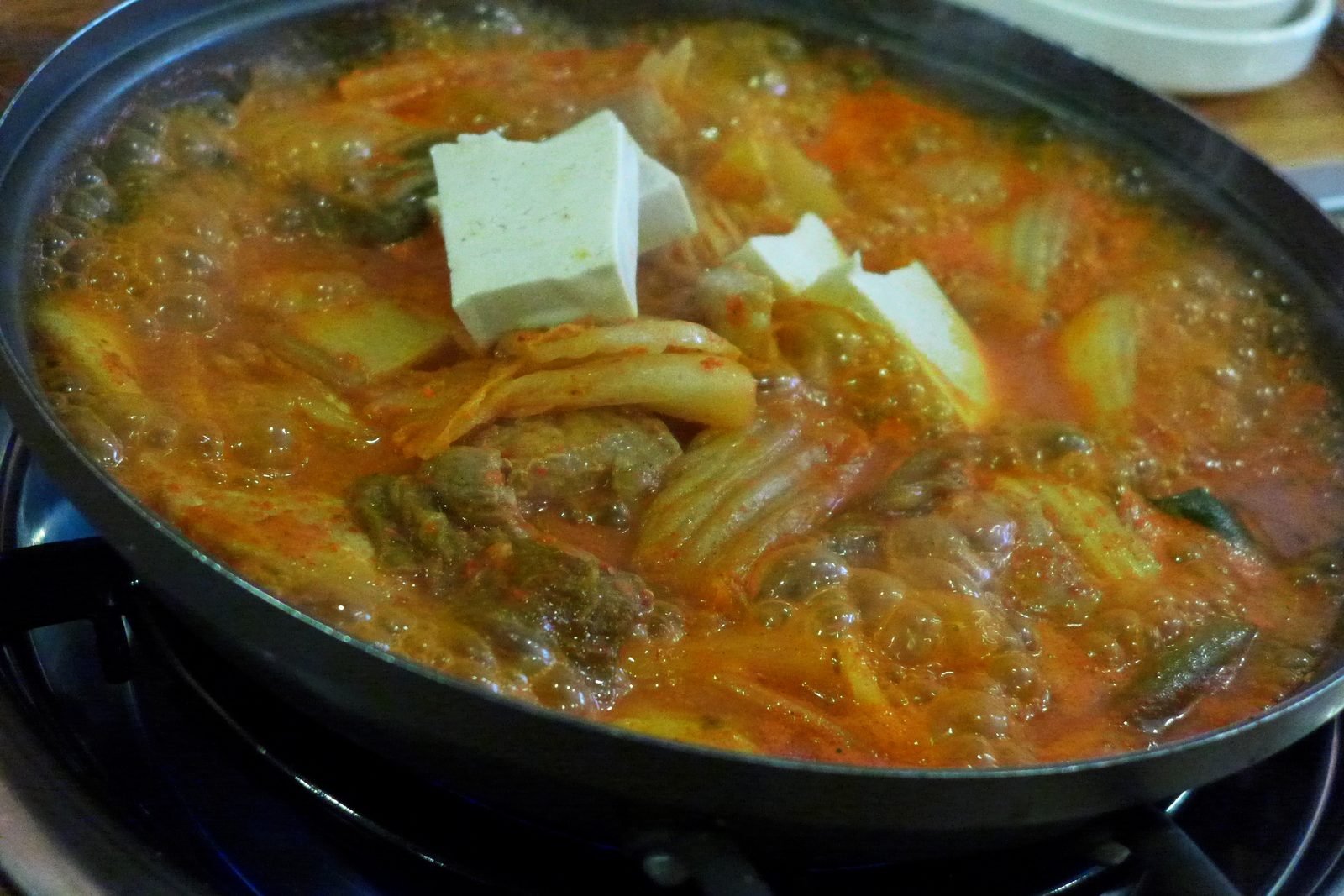

Dish Names Follow a Formula
The pattern is ingredient plus cooking word, sometimes with a portion word at the end. 김치찌개 is kimchi plus stew, 오징어볶음 is squid plus stir-fry, 두부조림 is tofu plus simmered-down, and 고등어구이 is mackerel plus grilled. The cooking word tends to come last, so reading from the right tells you what will arrive and reading from the left tells you what it is made of.
The same reading works at a seafood market, which the Jagalchi Fish Market guide walks through: a fish name followed by 회 is that fish served raw and sliced. Two limits apply. Regional names and a restaurant’s own inventions do not follow the formula, and a name is a clue to the method rather than a recipe. And one line on the board rarely arrives alone: the Korea Tourism Organization describes a typical Korean meal table as rice, soup, side dishes and stew, and says to expect many small side dishes alongside the main dish, with kimchi always among them.
Longer names stack. 돼지고기김치찌개 reads from left to right as pork, kimchi, stew: two ingredients in front of one ending, which is how a name grows without changing its structure. The ending still decides the shape of the dish and the first word still names the main ingredient; the extra words add detail rather than change the method. Even a name that seems to lack a cooking word fits the pattern. In 비빔밥 the second half is 밥, rice, and the first half is 비빔, mixed, so the dish is rice that you mix.
A worked example shows how little is needed. Take 오징어볶음 on a board. The ending 볶음 says the dish is stir-fried, so it will be cooked fast in a pan and arrive with little or no broth. The first word, 오징어, says squid. Nothing else on the line changes the reading, and if a number or a word such as 매운 follows, those are the portion and the heat. Now take 소고기전골: 전골 says a hot-pot pan with a little broth, 소고기 says beef, and the dish is therefore a shared pan of mixed ingredients built around beef. Two words were enough in each case, and the same two-step reading works on 닭고기튀김, 두부조림 and 새우무침.
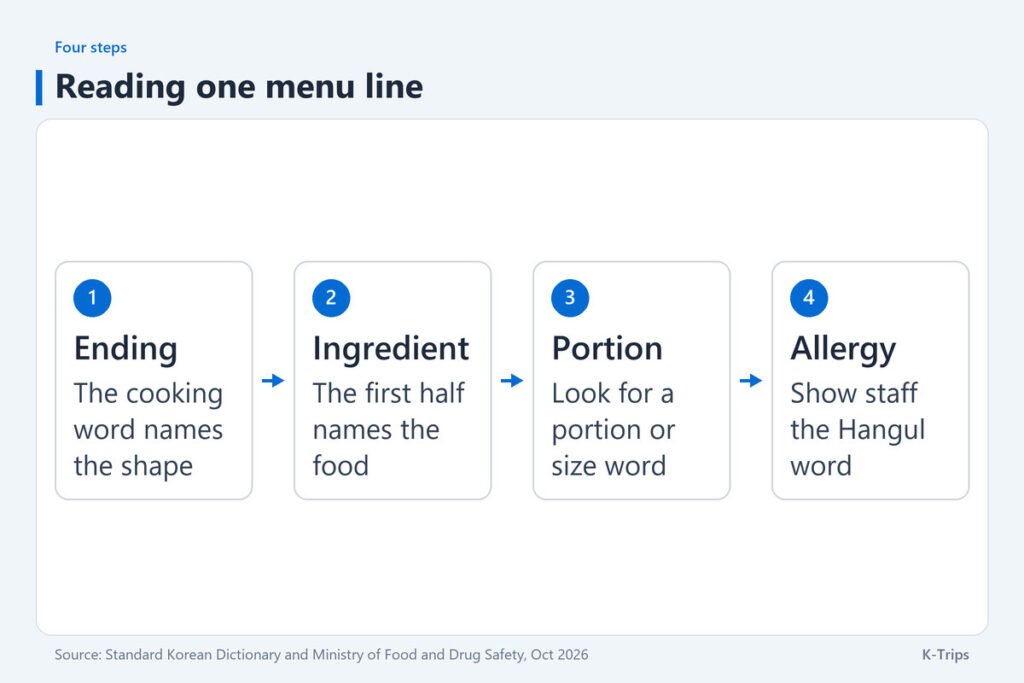
The order matters more than the vocabulary. Start from the ending, because it decides the shape of the meal, then read the ingredient, then look for a portion word, and only then check for words that raise a concern such as heat or an allergen. The four steps in the figure below follow that sequence, and each one is covered by a table in this post.
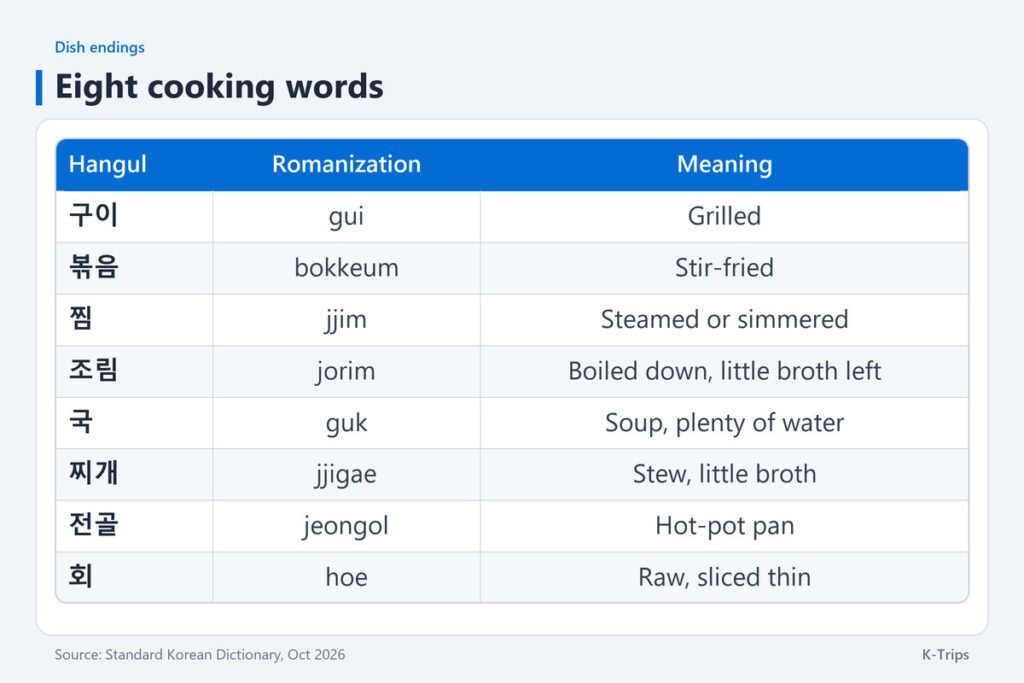
Twelve Cooking Words and What They Mean
These words usually close the dish name. The meanings below follow the National Institute of Korean Language’s Standard Korean Dictionary, which can be searched word by word, and the third column paraphrases its entries.
| Hangul | Romanization | Meaning in the dictionary |
|---|---|---|
| 구이 | gui | Meat or fish seasoned and grilled |
| 볶음 | bokkeum | Seasoned ingredients stir-fried, or the dish made that way |
| 찜 | jjim | Seasoned meat or vegetables steamed, or simmered with little broth |
| 조림 | jorim | Meat, fish or vegetables seasoned and boiled down until almost no broth is left |
| 튀김 | twigim | Fish, meat or vegetables coated in flour and fried in oil |
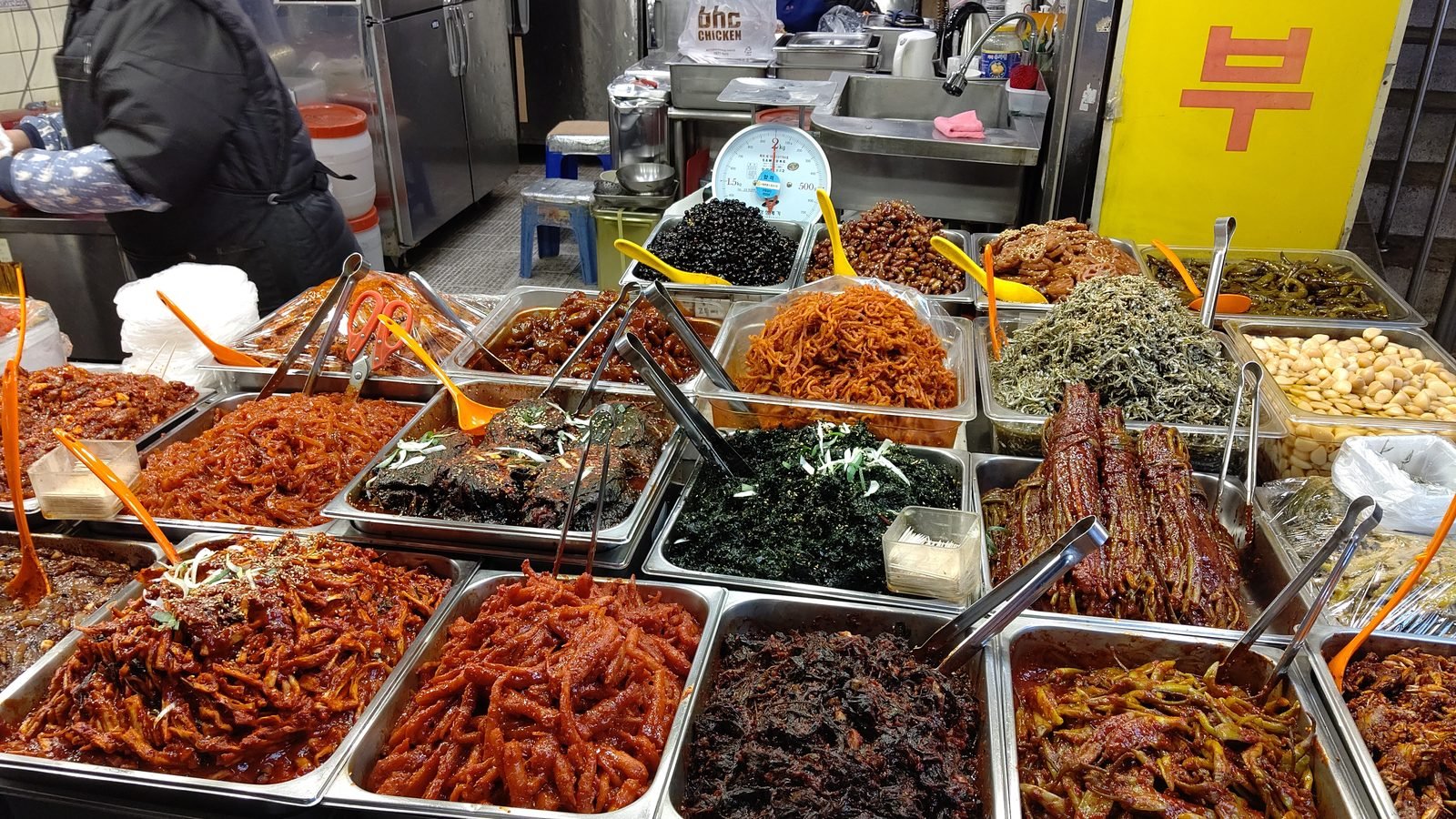
| 무침 | muchim | Vegetables, dried fish or seaweed dressed with seasoning, served as a side dish |
| 국 | guk | Meat, fish or vegetables boiled in plenty of water and seasoned |
| 찌개 | jjigae | Meat, vegetables or tofu simmered with a little broth and seasoned |
| 전골 | jeongol | Sliced meat, vegetables, mushrooms and seafood cooked in a hot-pot pan with a little broth |
| 회 | hoe | Meat or fish cut thin and eaten raw |
| 덮밥 | deopbap | A dish served on top of rice |
| 비빔 | bibim | Rice or noodles mixed with meat or seasoned vegetables and seasoning |
The dictionary entries also hold a small surprise. Both 무침 and 찌개 are labeled there as side dishes, 반찬, which fits the table described by the Korea Tourism Organization: Korean meals are built from several dishes set out together, and a stew is one of them rather than a separate course. A line that ends in 무침 is therefore usually a small plate, and one that ends in 찌개 is a dish meant to sit alongside rice and the other dishes.
Three bowls that look alike
The dictionary separates the three soupy words by how much liquid is in them. A 국 is made with plenty of water, so it is the one to drink from. A 찌개 keeps only a little broth and is seasoned heavily, with soy sauce, soybean paste, red chili paste or salted shrimp all listed in its entry, which makes it concentrated rather than watery. A 전골 is a pan of mixed ingredients with a little broth poured in and boiled, so it is closer to a cooked platter than to a soup. Reading the word first tells you whether a spoon, a shared pan or a side dish is coming.
Sorted by how much liquid ends up on the table, the twelve cooking words fall into three loose groups. Almost no liquid: 조림, which the dictionary says is boiled down until almost no broth is left, along with 구이, 볶음 and 튀김, which are grilled, stir-fried and fried. A little broth: 찜, 찌개 and 전골. Plenty of liquid: 국. The remaining words describe a form rather than a method: 회 is raw, 무침 is dressed, 비빔 is mixed and 덮밥 is served over rice. A line ending in one of the first group will not need a spoon for soup, and a line ending in the last group will.
Ingredients, Portions and Heat
The first half of a name is usually the ingredient. Twelve words cover most of what an everyday menu uses, and they are worth saving as a screenshot, since a board is usually read at the table rather than at home.
| Hangul | Romanization | Meaning |
|---|---|---|
| 돼지고기 | dwaeji-gogi | Pork |
| 소고기 | so-gogi | Beef |
| 닭고기 | dak-gogi | Chicken |
| 오징어 | ojingeo | Squid |
| 새우 | saeu | Shrimp |
| 고등어 | godeungeo | Mackerel |
| 두부 | dubu | Tofu |
| 김치 | kimchi | Kimchi |
| 된장 | doenjang | Soybean paste |
| 고추장 | gochujang | Red chili paste |
| 간장 | ganjang | Soy sauce |
| 계란 | gyeran | Egg |
Three of these name seasonings rather than foods. The dictionary lists soy sauce, soybean paste and red chili paste among the seasonings of a 찌개, so seeing 된장 or 고추장 in a name points to how the dish is seasoned. 고추장 in particular means a red, chili-based seasoning. Put the two halves together and a name opens up: 두부조림 is tofu boiled down, and 소고기전골 is a beef hot pot. Because a name can stack ingredients, scan the whole first half rather than stopping at the first word.
Portion and size words
| Hangul | Romanization | Meaning |
|---|---|---|
| 1인분 | il-inbun | One person’s portion |
| 정식 | jeongsik | A set meal sold with fixed side dishes |
| 곱빼기 | gopbaegi | Two bowls’ worth served in one bowl |
| 사리 | sari | A coiled bundle of noodles in the dictionary; on menus, an extra bundle added to a pot |
| 포장 | pojang | Wrapping or packing in the dictionary; on menus, takeaway |
| 매운 | maeun | Spicy |
Two of the six are easy to confuse. 곱빼기 enlarges the serving of one dish, whereas 사리, in its menu sense, adds a separate bundle of noodles to a dish that is already on the table, so the first is chosen with the order and the second is usually requested later. The menu sense of 사리 is a usage the dictionary entry does not spell out, so read the line rather than assuming. 정식 is the opposite of an add-on: the sides are already part of the line, so the price covers a main dish together with them.
These six decide quantity and heat more than the dish name does. Saying them aloud is a separate skill, covered in how to order food without speaking Korean. To test the reading on real boards, Visit Seoul puts Exit 8 of Jongno 5(o)-ga Station 62 meters from Gwangjang Market, and the Gwangjang street food walkthrough lists what its stalls serve.

Four Terms That Cause Mix-Ups
What does 곱빼기 change?
The dictionary defines it as two bowls’ worth of food placed in one bowl. Added to a dish name, it asks for the larger helping, so it changes the size of the dish and nothing else. A dish that is already the whole meal, such as a bowl of rice with a topping, is the natural place to use it.
What is a 정식?
The dictionary defines it as a dish a restaurant sells as standard with a fixed set of side dishes, and adds that the price differs with the number and kind of sides provided, so two 정식 lines at one restaurant can cost different amounts. On a board, a 정식 line is therefore a main dish with its sides already decided, and the sides are worth checking before ordering a second dish on top. For a solo diner, that makes it the line most likely to be a complete meal on its own.
Is a 탕 different from a 국?
Partly. As a stand-alone noun, the dictionary lists 탕 as the honorific form of 국. The ending -탕 on a menu name is a separate entry, though: a suffix that adds the sense of 국 and usually refers to a soup simmered longer than an ordinary 국 so that the broth comes out rich. That is the sense in 갈비탕 and 설렁탕, so a name ending in 탕 points to a long-cooked, concentrated broth rather than a light soup.
Which words warn that a dish is hot?
매운 means spicy and 고추장 is red chili paste, so either in a name is a signal. The reverse does not hold: a 찌개 may be seasoned with 고추장 without the name saying so, so a plain-looking name is not proof of a mild dish.
Allergy Words Need a Person, Not a Label
Allergen labels are a packaged-food rule under the Ministry of Food and Drug Safety, so at a restaurant the dependable tool is a Hangul word shown to staff, such as 메밀 (buckwheat), 대두 (soybean), 게 (crab) or 고등어 (mackerel).